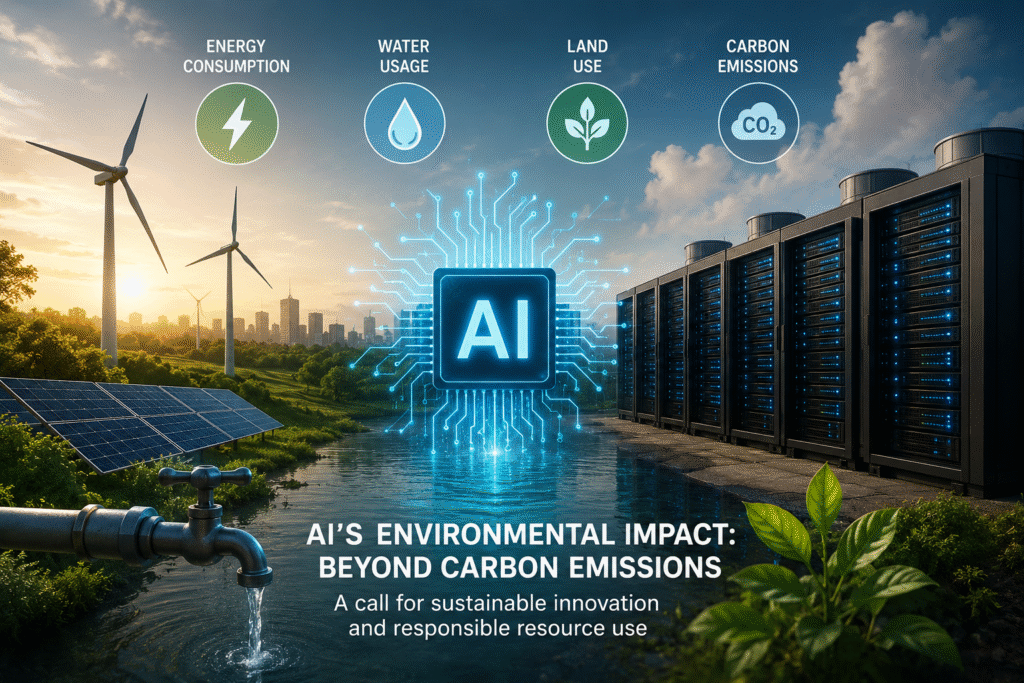
Artificial intelligence’s rapid expansion is increasing pressure on energy, water, and land resources worldwide, according to a new United Nations report.
Artificial intelligence has become a driving force behind innovation across industries, helping businesses improve efficiency and enabling new digital experiences. As AI adoption accelerates worldwide, experts are also raising concerns about the environmental cost of supporting this technological growth.
A recent report released by the United Nations University Institute for Water, Environment and Health (UNU-INWEH) suggests that the environmental impact of artificial intelligence reaches far beyond its carbon emissions. Researchers say the growing demand for AI infrastructure is placing increasing strain on electricity supplies, freshwater resources, and available land.
Rising AI demand is reshaping global resource consumption
The report explains that modern AI systems rely on extensive infrastructure, including high performance computing facilities, data centers, cooling equipment, and expanding power networks. Together, these systems require enormous amounts of energy to train and operate increasingly advanced AI models.
Researchers estimate that by 2030, AI related data centers could consume nearly 945 terawatt-hours of electricity each year. Such demand would place AI among the world’s largest electricity consuming sectors and increase the urgency of expanding cleaner and more efficient energy sources.
Experts believe that improving energy efficiency while increasing the use of renewable power will be essential if AI continues to grow at its current pace.
Water consumption is becoming a major sustainability challenge
The report also highlights the significant amount of water required to support AI operations. Data centers depend on cooling systems to maintain safe operating temperatures, while electricity generation for these facilities often requires additional water resources.
As more companies and governments adopt AI technologies, researchers warn that total water consumption could rise substantially. This trend may place additional pressure on regions already experiencing water scarcity, making responsible resource management increasingly important.
Expanding AI infrastructure also affects land use
Beyond electricity and water, the study identifies land use as another environmental consideration. New data centers, power generation facilities, and supporting infrastructure require large areas of land, particularly as digital services continue to expand.
The report notes that environmental impacts differ depending on where AI infrastructure is built and how local electricity is generated. In some locations, renewable energy may reduce emissions but still require considerable land or water resources to operate effectively.
Everyday AI activities contribute to growing energy demand
Many people associate AI’s environmental impact with large technology companies. However, researchers point out that everyday users also contribute to rising energy consumption.
Tasks such as creating AI generated images, producing videos, or running complex models generally require far more computing power than basic text based interactions. As billions of AI requests are processed globally, the combined demand places additional pressure on data centers and electricity networks.
Environmental responsibility should be shared fairly
The report also raises concerns about the unequal distribution of AI’s environmental burden. While countries around the world benefit from AI powered products and services, the environmental costs of building data centers, extracting critical minerals, and managing electronic waste are often concentrated in specific regions.
Researchers argue that future AI development should consider not only technological progress but also environmental justice and the fair distribution of both benefits and responsibilities.
Greater transparency and sustainable planning are essential
To reduce AI’s environmental footprint, the report encourages governments, technology companies, investors, and policymakers to improve transparency regarding resource consumption.
The researchers recommend tracking water use and land requirements alongside carbon emissions, investing in energy efficient technologies, expanding renewable energy infrastructure, and carefully selecting future data center locations based on environmental considerations.
They also stress that sustainability should become an integral part of AI planning rather than an afterthought.
Balancing innovation with environmental sustainability
The report makes it clear that artificial intelligence remains a powerful tool with enormous potential to improve economies, healthcare, education, and scientific research. However, ensuring that this progress remains sustainable will require long term planning and responsible resource management.
As AI continues to shape the future, experts believe that innovation and environmental stewardship must advance together. Taking action today can help ensure that technological progress supports economic growth while protecting natural resources for future generations.
About The Author