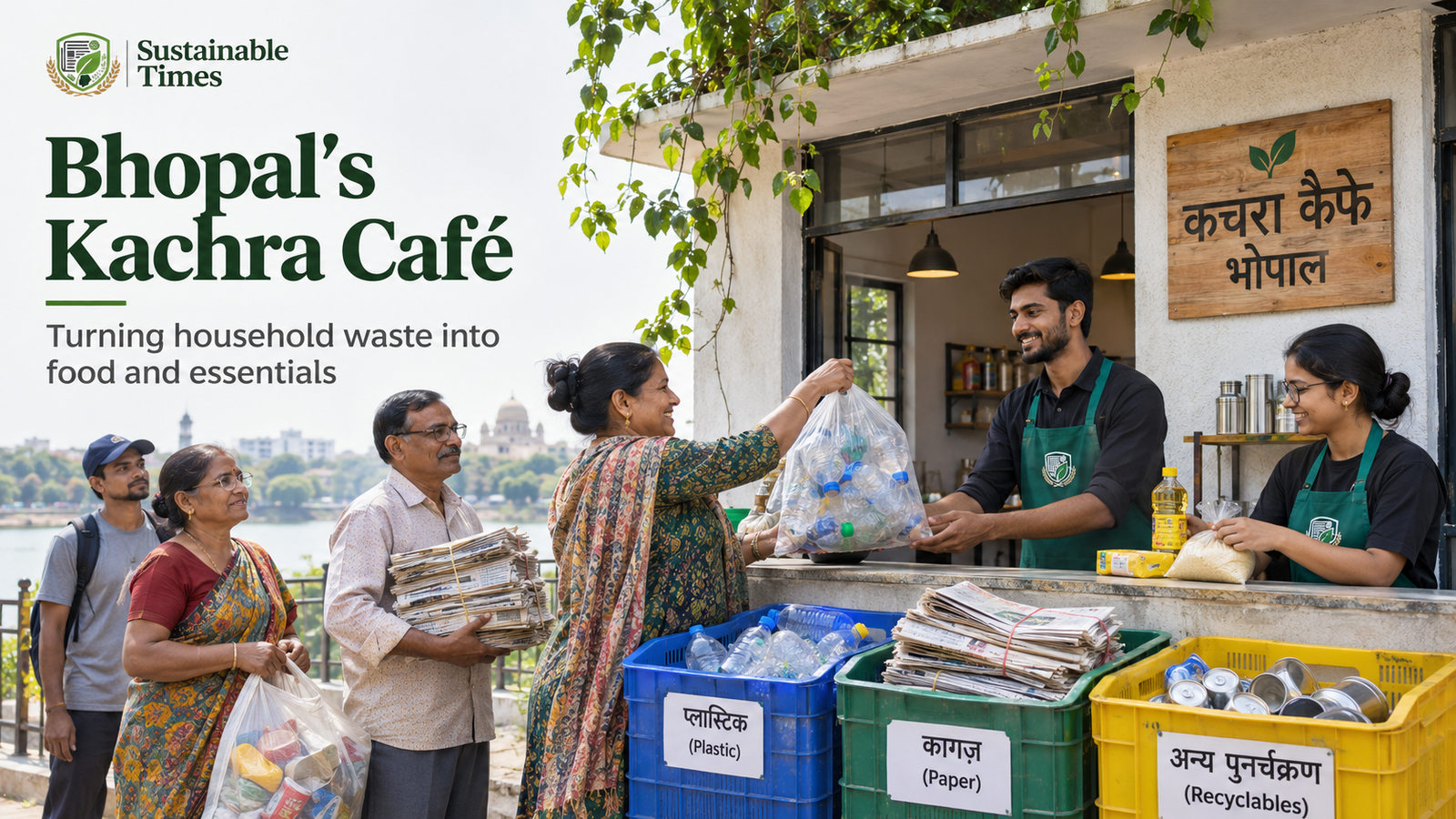
Imagine walking into a café with a bag of old newspapers and plastic bottles instead of a wallet.
Rather than paying with cash, you hand over the waste, receive credits based on its value and use those credits to buy food or other everyday essentials.
In Bhopal, Madhya Pradesh, this unusual idea is already working.
A community initiative called Kachra Café has created a system that rewards residents for collecting and segregating household waste. According to fresh reporting published on 4 November, the project has sent more than 45 tonnes of recyclable material for processing during its first eight months.
The café was developed by social entrepreneur Anjita Sabhlok through her NGO, Mannat, in collaboration with the Bhopal Municipal Corporation.
Its appeal lies in a straightforward idea: people may be more willing to manage waste responsibly when they receive something useful in return.
The initiative is attracting attention because it addresses two challenges that often appear separately in urban sustainability discussions—waste management and access to everyday necessities.
A Different Way to Think About Household Waste
Most households generate recyclable waste almost every day.
Plastic packaging, newspapers, cardboard boxes, beverage cans and other materials gradually accumulate before someone throws them away or sells them to a scrap collector.
When residents mix recyclable materials with food waste and other household rubbish, recovery becomes more difficult.
Contamination can reduce the quality of materials and increase the cost of sorting and processing.
Kachra Café attempts to change that behaviour before the waste enters the municipal disposal system.
Residents bring eligible recyclable materials to a collection centre, where workers weigh and assess them.
The café assigns a value to the material and converts it into digital credits known as Kachra Coins.
Customers can then redeem those credits for food, beverages or other available products.
The system turns waste segregation into a practical exchange rather than another responsibility that residents must remember.
How Much Is Your Waste Worth?
One interesting feature of Kachra Café is that it does not treat every type of waste equally.
Its published exchange rates reflect differences in the value of recoverable materials.
The café’s website lists paper at approximately ₹15 per kilogram, hard plastic jars at ₹14 per kilogram and aluminium at ₹120 per kilogram.
Copper and certain other metals command higher rates.
These values help residents understand why sorting materials matters.
A bag containing several different materials may be more useful to recycling businesses when those materials are separated correctly.
However, the exchange rates should not be confused with guaranteed recycling profits. Material prices, operating costs and the availability of recycling partners all affect the economics of recovery.
The café’s website provides the current rates and information about participating collection and redemption locations.
Why the Founder Chose Rewards Over Awareness Campaigns
For years, Anjita Sabhlok worked through Mannat to encourage better waste-management habits.
Like many environmental campaigners, she encountered a familiar problem.
People understood the importance of cleanliness and recycling, but awareness did not always translate into consistent action.
A household might agree that plastic pollution was harmful while continuing to mix recyclable waste with ordinary rubbish.
Sabhlok began exploring a more immediate incentive.
What if residents could receive something valuable simply by separating and bringing in materials they no longer needed?
That question eventually became the foundation of Kachra Café.
The project does not require customers to become environmental experts.
It asks them to make a relatively small change in how they handle everyday waste and rewards that effort.
This makes the initiative particularly interesting from a behavioural perspective.
Instead of depending entirely on environmental concern, it connects responsible disposal with a direct personal benefit.
Forty-Five Tonnes in Eight Months
The project’s early results provide evidence that the idea is attracting participation.
According to reporting by The Better India, Kachra Café has directed more than 45 tonnes of household waste toward recycling in eight months.
That is a meaningful quantity for a community-scale initiative.
But the figure needs careful interpretation.
It represents material sent into recycling channels, not necessarily material that the café recycled itself or proof that every kilogram became a new product.
The complete environmental benefit would depend on what happened after collection, including sorting losses, processing methods and the eventual recovery of usable materials.
Even with that limitation, the result shows that a reward-based system can encourage residents to bring recyclable materials into an organised collection network.
The next challenge will be sustaining that participation and verifying how much material successfully completes the recycling process.
The Circular Economy Begins Before Recycling
Recycling often receives most of the attention in waste-management discussions.
But a successful recycling system depends on what happens before materials reach a processing facility.
Households must separate suitable items.
Collection systems must accept them.
Transport networks must deliver them to appropriate facilities.
Recyclers must then recover materials at acceptable quality and cost.
If any part of that chain fails, potentially valuable resources can end up in landfills or unmanaged waste streams.
Kachra Café concentrates on one of the earliest stages: household participation.
By making the value of discarded materials visible, it encourages residents to treat recyclable waste as something worth keeping separate.
That approach could support more reliable collection while helping communities understand how different materials enter the circular economy.
A Social Innovation With Environmental Benefits
The café’s model is notable because the reward is not simply a discount on another consumer product.
Food and everyday essentials have immediate practical value.
For households managing tight budgets, exchanging recyclable materials for useful goods can provide a small additional benefit.
At the same time, the initiative helps direct material toward organised recovery channels.
These two outcomes give Kachra Café a social dimension that conventional recycling campaigns may lack.
However, the project should not be presented as a solution to food insecurity.
The available reporting does not establish how many households depend on the café for meals, how much financial support participants receive or whether the programme substantially changes household food security.
Its demonstrated contribution is more specific: it creates a community-level exchange that connects recyclable waste with useful rewards.
That is still a meaningful innovation.
Could Other Indian Cities Adopt the Model?
India’s growing cities face complex waste-management challenges.
Household waste volumes continue to increase as consumption patterns, packaging use and urban populations change.
Municipal authorities must collect, sort, transport and process materials while managing costs and environmental risks.
Reward-based collection systems could complement existing waste-management infrastructure.
But their success would depend on local conditions.
A city needs reliable recycling partners, accessible collection points, transparent material prices and a practical way to fund the rewards.
The system must also work alongside existing waste collectors and informal recycling workers rather than unnecessarily displacing their livelihoods.
Bhopal’s experience suggests that residents may respond positively when responsible disposal becomes convenient and rewarding.
Whether the model can expand sustainably will depend on its operating economics and long-term participation.
The Real Test Is What Happens After the First Success
The early results have attracted attention, but a community programme needs more than an encouraging headline.
To demonstrate lasting impact, Kachra Café will need to maintain a steady flow of recyclable materials, reliable redemption options and credible recycling partnerships.
It will also need to show that the value created through material recovery and other support can sustain the programme.
These are practical challenges rather than reasons to dismiss the idea.
Any initiative attempting to change household behaviour must build trust over time.
Residents need confidence that the materials they bring are valued fairly and that the credits they receive can actually be redeemed.
The environmental value also depends on whether collected waste reaches responsible recycling facilities.
If those conditions remain in place, the café could offer useful lessons for other municipalities and community organisations.
A Small Café With a Much Bigger Idea
Sustainability innovation is often associated with expensive technology.
Smart recycling machines, automated sorting systems and advanced material-recovery facilities can all improve waste management.
But Bhopal’s experiment demonstrates that innovation can also involve changing the relationship between people and existing systems.
The recyclable materials were already present.
The potential recovery value already existed.
The missing element was a simple mechanism that encouraged residents to participate.
Kachra Café has connected those pieces through an exchange that people can understand immediately.
Its reported 45-tonne collection achievement does not solve Bhopal’s waste problem, nor does it eliminate the need for stronger municipal infrastructure.
But it shows how a community initiative can turn an environmental responsibility into an activity with visible personal benefits.
The next stage will determine whether the model can operate sustainably and inspire similar programmes elsewhere.
For now, the idea offers a refreshing perspective on urban waste.
A plastic bottle may look worthless once its contents are gone. But in Bhopal, that same bottle can become part of a recycling system—and help pay for someone’s next meal.
About The Author