Published: 26 August 2026
Category: ESG | Climate Policy | Sustainable Finance | Corporate Sustainability
Australia has taken another step toward making climate transition planning part of mainstream business strategy.
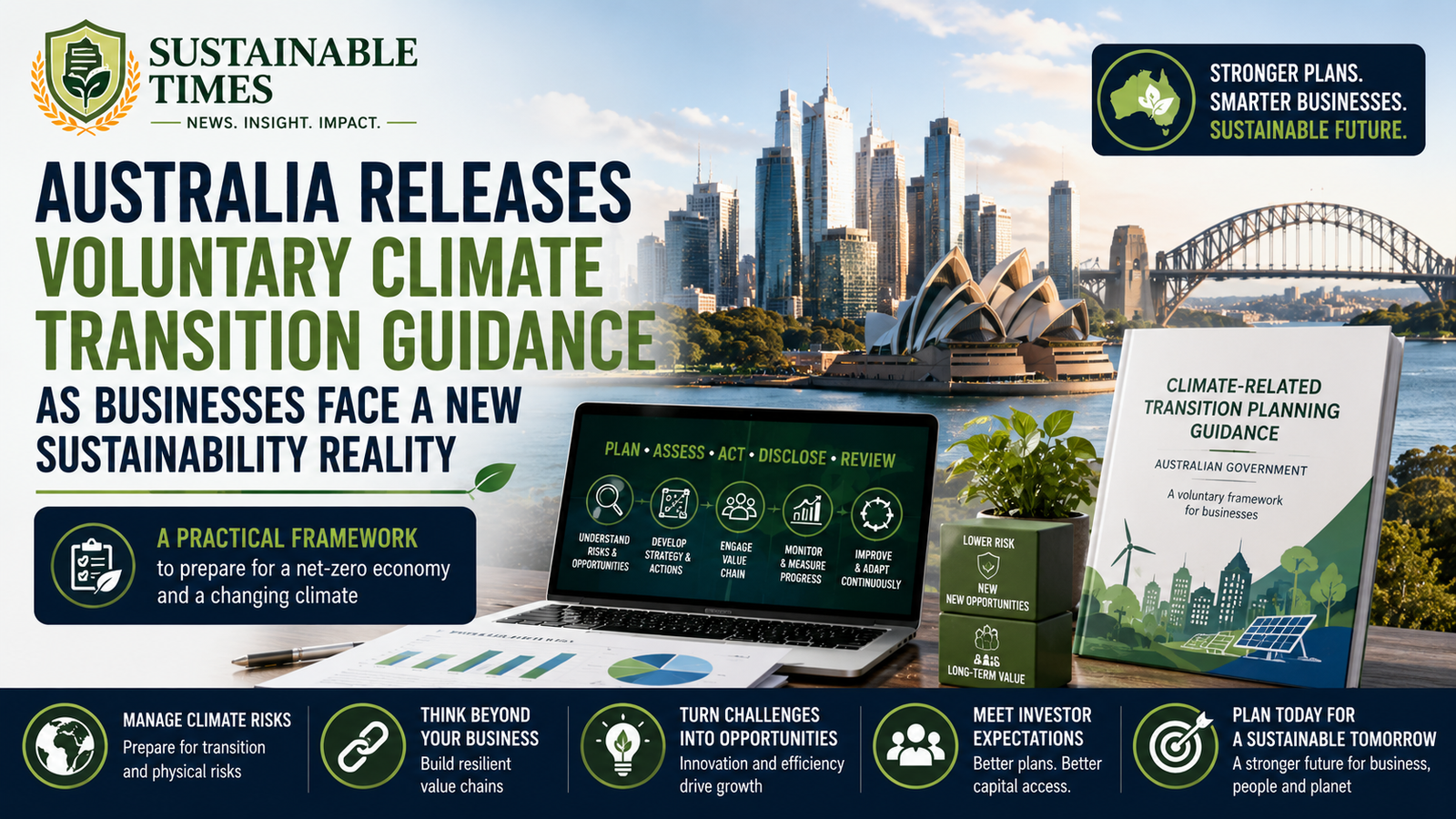
The Australian Government released voluntary Climate-related Transition Planning Guidance on 24 August, giving organisations a practical framework for preparing for both the shift toward a net-zero economy and the physical impacts of climate change. The guidance forms part of Australia’s Sustainable Finance Roadmap and builds on the Transition Plan Taskforce’s transition-planning approach.
The timing matters. Companies are facing growing pressure to understand how climate change could affect their operations, supply chains, investments and long-term competitiveness. Australia is now giving businesses a clearer framework for thinking through those risks rather than leaving transition planning entirely to individual companies.
From Climate Targets to Business Planning
Many companies already publish emissions targets. But setting a target is only one part of preparing for a low-carbon economy.
Transition planning asks a broader question:
What does a changing climate and a net-zero economy mean for the way a company actually operates?
The Australian guidance encourages organisations to consider their sector, value chain, size, complexity and exposure to climate-related risks and opportunities. It also treats transition planning as an ongoing internal process, rather than a document that companies create once and leave untouched.
That distinction could become increasingly important as companies face changing energy markets, technologies, regulations, customer expectations and physical climate risks.
Two Types of Climate Risk
The guidance separates climate-related risks into two broad categories.
Transition risks can emerge as economies move toward lower emissions. Changes in government policy, technology, markets, regulation and consumer preferences can all affect companies.
Physical risks come directly from climate change. These can include sudden events such as floods and extreme weather, as well as longer-term changes such as rising temperatures or changing rainfall patterns.
For a manufacturer, for example, transition risk could involve the cost of switching to cleaner energy or replacing carbon-intensive equipment.
Physical risk could involve a factory facing repeated flooding, water shortages or extreme heat.
The two risks can also interact.
The Supply Chain Becomes Part of the Climate Strategy
One of the most important implications for businesses is that climate planning cannot stop at company headquarters.
A company’s exposure often extends through its suppliers, logistics networks, customers and other value-chain partners.
A manufacturer may reduce emissions from its own facilities while remaining vulnerable to a supplier located in a drought-prone region. A retailer may improve its stores but still face disruption from climate-sensitive transport routes.
The Australian framework’s focus on the value chain therefore reflects a broader shift in corporate sustainability: companies increasingly need to understand not just their own footprint, but the resilience of the systems around them.
Climate Action Can Also Create Business Opportunities
The guidance does not present climate transition only as a risk-management exercise.
It also highlights opportunities that can emerge from the transition, including resource efficiency, lower operating costs, changing customer demand, new markets and new products or business models.
For example, an organisation could reduce energy costs and improve resilience by combining energy-efficiency upgrades, demand flexibility and onsite solar.
That changes the conversation around sustainability.
Instead of asking only, “How much will decarbonisation cost us?”, companies can also ask, “What new business opportunities could the transition create?”
Why Investors Are Watching
Transition planning also has implications for sustainable finance.
Investors need credible information to understand whether companies can adapt to a changing economy. Clear transition planning can help explain how a business intends to manage climate risks, allocate capital and pursue its sustainability objectives.
A group of Australian business and investment organisations welcomed the government’s guidance and called for greater uptake and disclosure of transition plans, arguing that better information could help investors allocate capital and identify areas where policy support is needed.
The guidance itself remains voluntary, so companies should not confuse it with a new mandatory reporting requirement. Australia’s existing climate-related financial disclosure regime operates separately.
Australia Is Trying to Connect Global Frameworks With Local Business
Another notable aspect of the guidance is its attempt to connect international transition-planning approaches with Australian business conditions.
The government says the framework builds on the Transition Plan Taskforce Transition Planning Cycle, while adapting the approach to the Australian context.
That could make the guidance useful for companies operating across borders.
As sustainability reporting becomes more interconnected globally, businesses increasingly need systems that can work across different markets rather than creating completely separate climate strategies for every jurisdiction.
What This Means for Companies
For businesses, the message is becoming clearer: climate strategy is moving closer to mainstream corporate planning.
Companies will increasingly need to consider:
- How climate change could disrupt operations
- How their supply chains could be affected
- What the transition to lower-carbon technologies means for capital investment
- How customer and investor expectations may change
- Which new products and markets could emerge
- How they will measure progress over time
The companies that start answering these questions early may have more flexibility when markets and regulations change.
Looking Ahead
Australia’s new guidance does not force companies to follow one fixed transition plan. Instead, it gives organisations a framework for thinking about climate risks and opportunities in a structured way.
That flexibility could prove useful because climate exposure differs dramatically between industries.
A mining company, food manufacturer, bank and technology business will not face the same transition challenges. Their plans need to reflect their individual operations and value chains.
The bigger shift is that transition planning is becoming a business discipline rather than simply a sustainability exercise.
Key Takeaway
Australia’s new voluntary climate-transition guidance gives businesses a clearer framework for preparing for both decarbonisation and physical climate risks. As climate considerations increasingly influence investment, supply chains, technology and competitiveness, credible transition planning could become an important part of long-term business strategy.
About The Author