The Vatican is moving ahead with an unusual clean-energy project that combines solar power and agriculture on the same land.
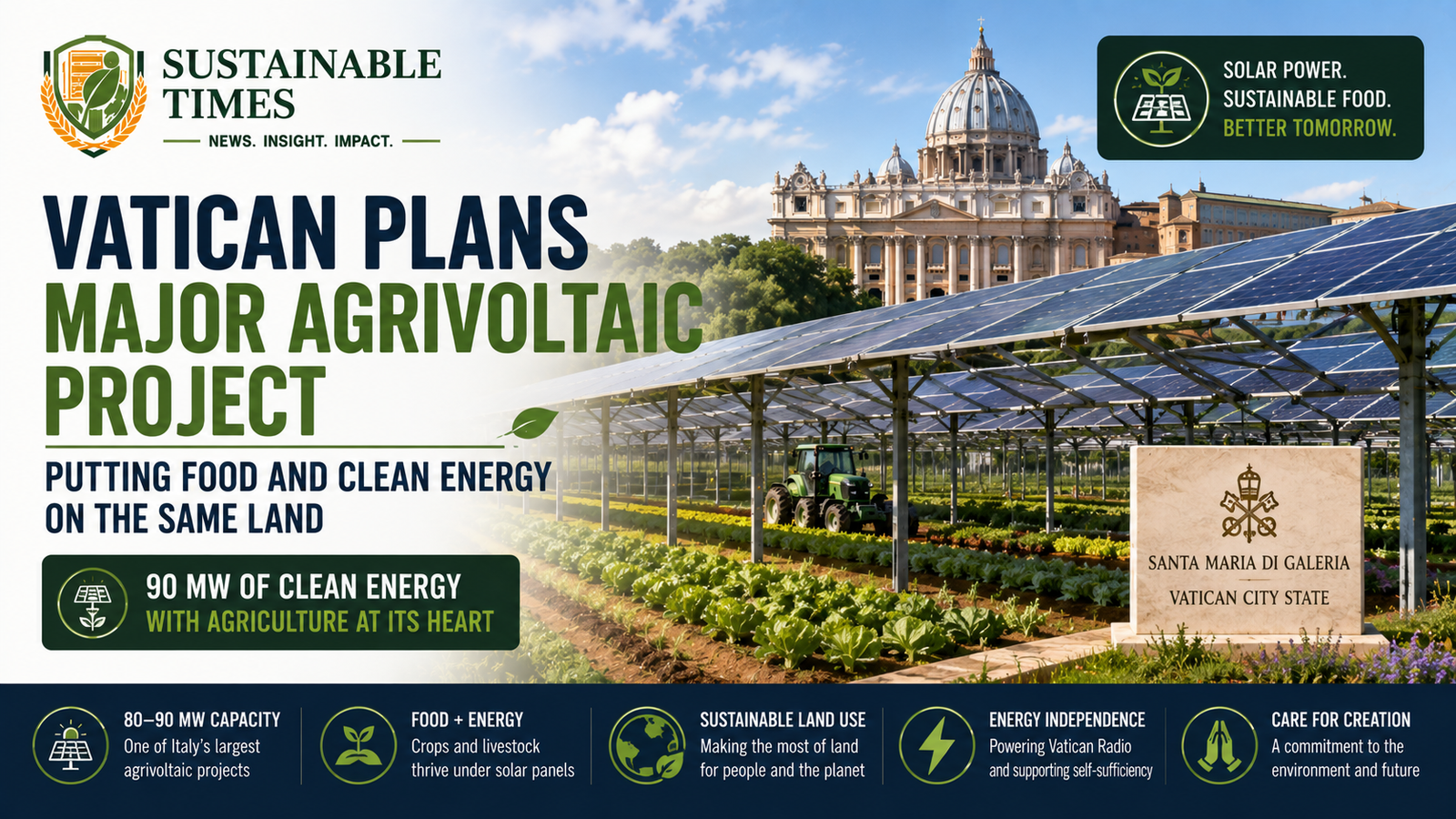
The Holy See plans to develop an agrivoltaic facility at Santa Maria di Galeria, an extraterritorial area near Rome that hosts the Vatican Radio transmission centre. The project could cost around €100 million and reach an estimated 80–90 megawatts of capacity, according to Reuters sources. If completed as planned, it would rank among Italy’s larger agrivoltaic installations.
What makes the project interesting is not simply its size. It reflects a growing effort to solve two problems at once: producing more renewable electricity while continuing to use agricultural land for food production.
Solar Panels Above Crops
Agrivoltaics places solar panels above agricultural land rather than replacing farming with conventional ground-mounted solar installations.
The Vatican’s project will use elevated structures that allow agricultural and livestock activities to continue underneath. The Vatican says the design will also consider water use, soil protection, ecosystems and the landscape around the site.
This approach can create an interesting relationship between farming and renewable energy.
Solar panels can provide shade to crops, potentially reducing evaporation and protecting plants from some forms of heat stress. At the same time, farmers can continue using the land beneath and around the panels.
The exact agricultural configuration and final technical design of the Vatican facility will determine how much of this potential it can deliver.
The Vatican Wants Energy Independence
The project has a clear practical objective.
The Holy See says the agrivoltaic plant should provide electricity to the Vatican Radio facility at Santa Maria di Galeria and contribute to the energy self-sufficiency of Vatican City State.
The project has been developing for several years.
In 2025, the Holy See and Italy signed an agreement establishing the framework for the plant. That agreement entered into force on 27 May 2026 after the required procedures were completed.
In June, the Vatican Governorate, the Administration of the Patrimony of the Apostolic See, the Fratello Sole Foundation and Italian utility ACEA signed a memorandum of understanding to move the project forward.
A joint Italy–Holy See commission then met in Rome on 4 August 2026 to oversee implementation of the project.
Why Agrivoltaics Is Gaining Attention
The Vatican project arrives as countries look for more land to accommodate the rapid expansion of solar power.
Land availability can become a significant issue when governments need to expand renewable electricity while also protecting farmland, ecosystems and communities.
Agrivoltaics offers one possible answer: use the same area for both electricity generation and agriculture.
Researchers and developers are increasingly examining whether crops can perform well under specific solar-panel configurations, particularly when the panels provide useful shade in hot and dry conditions.
However, agrivoltaics is not a universal solution. Crop type, climate, panel height, spacing, irrigation and local farming practices all influence the outcome.
A Project With a Broader Sustainability Message
The Vatican’s project also illustrates how the clean-energy transition is becoming more integrated with other sustainability priorities.
Instead of treating renewable energy, agriculture and land management as completely separate sectors, agrivoltaics connects them.
The Vatican has specifically said that the project should consider energy production, agriculture, water resources, soil, ecosystems and the surrounding landscape together.
That integrated approach could become increasingly valuable as countries face competing demands for land.
What Comes Next?
The project still needs to move through the development and permitting process.
Reuters reports that construction could take around 18 to 24 months, while the Vatican has already established the institutional and legal framework needed to progress the project.
If the facility reaches its proposed scale, it could provide a visible example of how agrivoltaics can combine renewable electricity with productive land use.
The bigger question will be whether the model can work economically and agriculturally in other regions.
Looking Ahead
The energy transition needs more renewable electricity, but the world also needs food, healthy soils and functioning ecosystems.
That creates a difficult land-use question: how do we build enough clean energy without competing unnecessarily with agriculture and nature?
Agrivoltaics cannot answer that question everywhere. But projects such as the Vatican’s show how new approaches can bring energy and agriculture closer together rather than forcing them into separate spaces.
The most interesting part of the project may therefore not be the number of solar panels installed. It is the idea behind them: one piece of land serving more than one sustainability purpose.
Key Takeaway
The Vatican’s planned agrivoltaic facility could combine 80–90 MW of renewable electricity with agricultural land use, creating a notable example of how solar energy and farming can coexist. Its progress will offer a useful real-world test for a technology attracting growing interest around the world.
About The Author