The global solar industry has spent the past decade making clean electricity cheaper and more accessible. Now, the country that helped drive much of that progress is considering new restrictions on sharing some of its most advanced manufacturing technologies.
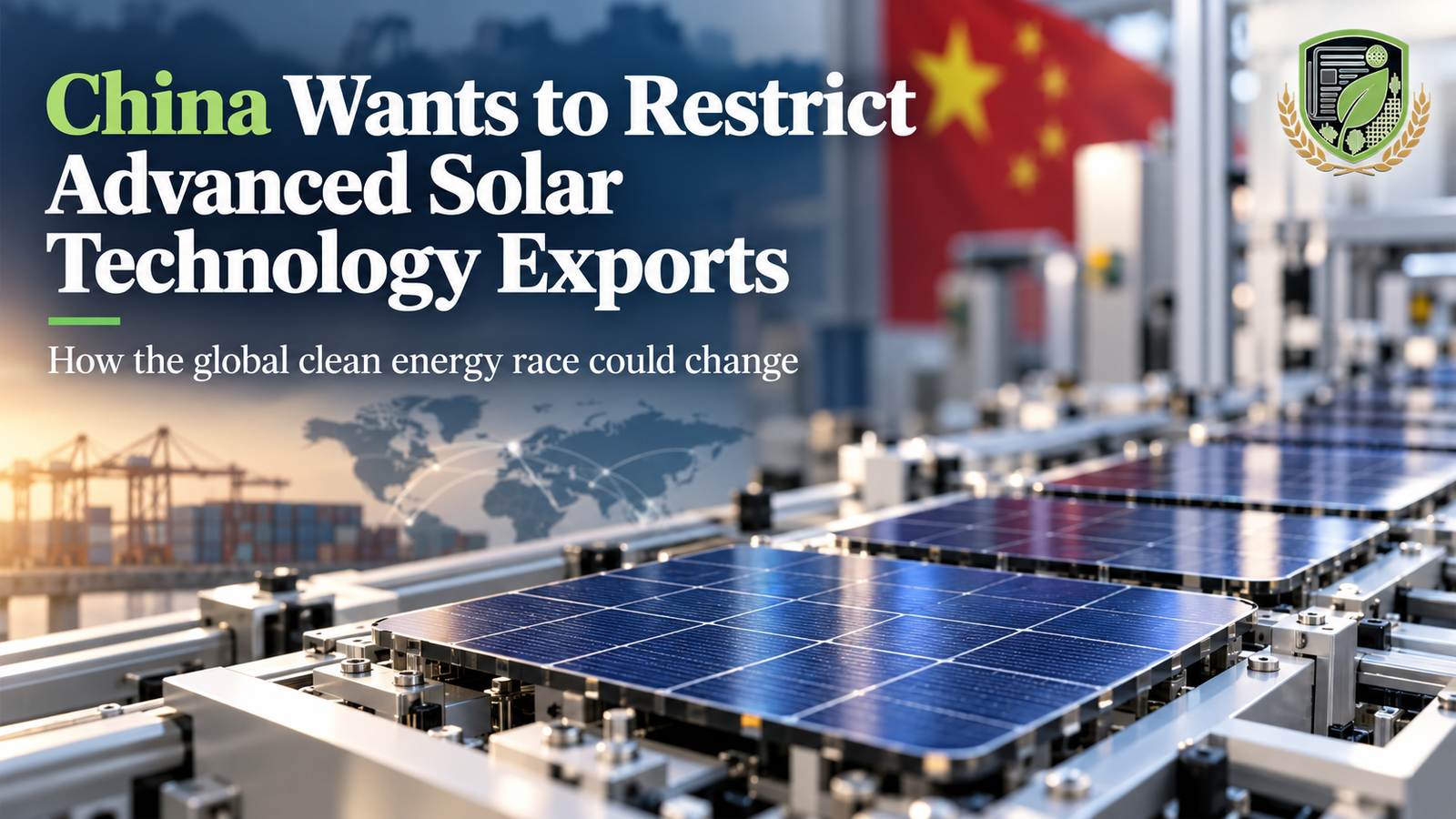
China has proposed export controls on 12 solar-manufacturing technologies, including processes used to produce advanced silicon wafers, high-efficiency solar cells and next-generation photovoltaic materials.
The announcement, issued by China’s Ministry of Commerce and Ministry of Science and Technology on 16 October, forms part of a wider review covering 40 technologies across solar energy, artificial intelligence and biotechnology.
Chinese authorities say the proposed controls aim to protect national security and prevent the inappropriate transfer of sensitive technologies.
But for the global clean-energy industry, the implications could be much broader.
Countries trying to develop their own solar manufacturing capacity may soon face a new challenge: securing access not only to materials and equipment, but also to the manufacturing knowledge needed to produce the next generation of solar panels.
China Is Protecting More Than Its Solar Factories
China already plays a dominant role in global solar manufacturing.
Over the past decade, Chinese companies have expanded production across almost every stage of the photovoltaic supply chain, from polysilicon and wafers to solar cells and finished modules.
That scale has helped reduce solar manufacturing costs and accelerate renewable-energy deployment worldwide.
However, it has also concentrated manufacturing expertise within a relatively small number of companies and countries.
The latest proposal suggests Beijing increasingly views that expertise as a strategic asset.
Rather than focusing exclusively on exports of finished solar panels, the proposed measures target the technologies and production processes that allow companies to manufacture them.
That distinction matters.
A country can import solar panels to build renewable-energy projects. Building a competitive solar manufacturing industry requires something different: reliable access to specialised machinery, engineering knowledge and efficient production processes.
China’s proposed restrictions could make that second task more complicated.
Next-Generation Solar Cells Are at the Centre
One of the most significant parts of the proposal concerns perovskite and tandem solar cells.
Conventional silicon solar panels have improved enormously, but researchers continue to investigate technologies that can convert a greater proportion of sunlight into electricity.
Perovskite materials offer one promising route.
Scientists can use them in solar cells or combine them with silicon to create tandem structures that absorb different parts of the solar spectrum.
That could improve conversion efficiency beyond the levels achieved by many conventional silicon cells.
China is considering prohibiting exports of certain high-performance manufacturing processes for these technologies, including specified perovskite-silicon tandem production methods.
The proposed controls would apply to processes meeting defined technical thresholds, not every perovskite-related technology.
This is an important distinction because the rules would target some of the industry’s most advanced manufacturing capabilities rather than prohibit all international cooperation in solar research.
Still, companies hoping to commercialise next-generation solar cells outside China may need to reconsider how they acquire manufacturing technology.
Even Polysilicon Manufacturing Is Part of the Proposal
The proposed restrictions also extend to parts of the polysilicon supply chain.
Polysilicon is a key material used in conventional crystalline-silicon solar cells.
Producing it efficiently requires specialised industrial processes and significant technical expertise.
China is proposing controls on certain fluidised-bed production technologies, which can offer energy and cost advantages compared with traditional manufacturing methods.
Other proposals cover advanced wafer-manufacturing processes, including technologies used to produce particularly thin silicon wafers.
Thinner wafers can help manufacturers reduce material consumption, although their production also creates technical challenges involving handling and breakage.
Restricting access to these processes could make it harder for foreign manufacturers to adopt some of the most advanced production methods.
The possible consequences extend beyond solar-panel prices.
They could influence where future factories are built, how companies license technology and which countries develop competitive manufacturing industries.
India Has a Particular Reason to Pay Attention
India has spent several years working to strengthen its domestic solar manufacturing sector.
The country wants to reduce its dependence on imported equipment and build more capacity across the photovoltaic value chain.
Government incentives, manufacturing investment and growing domestic demand have encouraged companies to expand solar-cell and module production.
But building factories does not automatically eliminate technological dependence.
Manufacturers may still need imported machinery, specialised components or licensed production processes.
Reuters reports that China has already restricted certain solar-manufacturing technology exports to India, while Indian policymakers continue trying to establish a more independent domestic supply chain.
The latest proposal could add uncertainty for manufacturers considering investments in advanced solar technologies.
However, it could also encourage greater domestic research and development.
Indian companies may have stronger incentives to collaborate with universities, research institutions and alternative international technology suppliers.
The long-term outcome will depend on how the final Chinese rules are written and how quickly other markets can develop competitive manufacturing capabilities.
Europe and the United States Face Similar Questions
India is not alone in seeking greater control over solar manufacturing.
Europe and the United States have also introduced policies intended to encourage domestic clean-technology production.
Their motivations include energy security, industrial competitiveness, job creation and concerns about excessive dependence on concentrated international supply chains.
China’s proposed export controls add another dimension to those strategies.
Subsidies and investment incentives can help finance factories.
But factories also need access to advanced manufacturing knowledge.
If that knowledge becomes more difficult to transfer internationally, companies may face longer development timelines or additional costs.
For some manufacturers, the response could involve developing alternative processes. Others may negotiate licensing arrangements or adapt production plans.
None of those outcomes is guaranteed.
The proposed restrictions remain under consultation, and their practical effects will depend on the final rules and how authorities implement them.
China Says Green Technology Cooperation Will Continue
Beijing has emphasised that its proposed measures do not amount to a blanket ban on green-technology cooperation.
The Ministry of Commerce says technologies that fall outside the specified control thresholds can continue to be exported.
Officials also argue that the measures will help protect sensitive technologies while supporting normal international scientific and technological exchanges.
The government’s explanation points to the increasing use of photovoltaic technologies in aerospace, defence and other sensitive applications.
Solar technology is no longer limited to generating electricity for homes and businesses.
Advanced photovoltaic systems can also support satellites, unmanned equipment and specialised infrastructure.
China argues that those applications create additional national-security considerations.
The challenge for policymakers will be distinguishing genuinely sensitive technologies from manufacturing processes whose wider availability could accelerate renewable-energy deployment.
The Restrictions Are Not Final Yet
The current proposal is open for public consultation until 15 November 2026.
China has also introduced temporary registration requirements for certain technology transfers while the revised export-control catalogue remains under consideration.
These interim requirements cover specified activities such as overseas technology licensing and transfers of technology ownership.
That does not mean all 12 solar technologies are already subject to the proposed final prohibitions or licensing restrictions.
The distinction matters for businesses making investment decisions.
Manufacturers and technology developers will need to follow the consultation process closely before assuming which activities will ultimately be permitted, restricted or prohibited.
The final policy could differ from the current draft.
A New Challenge for the Energy Transition
The solar industry has benefited enormously from international manufacturing networks.
Research developed in one country can support production in another. Equipment manufacturers supply factories across borders. Companies share engineering expertise through licensing, investment and joint ventures.
Those relationships have helped turn solar power into one of the world’s most competitive electricity technologies.
But they also depend on countries allowing technology to move across borders.
China’s proposal illustrates how geopolitical competition can complicate that model.
The clean-energy transition increasingly depends on technologies that governments consider strategically important.
Solar manufacturing now sits alongside semiconductors, artificial intelligence and other advanced industries in discussions about economic security.
That creates a difficult balance.
Countries want to protect their technological advantages, but the global climate transition benefits when efficient clean technologies become widely available.
The Next Solar Race May Be About Manufacturing Knowledge
For years, solar-industry headlines have focused on record installations, falling module prices and expanding renewable capacity.
Those developments remain important.
But the next phase of competition may increasingly centre on who controls advanced production technologies.
Countries that can manufacture efficient solar cells at scale may gain important industrial advantages.
Those that depend heavily on imported expertise could face greater uncertainty when export policies change.
China’s latest proposal does not mean the global solar industry is about to stop growing.
Nor does it mean foreign manufacturers will lose access to every advanced photovoltaic technology.
It does, however, reveal how closely renewable-energy innovation has become connected to trade policy and national security.
The clean-energy transition now faces a question that extends beyond how many solar panels the world can install.
Can countries build the technologies needed for a cleaner future without allowing geopolitical competition to slow their spread?
China’s proposed export controls suggest that answering that question may become one of the defining challenges of the next phase of the global solar industry.
About The Author