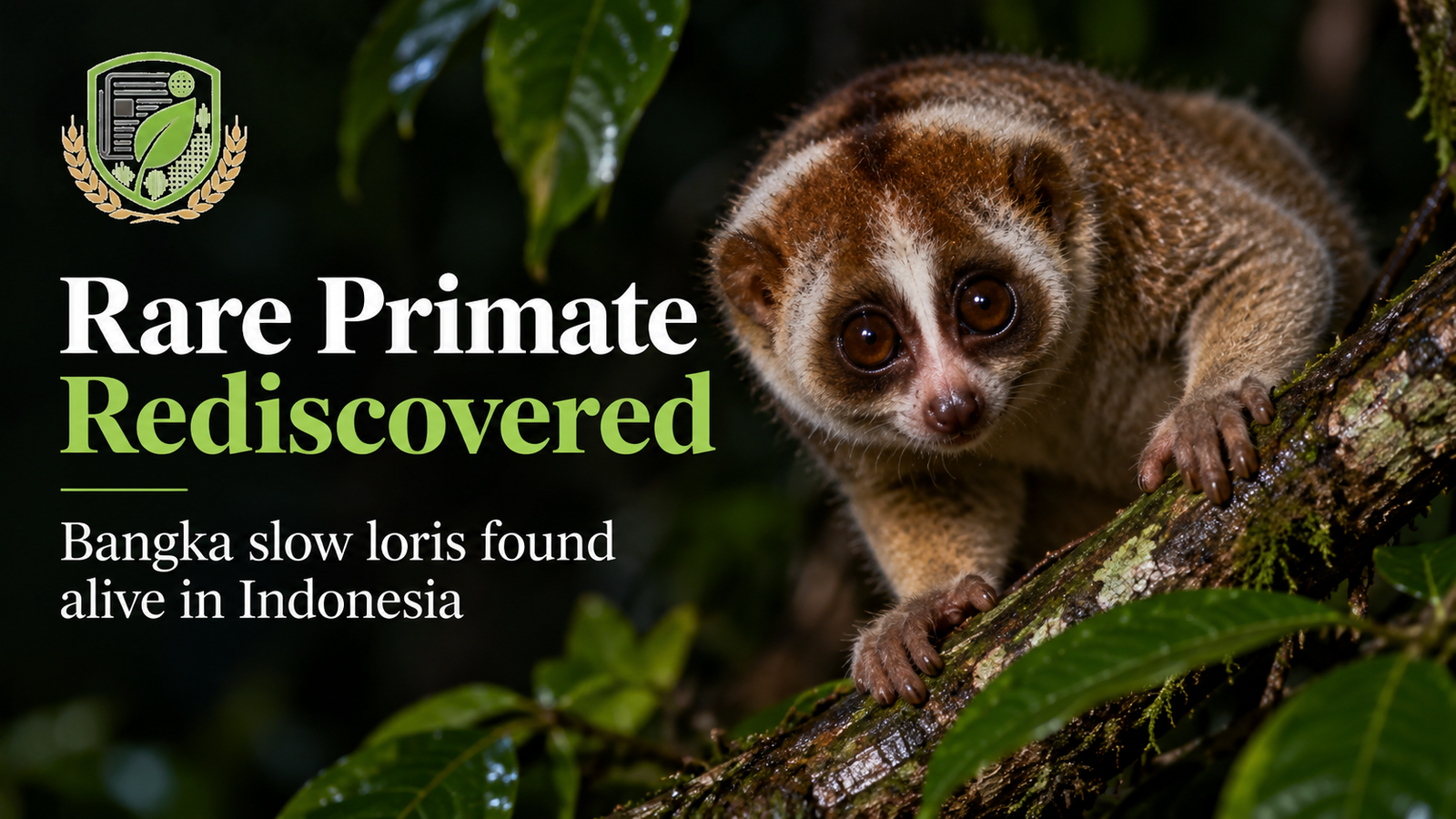
For almost a century, scientists had little evidence that one of the world’s rarest primates still survived in the wild.
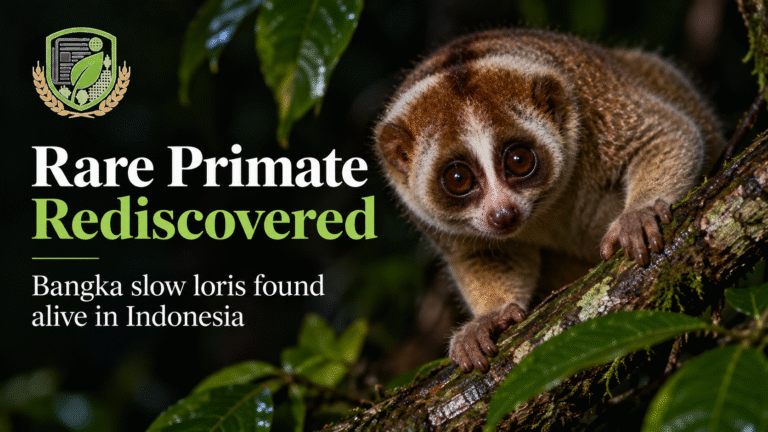
The Bangka slow loris, a small nocturnal animal known for its enormous eyes and unusual venomous bite, had largely disappeared from scientific records after the 1930s. Conservationists feared that the species might already have vanished as forests across its Indonesian island home gave way to mining, plantations and expanding settlements.
But the animal was never truly gone.
A newly published study has confirmed that the Bangka slow loris (Nycticebus bancanus) still survives on Indonesia’s Bangka Island, following years of rescue and rehabilitation work by local conservationists.
Between 2015 and 2025, the Alobi Wildlife Rescue Center documented more than 90 individuals across the island. Of those, 86 recovered sufficiently to be released into suitable forest habitats.
The discovery, announced on 20 October by conservation organisation Re and reported by Reuters, offers rare encouragement at a time when biodiversity loss dominates environmental headlines.
However, the researchers have issued an urgent warning: finding the species alive does not mean its future is secure.
The Animal Scientists Had Almost Given Up Finding
The Bangka slow loris has a remarkable history.
Scientists first described the animal in 1906, although researchers formally recognised it as a distinct species only in 2013.
For decades, information about its population and distribution remained extremely limited.
Its absence from modern scientific surveys eventually raised concerns that it might have disappeared altogether.
The International Union for Conservation of Nature classified the species as Critically Endangered, possibly extinct, reflecting the serious uncertainty surrounding its survival.
That uncertainty has now changed.
Researchers working with the Alobi Wildlife Rescue Center, Austria’s Haus des Meeres Aqua Terra Zoo and Indonesia’s Taman Safari Prigen Conservation Breeding Ark examined a decade of rescue records and confirmed that the species persists across several parts of Bangka Island.
The findings, published in the scientific journal Spixiana, establish an important new foundation for conservation planning.
But the story also exposes a surprising gap between scientific records and what local communities already knew.
Local Communities Had Been Finding the Animals for Years
While scientists struggled to confirm the species’ continued existence, residents of Bangka were encountering slow lorises in places far removed from protected forests.
Some appeared in gardens and backyards.
Others turned up beside roads, on electrical cables or near plantations.
Concerned residents reported these encounters to the Alobi Wildlife Rescue Center, allowing its team to collect injured animals, provide veterinary care and return suitable individuals to the wild.
Those records eventually became the basis for the new scientific study.
Researchers documented encounters across all four regencies of Bangka Island and the city of Pangkal Pinang.
That geographical spread suggests the species may still occupy more of the island than scientists previously understood.
However, the records do not establish how many slow lorises remain in the wild.
They show where rescuers encountered animals, not the size or stability of the overall population.
That distinction will shape the next stage of conservation work.
One of the World’s Most Unusual Primates
The Bangka slow loris is not an ordinary forest mammal.
Slow lorises are the only primates known to possess venom.
They produce a secretion from glands on their upper arms and mix it with saliva, creating a venomous bite that can cause pain and swelling.
Their physical adaptations are equally unusual.
Large, forward-facing eyes help them navigate dark forest environments, while their slow, deliberate movements allow them to move quietly through branches.
They also possess a specialised arrangement of lower teeth known as a toothcomb, which helps with grooming and other activities.
A secondary tongue-like structure helps clean that toothcomb.
These characteristics make slow lorises distinctive members of Southeast Asia’s forest ecosystems.
Yet their specialised lifestyle can also leave them vulnerable when forests disappear.
They depend on trees for movement, shelter and access to food. When roads and plantations divide forest habitats, even crossing between nearby trees can become dangerous.
The Rescue Records Reveal a Much Bigger Threat
The fact that so many slow lorises were found near human settlements is not necessarily evidence of a healthy population.
It may instead reveal how severely their habitat has changed.
Bangka Island has experienced extensive environmental pressure from tin mining, oil palm expansion and urban development.
Mining can remove vegetation and disturb landscapes, while plantation development can replace complex natural forests with simplified agricultural systems.
For a slow loris, those changes can eliminate the branches and vegetation needed to move safely through its habitat.
The animals may then enter plantations, gardens or developed areas while searching for food or suitable shelter.
Electrical infrastructure presents another danger.
Some of the rescued lorises had suffered serious injuries after coming into contact with power lines.
Others were found along roads or in areas where they faced additional human-related risks.
These encounters highlight a difficult conservation reality.
An animal can survive in a heavily altered landscape without that landscape being capable of supporting it safely in the long term.
Eighty-Six Animals Have Returned to the Forest
Despite those challenges, the rescue programme has achieved meaningful results.
Of the more than 90 slow lorises documented during the study period, 86 were rehabilitated and released at seven locations across Bangka Island.
Conservationists selected release sites based on the availability of suitable forest habitat and some degree of protection.
That represents an important achievement for a species whose survival had remained uncertain for decades.
However, successful release does not automatically guarantee long-term survival.
Animals need sufficient food, suitable shelter and opportunities to reproduce.
Their habitats must also remain protected from further destruction.
Without those conditions, rehabilitation can become a temporary response to a much larger problem.
The next conservation challenge is therefore not simply rescuing more slow lorises.
It is making sure the forests they return to can support viable populations.
Why Protecting the Remaining Forests Matters Most
Bangka’s remaining natural forests are essential to the species’ future.
The Alobi Wildlife Rescue Center has urged stronger protection against illegal tin mining and large-scale land clearing for oil palm plantations.
Researchers also want systematic field surveys to establish where the animals live and how many survive in each area.
Those surveys would help conservationists identify important habitats, assess population trends and determine where protection measures are most urgently needed.
Genetic research could provide additional information about whether isolated groups remain connected or face the risks associated with small populations.
The researchers have also recommended continued monitored releases and the possible development of a conservation-breeding programme.
These measures would provide valuable support, but none can replace the protection of natural habitat.
A species cannot recover indefinitely if the landscape it depends on continues to disappear.
The Discovery Shows Why Local Conservation Knowledge Matters
Perhaps the most important part of this story is how the rediscovery happened.
Scientists did not find the Bangka slow loris through a dramatic expedition into a previously unexplored forest.
Instead, the breakthrough came from reviewing records that local conservationists had gathered through years of practical rescue work.
The animals had remained visible to some local residents, even while they were largely absent from scientific literature.
That gap highlights a broader challenge in biodiversity research.
Many threatened species live in regions where scientific surveys are limited, funding is scarce or ecological records remain incomplete.
Local communities and wildlife organisations may possess valuable information that never reaches international databases or peer-reviewed publications.
By bringing those records into the scientific literature, researchers can improve conservation assessments and identify species that deserve renewed attention.
The Bangka slow loris demonstrates that valuable discoveries do not always require new technology.
Sometimes they require recognising the importance of knowledge that already exists.
Rediscovery Is Not the Same as Recovery
Conservation stories often celebrate the return of species thought to be extinct.
Those moments deserve attention, but they can create a misleading impression that the danger has passed.
The Bangka slow loris remains critically endangered.
Researchers do not yet know its total wild population, whether its numbers are increasing or how successfully released animals reproduce.
The threats that contributed to its disappearance from scientific attention have not disappeared either.
Mining, land conversion, roads and the illegal wildlife trade continue to create risks.
That means the rediscovery should mark the beginning of a stronger conservation effort, not the end of the story.
The species has gained something extremely valuable: renewed scientific attention.
Whether that attention becomes effective protection will determine what happens next.
A Rare Second Chance for Conservation
Around the world, many species decline before scientists have enough information to understand their biology or population status.
Some disappear without receiving meaningful conservation attention.
The Bangka slow loris has been given a different opportunity.
Local rescuers kept records, protected injured animals and returned survivors to the forest. Researchers then transformed those records into formal evidence that could support future conservation planning.
Now, governments, scientists and environmental organisations have a clearer starting point.
They can investigate the population, identify critical habitats and strengthen protection before further losses occur.
The discovery also offers a wider lesson about biodiversity conservation.
Protecting wildlife does not begin only when a species attracts international attention.
It often begins with local people who recognise an animal in danger and decide to help.
For nearly a century, the Bangka slow loris was missing from much of the scientific record.
But on a small Indonesian island, it continued moving quietly through the trees, appearing in gardens and surviving in fragments of its former habitat.
Scientists have finally confirmed what those encounters meant.
The Bangka slow loris is still here. The question now is whether the world can protect it before that extraordinary survival story becomes another extinction.
About The Author