They are often associated with death, but vultures quietly help keep ecosystems alive.
By rapidly consuming animal carcasses, these powerful scavengers recycle nutrients, reduce the build-up of decaying matter and help limit the spread of pathogens. Yet across India, the birds that perform this ecological cleanup service have suffered one of the most dramatic wildlife declines in recent decades.
Now, India is pushing a renewed conservation effort.
At an International Vulture Awareness Day event in Panchkula on 6 September, Environment Minister Bhupender Yadav called for continued creation of Vulture Safe Zones, alongside safer veterinary practices, reliable food availability and stronger technical capacity to support the recovery of wild populations.
The urgency becomes clearer in India’s latest nationwide assessment.
A dramatic loss across historic nesting sites
A nationwide vulture assessment led by the Wildlife Institute of India found that vultures were nesting at only 120 of 425 historically documented nesting sites surveyed during the assessment period. Including newly identified locations, researchers recorded nesting activity at 213 sites.
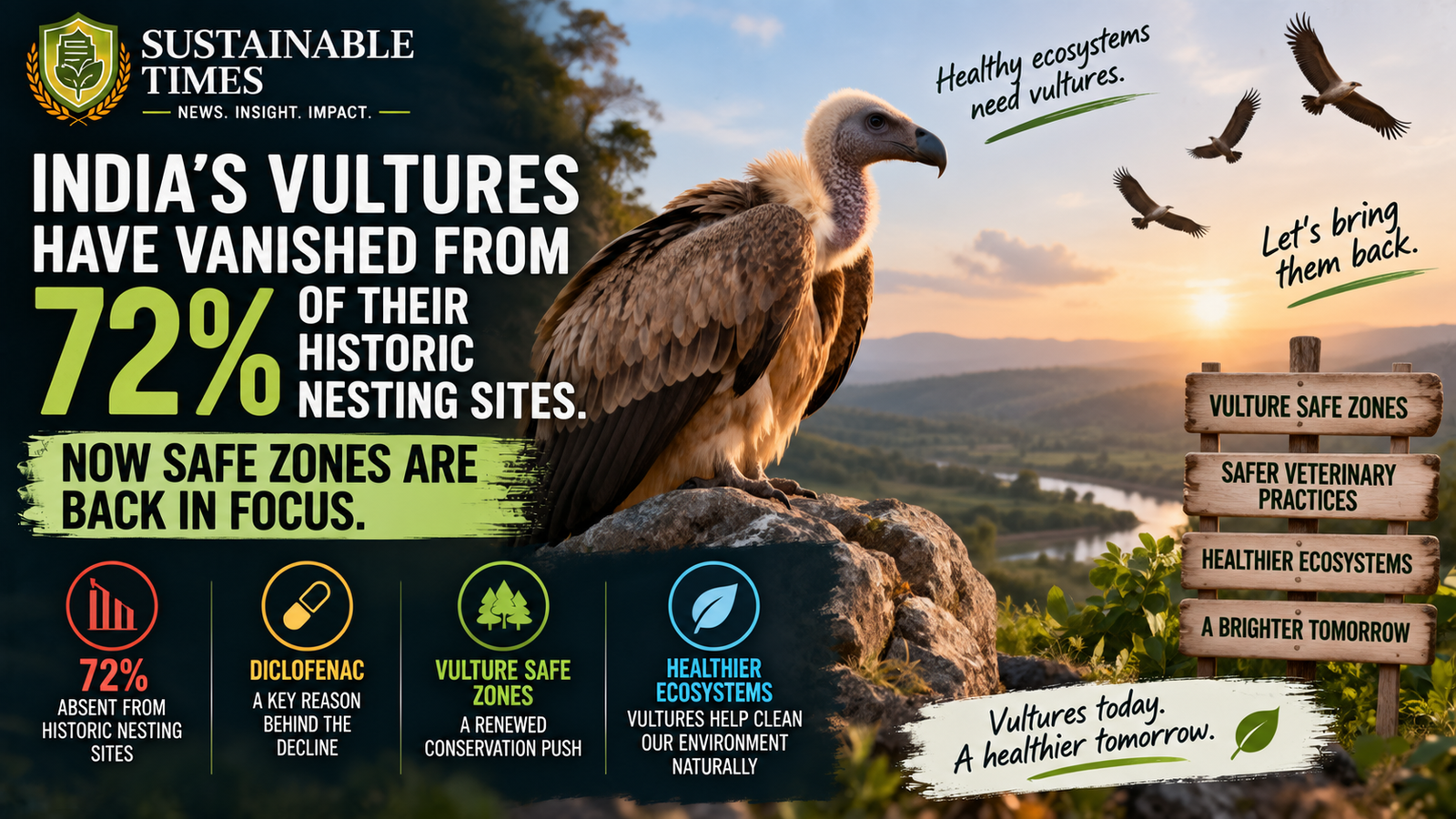
That means vultures were absent from nearly 72% of their previously known nesting sites.
The decline is particularly serious for some species. The assessment found that Slender-billed and Red-headed Vultures were absent from all of their previously known nesting sites included in the assessment. The White-rumped Vulture, once among India’s most widespread vultures, has disappeared from nearly 90% of its historic nesting range.
These are not simply numbers on a conservation chart. When a breeding population disappears from a landscape, natural recolonisation can be slow and uncertain.
The veterinary drug that changed India’s skies
One of the most important lessons from India’s vulture crisis came from an unexpected source: veterinary medicine.
Diclofenac, a painkiller used to treat livestock, proved highly toxic to vultures that consumed the carcasses of treated animals. The resulting deaths contributed heavily to the catastrophic decline of India’s Gyps vultures from the 1990s onward. India’s conservation strategy has therefore placed strong emphasis on preventing the use of vulture-toxic veterinary drugs.
The lesson extends well beyond vultures.
Wildlife conservation does not always mean protecting an animal from direct hunting or habitat destruction. Sometimes, a seemingly ordinary activity elsewhere in the human system can create a major ecological consequence.
A medicine used on livestock can affect a scavenger. A change in carcass disposal can alter food availability. A change in land use can remove nesting or roosting habitat.
Healthy ecosystems depend on all of these connections working together.
What exactly is a Vulture Safe Zone?
The idea is relatively simple: create landscapes where vultures can find food, nest and roost without being exposed to major human-created threats.
India’s conservation framework has already identified Vulture Safe Zones as an important intervention. The approach involves monitoring vulture populations, checking food availability, identifying nesting and roosting habitat, monitoring veterinary drugs and working with local communities.
That makes the concept much broader than drawing a boundary around a forest.
A successful safe zone needs cooperation from veterinarians, livestock owners, pharmacies, local administrations, conservation groups and communities. The government is now calling for that wider, whole-of-society approach.
Conservation can also be a story of recovery
India’s vulture crisis is severe, but the latest conservation push is not based entirely on bad news.
The country has developed conservation-breeding programmes, rescue facilities and safer landscapes aimed at rebuilding populations. The Ministry of Environment has also identified the need for additional conservation breeding centres and Vulture Safe Zones across states.
At the Jatayu Conservation Breeding Centre in Pinjore, Haryana, conservation officials are continuing work aimed at strengthening vulture recovery, while the latest national workshop brought together scientists, veterinarians, forest officials and conservation practitioners.
The challenge now is to connect these efforts with conditions in the wild.
Breeding birds in controlled environments can help build populations, but long-term recovery ultimately depends on whether landscapes outside those facilities become safe enough for vultures to survive and reproduce.
Why saving vultures matters beyond wildlife
It is easy to overlook a species because it does not fit the conventional image of a charismatic conservation animal.
Vultures do.
Their ecological role is unusually direct. They remove carcasses quickly and return nutrients to the ecosystem. Their disappearance can therefore create consequences that extend beyond the birds themselves. The Indian government describes them as highly efficient scavengers and part of nature’s own cleaning system.
That makes vulture conservation a useful reminder of something bigger in sustainability: ecosystems rarely work according to the species we find attractive.
The less visible species can perform some of the most important jobs.
India’s next step is therefore not simply to bring more vultures back into the sky. It is to make the landscapes beneath them safer.
If Vulture Safe Zones succeed, the result could be more than a recovery in bird numbers. It could demonstrate how veterinary policy, community participation, scientific monitoring and habitat protection can work together to rebuild an ecological system.
And for a bird that spends much of its life cleaning up after everything else, that would be a remarkable second chance.
Key Takeaway
India’s vultures have disappeared from nearly 72% of their historically recorded nesting sites, but conservation efforts are shifting toward safer landscapes, veterinary practices and community-led protection. Their recovery could become a powerful example of ecosystem restoration in action.
About The Author