A sugar mill and a biotechnology laboratory may seem like two completely different worlds. One processes agricultural crops into sugar, while the other uses microorganisms and carefully controlled equipment to produce new materials.
But an unusual partnership in Uttar Pradesh is bringing those worlds together.
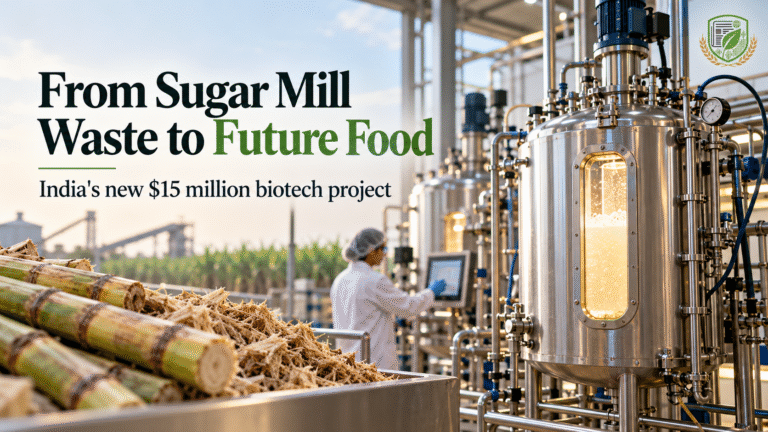
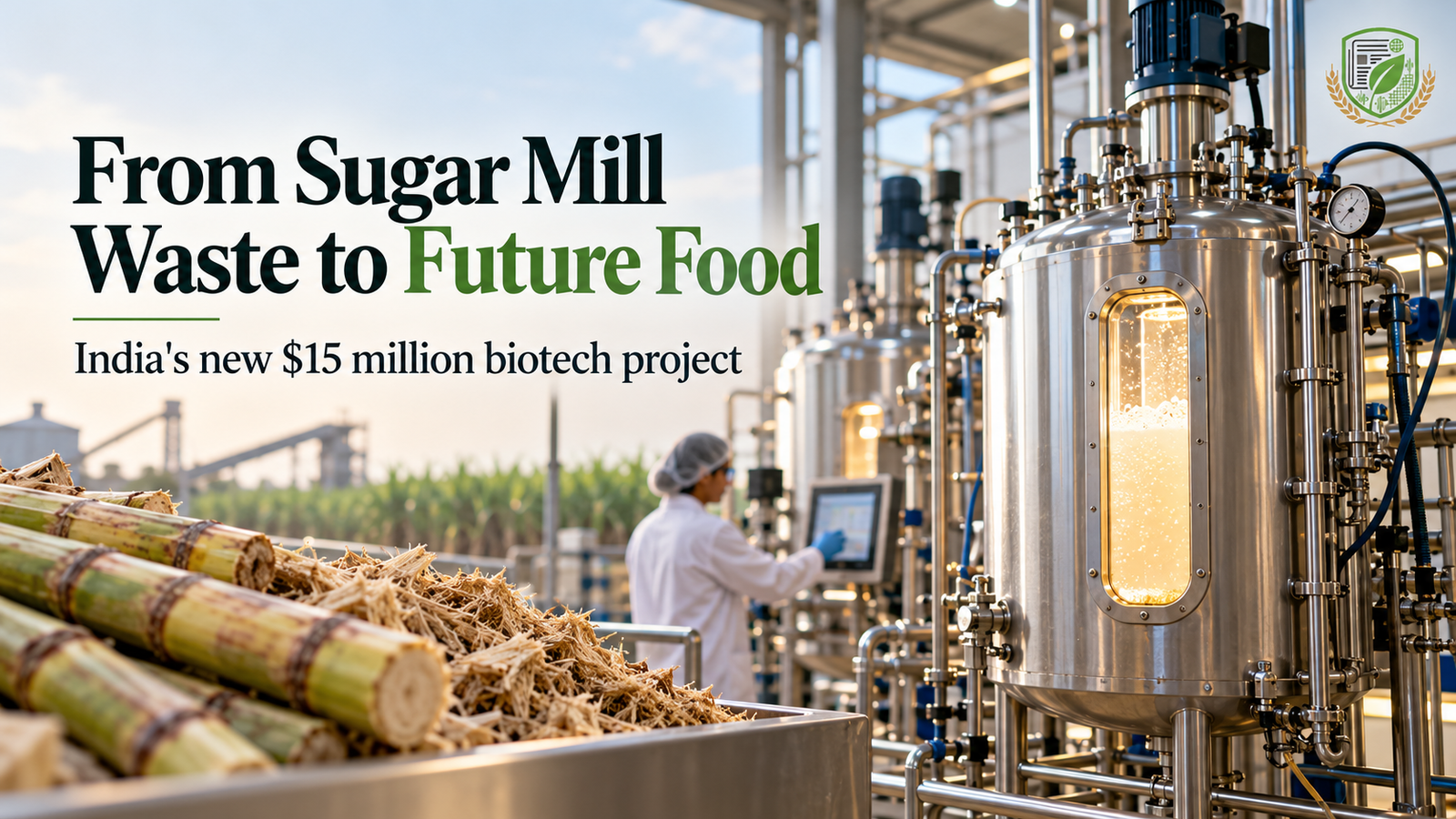
Israeli climate-biotechnology company Brevel has signed a joint-venture agreement with India’s The Wave Group to develop a large-scale manufacturing facility that will use sugar-mill byproducts to grow microalgae and other valuable biological ingredients.
The project, announced on 21 October, represents an estimated investment of $10 million to $15 million. Its planned bioreactor capacity will eventually reach 300,000 litres, making it a substantial expansion from Brevel’s existing production capabilities in Israel.
The technology behind the project is particularly interesting. Rather than relying on conventional agricultural production, Brevel uses a process called illuminated fermentation, combining microorganisms, nutrients and carefully controlled light inside industrial bioreactors.
For India’s expanding bioeconomy, the project raises an important question: Could agricultural processing byproducts become the starting point for an entirely new generation of food ingredients?
A New Use for India’s Sugar Industry
India is one of the world’s largest sugar producers, with an extensive network of sugar mills and agricultural supply chains.
Sugar production also creates secondary material streams, including molasses and other sugar-rich processing fractions. Some already support established industries such as ethanol production, animal feed and fermentation.
Brevel and The Wave Group want to explore another use.
The planned Uttar Pradesh facility will use suitable sugar-mill byproducts and processing intermediates as feedstock for microorganisms grown inside controlled bioreactors.
The Wave Group’s experience in sugar manufacturing gives the partnership potential access to these materials, while Brevel will contribute its fermentation technology.
Instead of treating agricultural processing and biotechnology as separate industries, the companies hope to connect them through a shared production system.
That approach could improve resource efficiency by creating additional value from materials already generated during sugar manufacturing.
However, the precise feedstock combinations remain under development. Brevel says it has been testing molasses, raw sugar and sucrose-rich intermediates to determine which can support efficient production at a competitive cost.
Why This Fermentation Process Needs Light
Most industrial fermentation takes place in enclosed vessels where microorganisms receive nutrients under carefully controlled conditions.
Brevel’s process introduces an additional element: light.
The company combines sugar-fed fermentation with illumination to grow photosynthetic microorganisms and support the production of valuable biological compounds.
This is particularly relevant for microalgae such as Chlorella vulgaris.
Chlorella contains protein and other nutrients, while its metabolism can produce compounds including chlorophyll and carotenoids.
By combining nutrient availability with controlled lighting, Brevel aims to create production conditions that support efficient growth and the formation of commercially useful ingredients.
The company has developed proprietary bioreactors designed to provide illumination while maintaining the controlled environment required for industrial fermentation.
But bringing light into a large bioreactor creates an engineering challenge.
As vessels become larger, distributing sufficient light throughout the culture becomes more difficult. Engineers must also maintain cleanliness, manage energy consumption and keep production costs under control.
Those challenges will become particularly important as Brevel moves toward commercial-scale manufacturing in India.
The Factory Will Begin With Microalgae, Not Meat Alternatives
The planned facility’s first product will be Purallis, Brevel’s chlorella-based ingredient intended for food, beverage and nutritional applications.
The company has previously attracted attention for developing microalgae proteins that could support alternatives to conventional animal-derived ingredients.
However, its immediate commercial strategy focuses on an established market.
Chlorella already has applications in food supplements and nutritional products, making it a more practical starting point for manufacturing expansion.
Brevel’s chief executive, Yonatan Golan, has explained that the company sees chlorella production as an opportunity to establish a profitable manufacturing base while continuing longer-term development of protein ingredients.
The Indian facility is also being designed to accommodate other microorganisms and plant-cell cultures that benefit from controlled illumination.
This could eventually allow additional biotechnology companies to use the manufacturing platform rather than constructing their own large production facilities.
For an emerging industry, access to suitable manufacturing infrastructure can be just as important as scientific innovation.
From 5,000 Litres to 300,000 Litres
The size of the proposed expansion highlights the companies’ ambitions.
Brevel currently operates a commercial facility in Israel with a 5,000-litre bioreactor.
The Uttar Pradesh project is designed to accommodate up to 300,000 litres of total bioreactor capacity.
However, the companies do not intend to install the full capacity immediately.
According to Brevel’s management, the first development phase will provide approximately 100,000 litres, with infrastructure allowing further expansion.
The project will use larger illuminated fermentation vessels, including units designed for approximately 30,000 litres.
Construction is expected to begin before the end of 2026, while full-scale production is targeted within approximately 18 months.
Those dates remain company projections rather than completed milestones.
The manufacturing process will still need to demonstrate reliable performance as equipment grows beyond the scale Brevel currently operates.
For investors and food manufacturers, the critical test will be whether the technology can deliver consistent ingredient quality while keeping energy, feedstock and operating costs competitive.
Could This Make Food Production More Sustainable?
The environmental appeal of microbial production lies partly in its ability to manufacture ingredients under controlled conditions.
Instead of relying entirely on conventional crop cultivation or livestock production, companies can use microorganisms to produce selected nutritional and functional compounds.
Such systems may offer opportunities to use industrial byproducts, reduce dependence on certain agricultural inputs and develop more efficient manufacturing processes.
However, fermentation is not automatically environmentally superior.
Bioreactors require electricity, equipment, nutrients and temperature control. Illuminated systems also consume energy to provide light.
The overall environmental performance therefore depends on the energy source, production efficiency, feedstock processing and other operational factors.
For Brevel’s Indian facility, the use of sugar-mill byproducts could support a more circular production model.
But independently verified environmental assessments will be necessary before anyone can conclude that the finished ingredients have a lower footprint than conventional alternatives.
The opportunity is promising; the final environmental benefits remain to be demonstrated.
India Could Become a Manufacturing Hub for New Food Ingredients
The partnership also reflects a broader opportunity for India’s biotechnology sector.
The country already has substantial capabilities in pharmaceuticals, industrial fermentation, food processing and agricultural manufacturing.
Connecting those capabilities could create opportunities for companies developing microbial proteins, nutraceutical ingredients and other bio-based products.
In the Brevel-Wave partnership, the Indian industrial group will provide manufacturing investment and access to agricultural processing resources, while the Israeli company supplies specialised biotechnology.
The agreement could eventually serve customers beyond India.
Brevel has indicated that companies developing plant-cell culture ingredients have already expressed interest in obtaining future manufacturing capacity.
This approach may help younger biotechnology businesses move from laboratory development toward commercial production without financing an entire factory independently.
It could also create a new role for existing agricultural-processing companies.
Instead of focusing only on their traditional products, they could become suppliers of raw materials and infrastructure for emerging biotechnology industries.
The Bigger Opportunity Is in Connecting Industries
For decades, food manufacturing has largely followed separate industrial pathways.
Sugar mills produce sugar and associated processing streams. Fermentation companies manufacture biological ingredients. Food brands purchase those ingredients and turn them into finished products.
The new partnership suggests these activities could become more closely connected.
A sugar-processing operation could provide feedstock for a biotechnology facility. That facility could produce microalgae ingredients or plant-derived compounds. Food and nutrition companies could then incorporate those materials into commercial products.
Each stage would create value from the previous stage’s output.
That is an important principle of the circular bioeconomy: finding productive uses for biological resources across different industries rather than allowing potentially valuable materials to go unused.
Of course, the practical benefits depend on whether the economics work.
The cost of feedstock preparation, electricity, bioreactor operation and ingredient recovery will determine whether the system can compete with established manufacturing methods.
What Happens Next?
The next 18 months will be important for Brevel and The Wave Group.
The companies must begin construction, establish suitable feedstock arrangements, install larger fermentation equipment and demonstrate consistent production at scale.
They will also need customers willing to purchase the ingredients at commercially viable prices.
If the project succeeds, it could show how agricultural processing infrastructure and advanced biotechnology can support one another.
If production proves too expensive or difficult to scale, the experience will still provide useful lessons for an industry trying to move promising biological technologies beyond laboratory and demonstration facilities.
For now, the project remains an ambitious manufacturing plan rather than proof of a fully established circular production system.
Still, the direction is worth watching.
India’s agricultural sector produces enormous quantities of biological materials, while its biotechnology industry continues to develop new manufacturing capabilities.
Bringing those two systems together could create opportunities that neither industry can achieve independently.
The future of sustainable food manufacturing may not depend only on growing new crops. It may also depend on finding smarter ways to use the resources already passing through India’s factories and farms.
About The Author