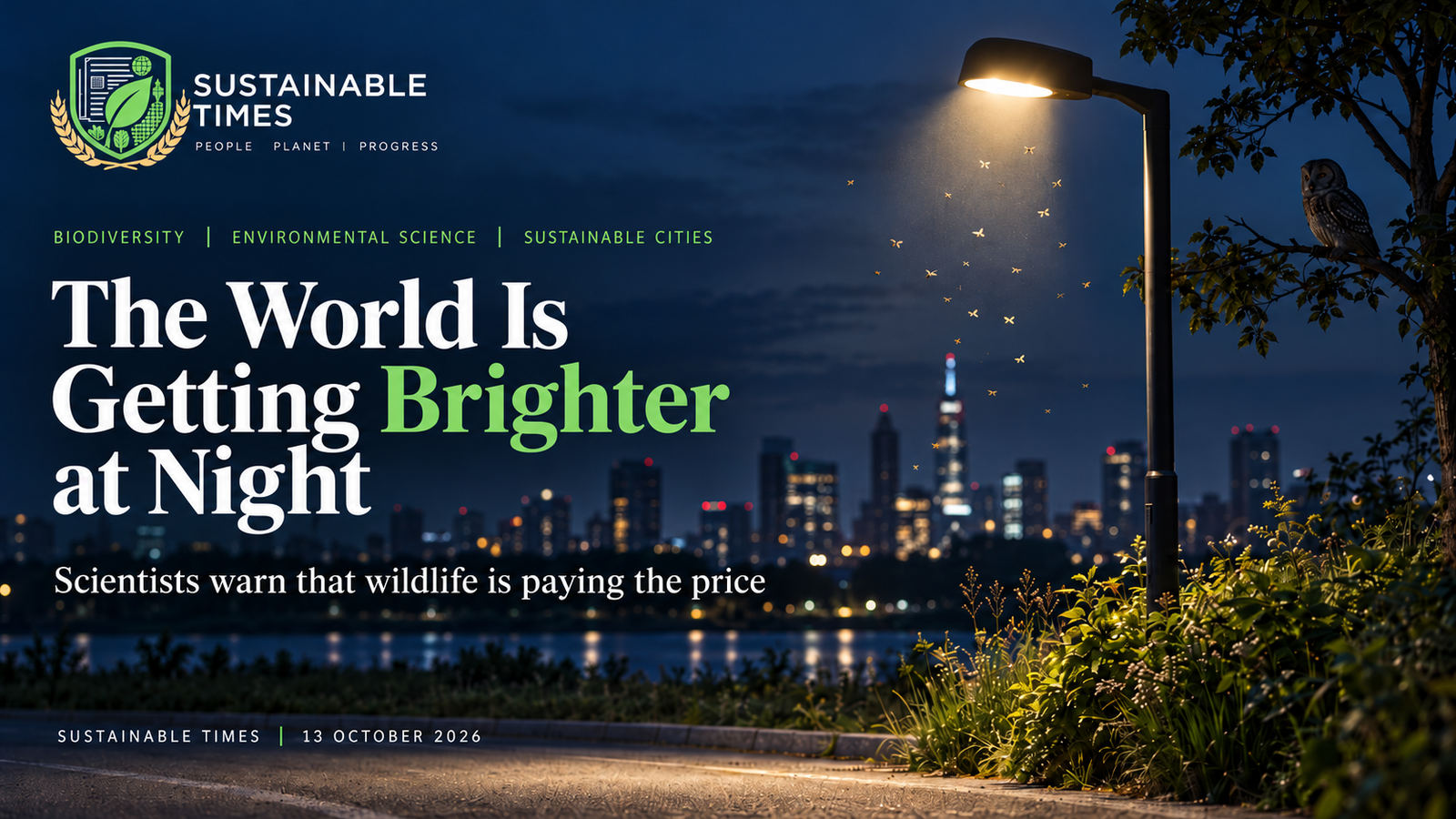
When a city switches on its lights after sunset, most people see a sign of progress. Roads become easier to navigate, buildings illuminate the skyline, and public spaces remain active long after daylight disappears.
But for wildlife, the same lights can turn the natural world upside down.
A major scientific review published on 5 October 2026 in Nature Reviews Biodiversity warns that artificial lighting has become one of the fastest-growing yet least regulated forms of environmental change. Researchers say it disrupts biological processes across ecosystems, affecting everything from insect behaviour and bird migration to plant growth and aquatic life.
The research, titled Understanding and Managing Ecological Light Pollution, brings together evidence from numerous studies to examine how artificial light at night changes the way living organisms interact with their surroundings.
Its central message is striking: Protecting biodiversity may require cities to rethink not only how much they illuminate, but also where, when and why they use light.
The Environmental Problem Hidden in Plain Sight
Most environmental pollution is associated with something harmful entering the air, water or soil.
Light pollution works differently.
It occurs when artificial lighting changes natural nighttime conditions, exposing organisms to illumination that would otherwise be absent or much weaker.
Streetlights, illuminated buildings, industrial facilities, advertising displays and other light sources all contribute.
The consequences extend far beyond losing a clear view of the stars.
Many animals depend on natural cycles of daylight and darkness to determine when to feed, reproduce, migrate or avoid predators.
Artificial lighting can interfere with those signals.
The new review, led by Ashton L. Dickerson and colleagues including Travis Longcore and Franz Hölker, finds that scientists have made considerable progress in understanding these effects. However, regulations and urban planning practices have not kept pace with the evidence.
That gap is becoming increasingly important as cities expand and outdoor lighting reaches previously dark environments.
Insects Are Among the Most Vulnerable
Anyone who has watched insects gather around a streetlight has seen one of the most familiar effects of artificial lighting.
For many insects, however, the problem goes much deeper than attraction to a bright bulb.
Artificial light can change flight behaviour, interfere with feeding and mating, and alter interactions with predators.
Research reviewed by the scientists also shows that lighting can affect moths and other insects differently depending on its brightness and colour.
This matters because insects perform essential ecological functions.
They pollinate plants, break down organic matter and provide food for birds, bats and other animals.
When artificial lighting disrupts insect activity, the effects can spread through food webs.
A decline in nighttime pollination, for example, can influence plant reproduction. Changes in insect availability can also affect animals that depend on them for food.
The researchers argue that understanding these indirect effects is essential because the ecological consequences of light pollution may extend well beyond the organisms directly exposed to it.
Birds and Bats Are Navigating an Artificial Night
Artificial lighting also changes conditions for animals that move through the night.
Migratory birds can become disoriented by illuminated structures, particularly when visibility is poor or weather conditions are unfavourable.
Some birds may circle brightly lit buildings, increasing exhaustion and collision risks.
Bats face a different set of challenges.
Certain species exploit insects gathering around lights, while others avoid illuminated areas because they become more exposed to predators or lose access to preferred feeding routes.
This creates uneven consequences.
One species may benefit from a particular lighting arrangement while another loses access to important habitat.
That makes it difficult to develop a single lighting solution suitable for every ecosystem.
The new review emphasises that conservation planning needs to consider species-specific responses rather than assuming all wildlife reacts to artificial light in the same way.
Even Rivers and Oceans Are Feeling the Effects
Light pollution does not stop at the edge of a city.
Artificial illumination from bridges, ports, coastal developments and waterfront infrastructure can reach rivers, lakes and marine ecosystems.
Aquatic organisms also depend on natural light cycles.
Some use moonlight and darkness to regulate movement, feeding and reproduction.
When artificial light changes those conditions, it can alter ecological behaviour in ways that scientists are still working to understand.
The review highlights the need for better monitoring across terrestrial and aquatic environments.
This is particularly relevant for rapidly developing coastal regions, where tourism, ports, transport infrastructure and urban expansion are increasing nighttime illumination.
A brighter waterfront may attract visitors and investment, but it can also change the conditions experienced by nearby wildlife.
Scientists Say Better Light Bulbs Are Not Enough
One of the most important findings concerns how cities should respond.
The researchers propose a hierarchy of interventions.
The strongest approach is to eliminate unnecessary artificial lighting wherever possible.
Where lighting remains necessary, cities can control its direction, location and operating hours.
Only after those decisions should they focus on adjusting the colour and spectral characteristics of the light.
This is a meaningful distinction.
Switching to a different LED bulb may reduce some ecological impacts, but it does not necessarily solve the problem if the light remains unnecessary or reaches sensitive habitats.
A poorly directed light can illuminate nearby vegetation, waterways or wildlife corridors even when the road or building requires only a small area of illumination.
The solution may therefore involve better lighting design rather than simply more efficient lighting technology.
The Sustainable City May Need to Become Darker
Cities have spent decades improving energy efficiency.
LED lighting has helped reduce electricity consumption compared with many older lighting technologies.
But efficiency creates an interesting challenge.
When lighting becomes cheaper to operate, businesses and local authorities may install more of it or keep it running for longer.
That can increase the total amount of artificial light reaching the environment.
The environmental value of efficient lighting therefore depends partly on how people use it.
A sustainable lighting strategy should consider energy consumption, public safety, visibility and ecological impact together.
For example, motion-controlled lighting can provide illumination when people need it while reducing unnecessary exposure during quieter periods.
Shielded fixtures can direct light toward roads and pathways rather than surrounding habitats.
Carefully planned lighting schedules can also help protect sensitive nighttime environments.
The objective is not to plunge cities into darkness.
It is to use artificial light more deliberately.
Why the Research Matters for Urban Planning
The study identifies a significant weakness in current environmental governance.
Although scientists have documented numerous ecological impacts of artificial light, many planning systems still lack strong requirements to assess them.
Environmental impact assessments often concentrate on land disturbance, emissions, water use and conventional forms of pollution.
Lighting can receive less attention, even when developments operate near sensitive habitats.
The researchers argue that governments should incorporate stronger ecological evidence into legally binding planning and lighting standards.
They also call for more consistent measurement methods and long-term monitoring.
Without reliable measurements, authorities may struggle to determine whether lighting interventions actually improve conditions for wildlife.
This creates an opportunity for architects, lighting designers, infrastructure developers and city planners to treat darkness as part of environmental design.
Protecting Darkness Could Deliver More Than Biodiversity Benefits
Reducing unnecessary lighting can also lower electricity consumption and operating costs.
For municipalities managing large networks of streetlights, better controls and more selective illumination may create measurable financial savings.
Businesses could benefit from similar improvements across industrial sites, commercial buildings and outdoor facilities.
However, ecological benefits must remain central to the strategy.
A lighting system that consumes less electricity but continues disrupting sensitive habitats may still require redesign.
The strongest approach combines efficient technology with thoughtful placement, timing and intensity.
This makes light pollution an unusual sustainability challenge because some solutions may be comparatively straightforward to implement.
Unlike rebuilding an electricity grid or restoring a damaged forest, reducing unnecessary illumination can sometimes begin with changing how existing equipment operates.
The Biggest Challenge Is Changing How We Think About Light
Artificial lighting has become so familiar that people rarely question its presence.
A brightly illuminated building appears attractive.
A glowing skyline becomes part of a city’s identity.
A constantly lit street can feel reassuring.
But the new research asks planners and policymakers to consider the ecological consequences alongside those human preferences.
Darkness is not simply an absence of infrastructure.
For many species, it is an essential environmental condition.
Animals evolved around predictable cycles of sunlight, moonlight and darkness long before modern cities existed.
Changing those cycles can affect relationships that support entire ecosystems.
The challenge is finding a better balance between human activity and the natural environment.
Looking Ahead
The October 2026 review does not suggest that cities should eliminate outdoor lighting or compromise essential safety requirements.
Instead, it calls for more evidence-based decisions about where artificial light is necessary and how its ecological effects can be reduced.
The researchers identify important gaps in scientific knowledge, particularly around long-term impacts, interactions between species and the combined effects of light pollution with other environmental pressures.
Addressing those gaps could help governments develop stronger lighting standards and protect vulnerable ecosystems more effectively.
For businesses and cities, the lesson is already becoming clear.
Environmental responsibility is not limited to reducing carbon emissions or managing waste.
It also involves understanding how infrastructure changes the natural conditions that living organisms depend on.
The next major improvement in sustainable urban design may not involve adding another technology to the skyline. It may involve knowing when to switch the lights off.
About The Author