Published: 6 October 2026 | Climate | Clean Air | Methane | Corporate Sustainability
For decades, the climate conversation has revolved around one molecule: carbon dioxide.
That focus is justified. CO₂ is the dominant driver of long-term human-caused warming, and cutting it remains essential.
But scientists and climate strategists are increasingly pointing toward another opportunity, one that could produce results much faster.
Superpollutants.
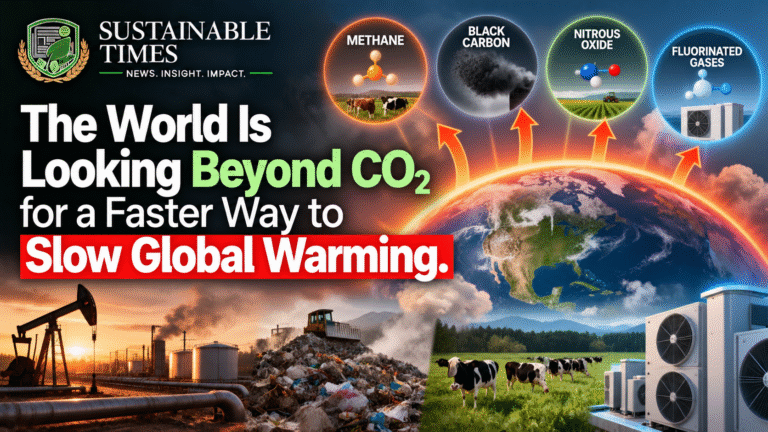
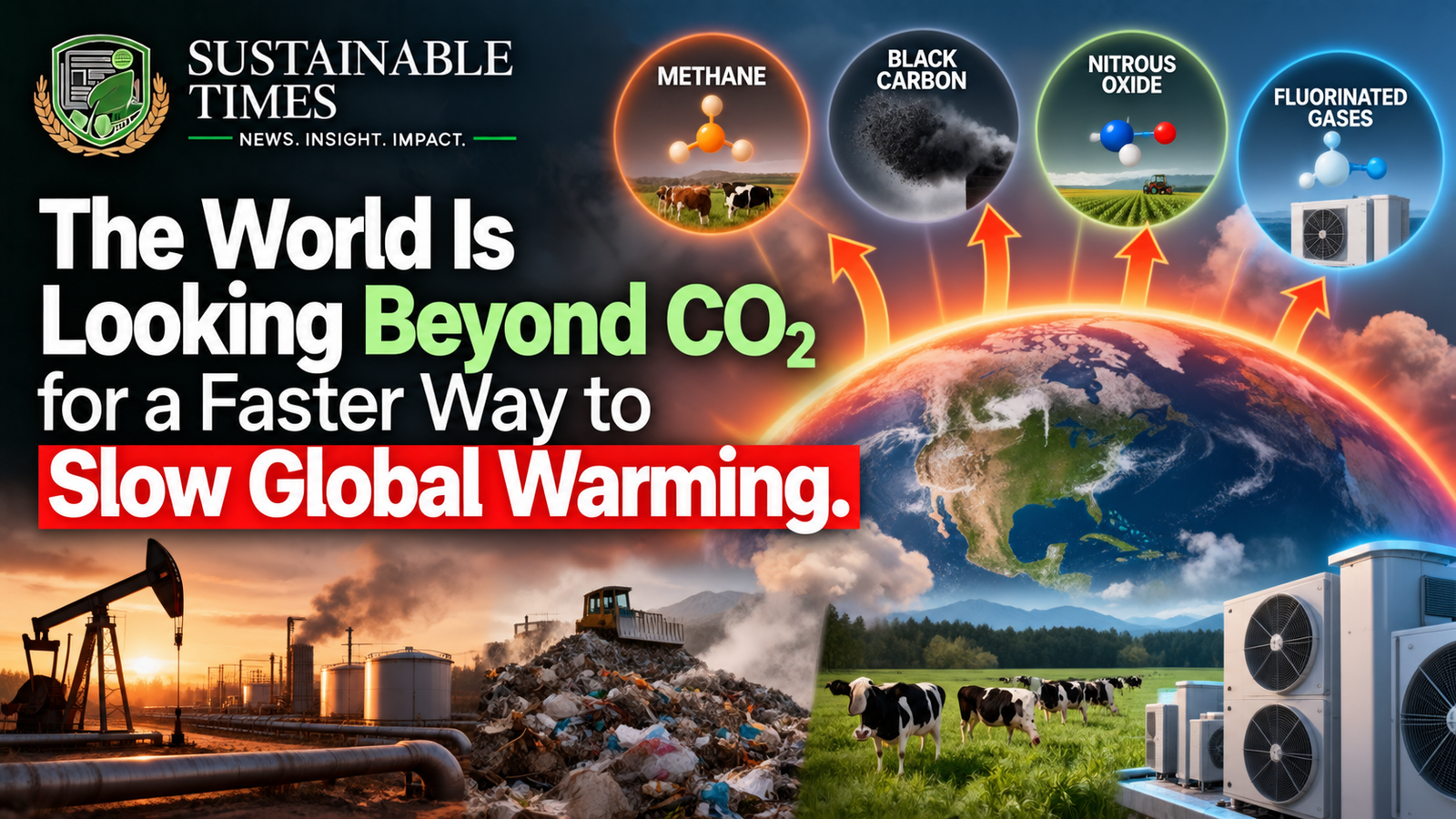
Methane, black carbon, nitrous oxide, fluorinated gases and other powerful climate pollutants may not stay in the atmosphere as long as carbon dioxide, but some are extraordinarily effective at trapping heat. Together, these pollutants account for roughly half of the warming occurring today, according to the Carbon Containment Lab and the Beyond Alliance. Carbon Containment Lab
Now a group of companies and climate organisations is trying to turn that science into an investment and corporate-action strategy.
The idea is straightforward:
While the world works on the decades-long task of decarbonising the global economy, it can also attack the pollutants that are heating the planet right now.
A new climate strategy is gaining attention
The development receiving fresh attention this week is the Superpollutant Roadmap for Corporate Action, developed by the Carbon Containment Lab with the Beyond Alliance.
The roadmap was launched during Climate Week NYC in September and is designed to show companies where they can intervene across their value chains, voluntary carbon markets and policy engagement. Carbon Containment Lab
The timing matters.
The world cannot simply replace every fossil-fuel system overnight. Electricity grids, industrial equipment, transport systems, buildings and agricultural practices take years or decades to transform.
Superpollutant reductions offer a different possibility.
Some of these pollutants disappear from the atmosphere relatively quickly after emissions fall.
That means cutting them can slow the rate of warming sooner than waiting for the full benefits of long-term CO₂ reductions.
Methane is the biggest opportunity
Among the superpollutants, methane is attracting enormous attention.
It is released from oil and gas production, coal mining, landfills, livestock, rice cultivation and other sources.
Methane also has a much shorter atmospheric lifetime than CO₂.
That creates an unusual climate opportunity.
If methane emissions fall sharply, atmospheric methane concentrations can respond relatively quickly.
Reuters reported this week that reducing methane alone could prevent approximately 0.2°C of warming by 2050. It could also make as much as 200 billion cubic metres of gas available to markets by preventing methane from being unnecessarily released or flared. Reuters
That second point is particularly interesting for industry.
A methane leak is not only a climate problem.
It can also represent a lost product.
The invisible leaks hiding inside the energy system
Imagine an oil or gas facility operating normally.
Thousands of pieces of equipment may be working across the site.
Valves.
Pipelines.
Compressors.
Storage systems.
Wells.
Processing equipment.
A small leak from one component might be difficult to see with the naked eye.
But methane monitoring technologies are becoming increasingly capable of identifying those emissions.
Satellites can detect major methane plumes from space.
Aircraft can survey industrial regions.
Ground-based sensors can continuously monitor facilities.
Artificial intelligence can help process enormous quantities of observations.
This creates something the climate movement did not have at the same scale a decade ago:
the ability to increasingly locate invisible emissions.
That changes the economics of mitigation.
Once a company knows where methane is escaping, it can potentially repair the source, capture the gas or change the equipment responsible.
Agriculture is part of the equation too
The superpollutant story is not only about fossil fuels.
Agriculture is one of the major sources of methane and nitrous oxide.
Livestock digestion produces methane.
Manure management can release methane and nitrous oxide.
Fertiliser use can generate nitrous oxide.
Rice cultivation can produce methane from flooded soils.
That makes food systems a major part of the superpollutant challenge.
And it creates an important sustainability connection.
The same agricultural practices that reduce emissions can sometimes improve resource efficiency, soil health or farm productivity.
The opportunity is therefore not simply to remove pollution.
It is to redesign production systems so that economic activity generates less climate pollution in the first place.
Waste is another surprisingly large opportunity
Landfills are another major methane source.
Organic waste decomposes in oxygen-poor conditions and produces methane.
When landfill gas escapes without being captured, the atmosphere receives a powerful greenhouse gas while the energy contained in that gas is wasted.
Better waste separation, organic-waste treatment, landfill-gas capture and methane monitoring can therefore address several problems simultaneously.
Cleaner air.
Lower greenhouse-gas emissions.
Better waste management.
Potential energy recovery.
And in some cases, an additional revenue stream.
This is one reason superpollutant reduction is attracting attention from investors as well as environmental organisations.
Black carbon brings climate and health together
Not every superpollutant is a greenhouse gas.
Black carbon, commonly associated with incomplete combustion, is a major air pollutant and also contributes to warming.
It can come from diesel engines, industrial combustion, residential solid-fuel use, agricultural burning and other sources.
Its climate effects are particularly important in sensitive regions.
When black carbon settles on snow and ice, it can darken the surface and increase the absorption of sunlight, contributing to faster melting.
At the same time, people exposed to particulate pollution face serious health risks.
That means reducing black carbon can produce benefits that are much more immediate than climate stabilisation.
Cleaner air can mean healthier communities.
Cleaner combustion can mean lower pollution.
And lower black-carbon emissions can reduce warming.
One intervention can therefore deliver multiple benefits.
Refrigerants are another climate blind spot
Fluorinated gases, including many refrigerants, can have extremely high warming potential.
They are used in air conditioning, refrigeration and industrial cooling systems.
The paradox is striking.
As global temperatures rise, demand for cooling is increasing.
But some cooling technologies can release gases that contribute to further warming.
That creates a feedback challenge.
Hotter temperatures increase demand for air conditioning.
More cooling can increase demand for refrigerants.
Poor refrigerant management can increase emissions.
And those emissions contribute to warming.
The solution requires better equipment, leak detection, refrigerant recovery and the transition toward lower-global-warming-potential alternatives.
Companies are being asked to look beyond their carbon footprint
One of the most important arguments in the new roadmap is that corporate climate strategies have historically focused heavily on CO₂.
That has created a measurement problem.
A company may have a detailed net-zero strategy while paying comparatively little attention to methane, refrigerants, black carbon or other short-lived climate pollutants.
The roadmap argues that companies should examine these pollutants across their value chains, rather than treating them as somebody else’s problem. Carbon Containment Lab
That could mean examining suppliers, logistics networks, manufacturing processes, agricultural inputs, waste systems and purchased cooling equipment.
In other words, the climate footprint of a company may be considerably more complicated than its annual tonnes of CO₂ equivalent suggest.
$100 million is being put behind the idea
The strategy is not entirely theoretical.
A group of major companies including Amazon, Autodesk, Figma, Google, JPMorganChase, Salesforce and Workday has committed to deploying $100 million through 2030 for superpollutant action, according to the Carbon Containment Lab and its partners. Carbon Containment Lab
The objective is to support projects that can reduce these pollutants while also generating health, economic and environmental benefits.
That matters because climate solutions often struggle with a familiar problem:
There may be a technically effective solution, but not enough money to deploy it at scale.
The new initiative is attempting to move capital toward that gap.
The business case may be stronger than it first appears
Superpollutant reduction is often presented as climate action.
It can also be a business-efficiency strategy.
A leaking gas pipeline is losing valuable gas.
A poorly maintained refrigeration system can waste energy and refrigerant.
An inefficient combustion system can consume more fuel.
Unmanaged organic waste can create disposal costs while releasing methane.
Better monitoring and mitigation can therefore produce economic savings alongside environmental benefits.
That is particularly important for companies that are reluctant to invest in climate projects that only generate benefits decades into the future.
Some superpollutant interventions can produce measurable operational benefits much sooner.
Technology is changing what companies can measure
One of the most interesting developments is the convergence of satellites, sensors and artificial intelligence.
Only recently has it become practical to monitor enormous areas for emissions that humans cannot see.
Satellite instruments can identify methane plumes.
Machine-learning systems can analyse large volumes of imagery.
Ground sensors can track facilities continuously.
Companies can then combine those datasets with equipment records and operational information.
That creates a new possibility:
Instead of estimating emissions from generic assumptions, businesses can increasingly move toward measurement-based emissions management.
The implications go beyond methane.
As monitoring becomes cheaper and more precise, previously invisible environmental impacts could become much harder for companies to ignore.
The biggest challenge is turning detection into action
Finding pollution is only the first step.
A satellite can identify a methane plume.
It cannot repair the valve.
A sensor can identify a refrigerant leak.
It cannot replace the equipment.
An AI model can identify an emissions hotspot.
It cannot automatically change the business process causing it.
That is why the roadmap focuses on implementation rather than simply measurement. Carbon Containment Lab
The climate value comes when detection leads to intervention.
And intervention needs money, technical expertise, regulation and accountability.
Governments still have a crucial role
Corporate action can move quickly, but voluntary commitments alone are unlikely to solve the superpollutant problem.
Reuters reports that experts and campaigners are calling for stronger policies, including mandatory methane measurement, restrictions on flaring and tighter pollution controls. Reuters
This matters because the economics of pollution can otherwise be distorted.
If a company saves money by releasing methane into the atmosphere while society pays for the climate and health consequences, the market is not pricing the full cost of the activity.
Regulation can change that equation.
Mandatory measurement can make emissions visible.
Performance standards can create minimum requirements.
Pollution fees can create financial incentives.
Disclosure rules can increase transparency.
And public investment can help finance technologies that are still too expensive for smaller operators.
The climate benefits could arrive faster than many people expect
The strongest argument for superpollutant action is timing.
CO₂ is extremely persistent.
Even after emissions reach net zero, much of the carbon dioxide already added to the atmosphere remains part of the climate system for a very long time.
Many superpollutants behave differently.
If emissions fall, their atmospheric concentrations can decline much more quickly.
That does not make them more important than CO₂.
It makes them complementary.
The world needs both strategies.
Long-term CO₂ reduction determines the ultimate level of warming.
Rapid superpollutant reduction can slow the pace of warming in the nearer term.
That combination could become particularly important as the world approaches climate thresholds that become harder to reverse.
There is also a clean-air dividend
Climate policy and air-quality policy are often treated as separate subjects.
Superpollutants show why that separation can be misleading.
Methane contributes to the formation of ground-level ozone.
Black carbon directly contributes to particulate pollution.
Many combustion sources release multiple pollutants simultaneously.
Reducing those emissions can therefore improve public health while also reducing climate forcing.
The Beyond Alliance says action on superpollutants could prevent millions of premature deaths and protect agricultural production by 2050. Beyond
That makes the policy case broader than climate alone.
A government does not necessarily have to sell methane regulation to citizens as an abstract global-warming policy.
It can also present it as cleaner air, healthier communities and more efficient resource use.
Developing economies could have some of the biggest opportunities
Superpollutant mitigation is particularly relevant in emerging economies where waste systems, energy infrastructure, agriculture and cooling demand are expanding rapidly.
The challenge is financing.
A landfill in a developing city may not have enough money to install sophisticated methane-capture equipment.
A small dairy farm may not have access to advanced methane-reduction technology.
A household may depend on polluting cooking fuels because cleaner alternatives remain unaffordable.
A rapidly expanding cooling market may lock in inefficient equipment.
That means international climate finance will matter.
If superpollutant action produces rapid climate benefits, directing more finance toward these interventions could offer a relatively fast return in terms of avoided warming and improved public health.
There is no substitute for cutting CO₂
This is where the superpollutant message needs careful handling.
It would be a mistake to present methane reduction as an alternative to decarbonisation.
It is not.
Carbon dioxide remains the central driver of long-term warming.
Even eliminating major superpollutant sources would not remove the need to transition away from fossil fuels and reach net-zero CO₂ emissions.
The value of superpollutant action is that it buys time.
It slows near-term warming while the much larger transformation of the energy, transport, industrial and food systems continues.
Think of it less as a replacement for decarbonisation and more as an emergency brake alongside it.
The corporate climate playbook may need another chapter
For years, companies were encouraged to calculate Scope 1, Scope 2 and Scope 3 emissions.
That framework remains important.
But the superpollutant push suggests another question:
Which pollutants within those emissions create the greatest near-term climate impact, and where can the company realistically reduce them?
That could change corporate climate strategies.
Instead of simply setting a distant net-zero target, companies may begin ranking interventions by the amount of warming they can prevent and the speed at which they can deliver it.
That is a more strategic approach.
It asks not just:
“How much carbon can we reduce?”
but:
“Where can our next dollar produce the greatest climate benefit?”
Investors are beginning to see the same opportunity
Climate finance has traditionally focused heavily on renewable energy, energy efficiency, electric vehicles and carbon removal.
Superpollutants add another category.
The opportunity includes methane detection.
Landfill-gas capture.
Low-emission agriculture.
Refrigerant management.
Cleaner industrial processes.
Black-carbon reduction.
Waste treatment.
Some of these projects may generate direct financial returns.
Others may need blended finance or carbon-market support.
The emerging investment challenge is to distinguish genuinely effective projects from those that simply make attractive environmental claims.
Measurement will therefore become critical.
The next climate race may be about speed
The climate transition is often measured in decades.
Coal plants take years to replace.
Electric grids require massive investment.
Industrial systems need redesign.
Buildings have long lifetimes.
Transport fleets turn over slowly.
Superpollutant reduction operates on a different clock.
A methane leak can be fixed today.
A refrigerant can be recovered today.
A landfill can start capturing gas today.
A combustion source can be cleaned up today.
That does not solve climate change.
But it means the climate system can respond to some interventions much sooner.
And as the world faces rising temperatures, that speed is becoming increasingly valuable.
The opportunity is hiding in places companies already operate
The most interesting part of the superpollutant strategy is that many of the opportunities are not futuristic.
They are already sitting inside existing businesses.
Oil and gas facilities.
Dairy farms.
Rice fields.
Landfills.
Factories.
Refrigeration systems.
Diesel engines.
Waste-treatment plants.
The challenge is finding the emissions, determining the most effective intervention and financing the change.
That makes superpollutant action less about inventing a miracle technology and more about scaling technologies and practices that already work.
A different way to think about climate action
The climate debate can sometimes feel trapped between two extremes.
One side focuses on massive long-term transformation.
The other searches for immediate technological breakthroughs.
Superpollutants offer a third perspective.
Do both.
Transform the energy system for the long term.
At the same time, attack the pollutants that can be reduced quickly.
Improve measurement.
Strengthen regulation.
Deploy capital.
Use satellites and AI.
Fix leaks.
Improve waste systems.
Upgrade cooling.
Change agricultural practices.
Reduce black carbon.
Every intervention will not be equally effective.
But the combined effect can be significant.
The planet does not need another climate slogan
It needs measurable reductions.
That is ultimately why the superpollutant strategy is worth watching.
The science points to a category of pollutants capable of driving substantial near-term warming.
Technologies increasingly exist to identify and reduce them.
Companies are beginning to commit capital.
Governments can create stronger rules.
And the benefits extend beyond climate.
Cleaner air.
Better health.
Less wasted energy.
More efficient resource use.
Stronger agricultural systems.
The opportunity is unusually broad.
The fastest climate gains may be hiding outside the carbon ledger
The global climate effort cannot afford to abandon CO₂ reduction.
But it also cannot afford to ignore pollutants that are heating the atmosphere rapidly and can sometimes be reduced within years rather than decades.
That makes the new superpollutant push more than another corporate sustainability initiative.
It is a change in strategy.
Instead of measuring climate progress only by how much carbon dioxide we avoid, the world is beginning to ask which pollutants we can eliminate fastest and where those reductions can deliver the greatest immediate benefit.
The answer could be found in a leaking pipeline, a landfill, a rice field, a refrigeration system or a diesel engine.
The technologies already exist in many cases.
Now the challenge is scale.
And if the world can move quickly enough, the smallest leaks may become part of one of the biggest opportunities to slow warming this decade.
SEO Details
SEO Title:
The World Is Looking Beyond CO₂ for a Faster Way to Slow Global Warming
Meta Description:
Superpollutants such as methane and black carbon could offer a faster climate lever. New corporate action aims to cut these powerful warming pollutants.
Category:
Climate | Clean Technology | Corporate Sustainability
SEO Tags:
Superpollutants, Methane, Climate Change, Black Carbon, Nitrous Oxide, HFCs, Climate Action, Global Warming, Corporate Sustainability, Climate Technology, Methane Reduction, Clean Air, ESG, Climate Finance, Sustainable Business, Climate Week NYC
Verification Sources
Reuters, 5 October 2026
Current reporting on the Superpollutant Roadmap, the $100 million corporate commitment and the potential climate benefits of reducing methane and other short-lived pollutants. Reuters
Carbon Containment Lab, Superpollutant Roadmap
The organisation behind the roadmap explains its scientific rationale, corporate-action framework and three major intervention channels. Carbon Containment Lab
Beyond Alliance, Superpollutants
Provides background on the pollutants covered by the initiative and the broader climate, health and agricultural benefits of reducing them. Beyond
UN Environment Programme
UNEP’s Climate and Clean Air Coalition provides independent background on why superpollutants such as methane and black carbon are important for both climate and air-quality policy. UNEP – UN Environment Programme
Google Research, 2026 Superpollutant R&D Programme
Shows that major technology companies are also investing in research aimed at scaling superpollutant mitigation, including difficult-to-abate methane sources.
About The Author