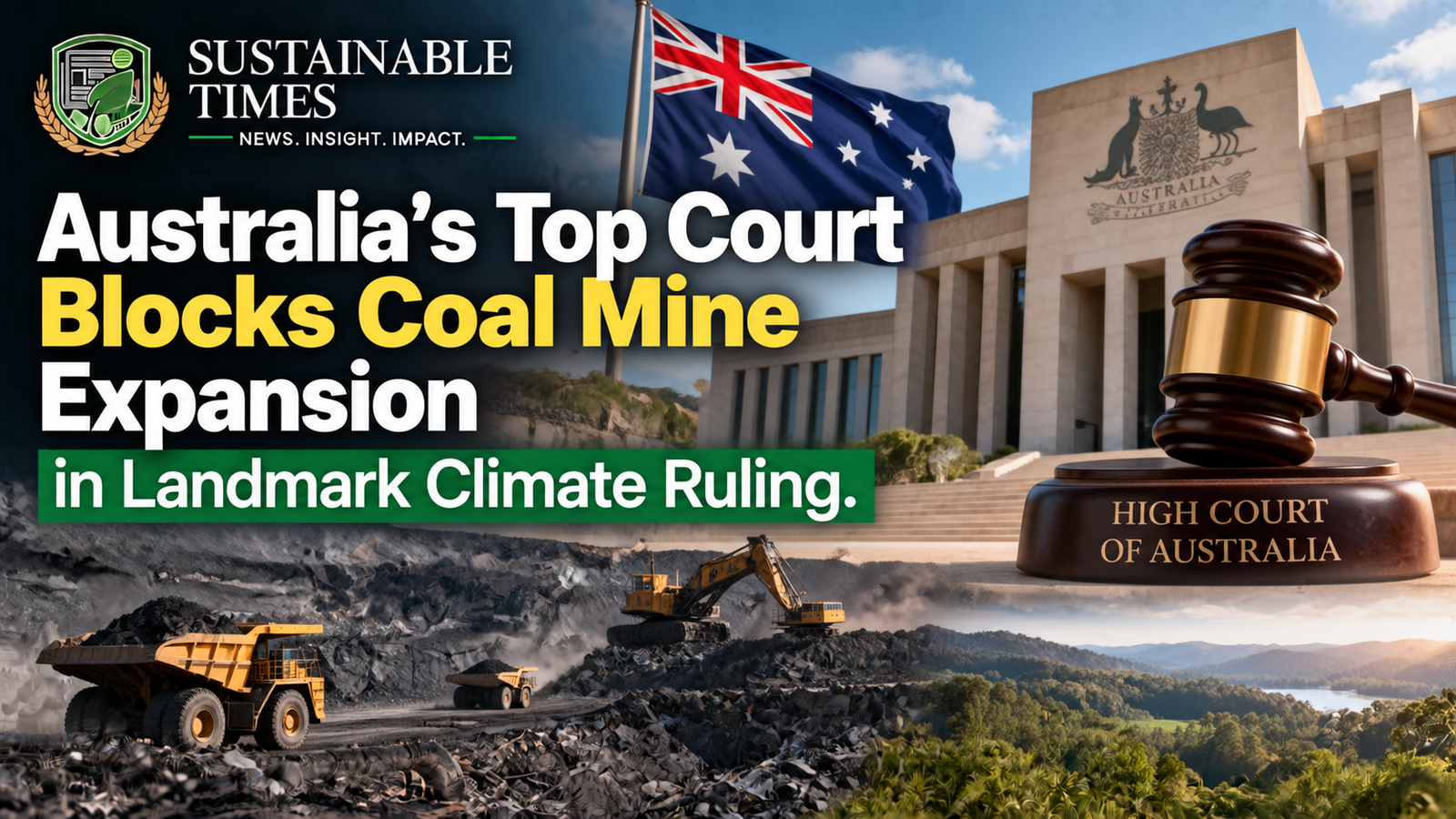
Australia’s highest court has blocked a major coal mine expansion after finding that planners failed to properly consider the climate impact of emissions released when exported coal is eventually burned. The decision could reshape how fossil-fuel projects are assessed.
Australia has just delivered a ruling that could make it harder for major fossil-fuel projects to treat climate impacts as someone else’s problem.
On October 7, the High Court of Australia dismissed an appeal by MACH Energy and upheld the blocking of an expansion of the Mount Pleasant coal mine in New South Wales. The case is significant not simply because one coal project has been stopped, but because the country’s highest court has now ruled on how climate emissions must be considered when authorities assess a fossil-fuel project.
The decision could become an important reference point for future coal and gas developments in Australia, one of the world’s major fossil-fuel exporters.
A mine that was supposed to run until 2048
MACH Energy wanted to extend the operating life of its Mount Pleasant mine in the Upper Hunter Valley by 22 years, taking it through to December 2048.
The proposed optimisation would also have allowed the mine to substantially increase production. According to Reuters, the expansion could have resulted in an additional 406 million tonnes of coal being extracted.
The existing mine approval was due to expire in December 2026.
Instead of becoming a long-term extension of one of Australia’s established coal operations, the project became the centre of a much bigger question: How far should the climate responsibility of a coal mine extend?
That question eventually reached the country’s highest court.
The emissions problem was mostly outside the mine
The key issue was something increasingly familiar in corporate climate reporting: Scope 3 emissions.
Scope 1 emissions come directly from an organisation’s operations. Scope 2 covers emissions associated with purchased energy. Scope 3 covers other indirect emissions across the value chain.
For a coal mine, that distinction matters enormously.
The emissions produced while operating the mine are only a fraction of the climate impact associated with the coal itself. The much larger emissions occur later, when customers burn the exported coal.
In the Mount Pleasant case, Scope 3 emissions represented approximately 98% of the project’s greenhouse-gas emissions.
The Independent Planning Commission of New South Wales had considered the project’s emissions, but the High Court found that it had failed to properly consider whether conditions could be imposed to minimise greenhouse-gas emissions to the greatest extent practicable.
Justice James Edelman said the commission had focused on only around 2% of the project’s emissions while failing to properly address the much larger Scope 3 component.
That distinction is at the heart of the ruling.
The court did not simply decide that every project producing Scope 3 emissions must automatically be rejected. Rather, the judgment concerned whether the relevant planning authority had properly performed the legal task required of it, including considering conditions to minimise greenhouse-gas emissions.
That makes the decision more consequential than a straightforward ban on one coal mine.
Why this matters beyond one Australian mine
For years, a central difficulty in climate policy has been the gap between where fossil fuels are extracted and where their emissions eventually occur.
A coal mine can operate in one country, ship its product across the world and generate most of its climate impact somewhere else.
The Mount Pleasant ruling challenges the idea that those downstream emissions can simply disappear from the planning conversation because they occur outside the mine’s physical boundaries.
That could matter for future projects across Australia’s resource economy.
Australia remains a major exporter of coal and liquefied natural gas. Reuters reported that the country shipped about 209 million tonnes of thermal coal in 2026-27, generating roughly A$31 billion in export earnings, while LNG exports were valued at about A$70 billion.
That makes the legal treatment of climate impacts more than an environmental question. It is also a question about investment, project approvals, export markets and Australia’s future energy economy.
The ESG implications are significant
The ruling also arrives at a time when investors and companies increasingly assess climate exposure through the entire value chain.
For companies involved in fossil fuels, Scope 3 emissions have long represented one of the hardest parts of climate strategy because they depend heavily on what customers do with the product after sale.
The Australian case brings that issue directly into project approval.
If regulators must seriously examine downstream climate impacts when deciding whether a project should proceed, fossil-fuel companies may face greater pressure to demonstrate how their projects fit within climate policy rather than relying primarily on operational emissions controls.
That does not mean Scope 3 emissions suddenly become easy to eliminate. For a coal mine, the fundamental problem is the intended use of the product itself.
But the ruling potentially changes the question regulators must ask.
Instead of asking only, “How much pollution will this project produce at the mine?”, authorities may increasingly have to ask, “What environmental consequences are reasonably connected to approving this project, and what can legally be done about them?”
That is a much bigger question.
Industry sees investment risk
Environmental groups welcomed the ruling, but Australia’s resources industry has warned that the decision could create additional uncertainty for future fossil-fuel investments.
The Western Australia Chamber of Minerals and Energy described the ruling as creating fresh uncertainty for LNG projects, while the Minerals Council of Australia argued that it could send a negative signal to investors.
That tension is unlikely to disappear.
Australia faces a difficult balancing act. Fossil-fuel exports remain economically important, while climate policy increasingly demands reductions in greenhouse-gas emissions.
The more climate considerations become embedded in planning law, the more those two priorities can collide at the project-approval stage.
A new question for fossil-fuel development
The importance of today’s ruling may ultimately depend on what happens next.
The High Court’s decision does not mean Australia has prohibited new coal or gas projects. It also does not establish that downstream emissions alone automatically make a project unlawful.
What it does establish is that, under the relevant New South Wales planning framework, authorities cannot simply overlook the question of whether conditions could minimise greenhouse-gas emissions to the greatest extent practicable.
That creates a potentially important precedent for future environmental assessments.
For climate campaigners, it is evidence that climate considerations can reach deeper into the legal machinery governing major infrastructure.
For investors, it adds another factor to project risk.
For fossil-fuel companies, it raises a difficult strategic question: Can a new project still make sense if its full climate footprint has to be considered before approval?
Australia’s High Court has not answered that question for every future project.
But today, it has made clear that the question cannot simply be ignored.
About The Author