For years, countries have negotiated climate agreements on one side of the table and trade agreements on the other.
Now those two worlds are colliding.
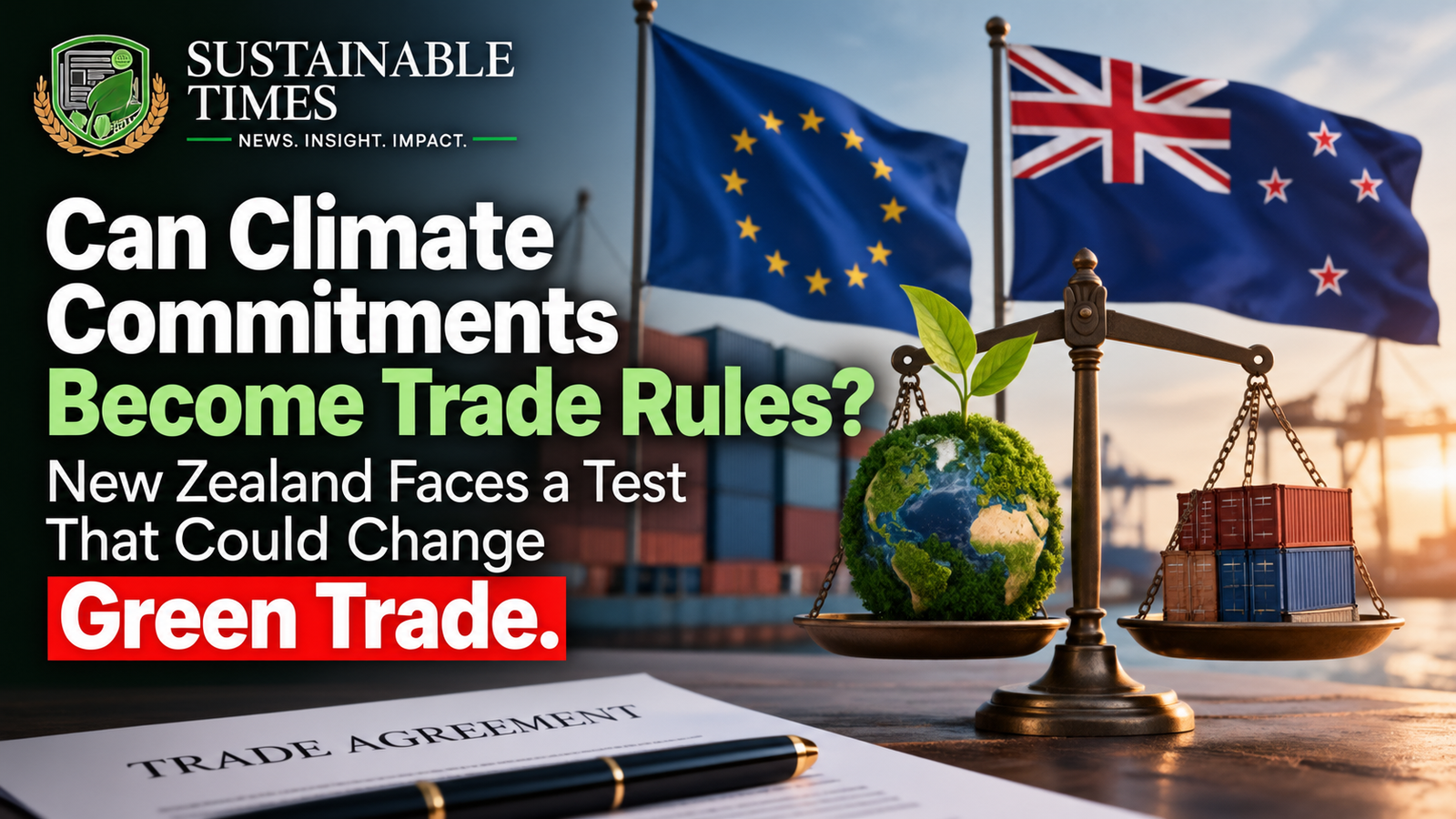
A Dutch environmental organisation has filed what it says is the first climate and environmental complaint under the European Union’s enforcement mechanism for trade agreements, targeting New Zealand’s commitments under its free trade agreement with the EU. The complaint argues that New Zealand has weakened climate protections after promising not to do so and has failed to uphold commitments connected to the Paris Agreement. New Zealand’s government rejects the allegations and says it remains compliant with the agreement.
The case could become much more important than a dispute between Brussels and Wellington.
It is testing a question that governments and businesses around the world are increasingly going to face:
What happens when a country’s climate policy becomes part of the legal bargain behind its access to a major export market?
This is not an ordinary climate complaint
The complaint was lodged by Both ENDS, a Dutch environmental justice organisation, through the European Commission’s Single Entry Point mechanism.
The mechanism allows civil-society organisations to raise concerns about whether a trading partner is complying with sustainability commitments contained in an EU trade agreement. Both ENDS says this is the first complaint submitted through the mechanism specifically on environmental and climate grounds.
That distinction matters.
The EU-New Zealand Free Trade Agreement is not simply about tariffs.
It contains a dedicated Trade and Sustainable Development chapter with legally binding commitments covering environmental protection, climate change, labour rights and other sustainability issues. The agreement entered into force on 1 May 2024.
The European Commission describes the agreement as its first trade deal incorporating its newer approach to enforceable sustainable-development commitments.
In other words, sustainability was deliberately written into the trade relationship.
Now someone is testing whether those words actually have consequences.
What does the complaint allege?
Both ENDS argues that New Zealand has taken several decisions since the trade agreement entered into force that amount to climate-policy regression.
Among the measures cited are a lower 2050 methane target, the exclusion of agriculture from carbon pricing, the reversal of an offshore oil and gas exploration ban, the creation of a NZ$200 million Gas Security Fund, plans for an LNG import facility and legislation that prevents certain climate-related claims against major greenhouse-gas emitters.
The organisation argues that these actions conflict with commitments contained in the EU-New Zealand agreement.
One of the provisions says the parties should not weaken environmental or labour protections in order to encourage trade or investment.
The agreement also contains commitments concerning implementation of the Paris Agreement.
That creates the heart of the dispute.
The question is not simply whether New Zealand has reduced emissions enough.
The question is whether specific changes to its climate and environmental policy are compatible with promises it made in a legally enforceable trade agreement.
New Zealand says the complaint is wrong
The New Zealand government has rejected the allegations.
Trade Minister Todd McClay said New Zealand is compliant with the EU trade agreement and argued that decisions about how the country meets its international climate commitments belong to its Parliament and government.
That means there are now two very different interpretations of the same treaty.
The complainants say New Zealand has weakened protections in ways the agreement prohibits.
The government says it has the right to determine how it meets its obligations and remains compliant.
The European Commission will ultimately have to determine whether the complaint merits further action.
And that makes this more than an activist-government disagreement.
It is becoming a test of how environmental provisions in modern trade agreements actually work.
Why the EU-New Zealand deal is so important
The agreement was designed to be different.
The European Commission says the deal contains binding and enforceable commitments to international environmental standards, including the Paris Agreement. It also includes cooperation on areas such as carbon pricing, deforestation, circular economy policies and sustainable management of natural resources.
It also contains a particularly important provision.
In serious cases involving core commitments, including the Paris Agreement, trade sanctions can potentially be used as a last resort.
That does not mean New Zealand is about to lose access to the European market.
It does not mean the complaint has already been upheld.
And it certainly does not mean sanctions are inevitable.
There is a long process before anything like that could happen.
But the possibility exists because the two sides deliberately put climate commitments inside the trade framework.
This could change the meaning of a “green trade agreement”
Trade agreements have traditionally focused on tariffs, market access, investment and rules for goods and services.
Environmental provisions were often included, but their enforcement could be politically difficult.
The EU has increasingly tried to change that model.
Its New Zealand agreement explicitly links trade with sustainable development and makes important environmental and climate commitments enforceable.
That approach could eventually become more common.
Imagine a future trade agreement where a country promises to stop deforestation, maintain environmental protections, implement climate commitments or improve labour standards.
If those promises become legally enforceable, governments cannot necessarily treat them as diplomatic language.
They become part of the commercial relationship.
That is a significant shift.
The consequences could reach exporters
This is where the story becomes particularly important for businesses.
New Zealand exports major agricultural products to Europe, including meat, dairy and fruit. The European Commission identifies agricultural products as a dominant part of New Zealand’s exports to the EU.
The trade agreement provides preferential access.
That creates a straightforward economic relationship.
Climate commitments → trade agreement → market access.
If a dispute eventually affected trade preferences, exporters could find themselves dealing with consequences arising from government-level climate policy decisions.
Again, that is not what has happened yet.
The complaint does not suspend the agreement.
But the possibility illustrates a broader trend.
Environmental policy is increasingly becoming part of market-access risk.
That could matter far beyond New Zealand
Consider a company selling agricultural products into Europe.
Its own production practices may be responsible.
It may have strong traceability.
It may follow environmental standards.
It may have a detailed sustainability strategy.
But if the exporting country’s wider environmental policies become the subject of a trade dispute, businesses could still face uncertainty.
That means sustainability risk is becoming increasingly connected to geopolitical and trade risk.
A company can no longer look only at its own emissions or supply chain.
It may also need to understand the regulatory direction of the country from which it sources.
For food, textiles, forestry, minerals and other internationally traded products, that could become increasingly important.
The EU is making sustainability part of commercial competition
There is another reason this case deserves attention.
The EU is not simply asking trading partners to reduce emissions.
It is building a broader framework in which environmental performance increasingly affects how international commerce operates.
The EU-New Zealand agreement includes provisions covering sustainable food systems, animal welfare, deforestation, circular economy issues, carbon pricing and fossil-fuel subsidies.
That creates a very different environment for businesses.
Sustainability is no longer necessarily something companies deal with after entering a market.
It can influence the rules under which the market itself operates.
This is particularly relevant for exporters in agriculture and food.
The EU-New Zealand agreement specifically includes cooperation on food loss and waste, pesticides, fertilisers and the resilience of food supply chains.
The direction is clear.
Trade policy and sustainability policy are becoming increasingly difficult to separate.
The case is also about credibility
New Zealand has long promoted an international image built partly around environmental credentials.
That makes the dispute politically sensitive.
The complaint argues that changes in domestic climate policy have moved away from commitments New Zealand made when it entered the trade agreement.
The government strongly disagrees.
The outcome could therefore affect more than legal obligations.
It could influence how trading partners assess New Zealand’s credibility.
This is one reason experts quoted by New Zealand’s Science Media Centre have described the case as a significant test of the way environmental commitments are incorporated into trade agreements.
If the EU takes the complaint seriously, other governments will be watching.
If the complaint fails, governments will also be watching.
Either way, the precedent could matter.
The process will not be quick
This is not a case where a complaint arrives today and a trade penalty appears tomorrow.
The European Commission first has to assess the complaint.
If it considers the case valid, the process can move into engagement and consultations with New Zealand.
If the dispute cannot be resolved, an independent expert process can follow.
Only after further stages could more serious consequences become possible. Experts quoted by the New Zealand Science Media Centre describe the procedure as a multi-stage process that could take considerable time.
That means businesses should not interpret today’s development as an immediate threat to EU-New Zealand trade.
The more significant issue is what the case could establish over time.
There is a bigger question hiding behind the dispute
Should countries be able to change environmental laws after signing trade agreements?
Of course they need some ability to change policy.
Governments cannot freeze environmental regulation forever.
Technologies change.
Scientific understanding changes.
Economic conditions change.
Public priorities change.
The real question is where the line sits between legitimate policy changes and weakening environmental protections to support trade or investment.
That line is now being tested.
And because the EU-New Zealand agreement was deliberately designed with enforceable sustainability provisions, the answer could influence future trade negotiations.
Climate policy may become a trade-policy issue everywhere
For companies, this is perhaps the most important lesson.
Climate policy used to sit mainly with environmental ministries.
Trade policy sat with commerce and foreign affairs departments.
Energy policy sat somewhere else.
Agriculture had its own institutions.
Those boundaries are becoming less useful.
A decision to expand oil and gas exploration can affect climate commitments.
Climate commitments can affect trade agreements.
Trade agreements can affect exporters.
Export rules can affect farmers.
Farmers can affect food supply chains.
The systems are increasingly connected.
That means businesses operating internationally need to watch sustainability regulation not just as an environmental issue, but as a commercial issue.
It could also strengthen the case for credible sustainability standards
There is a useful lesson here for businesses.
If governments and trade agreements are increasingly demanding evidence of environmental performance, companies will need reliable ways to demonstrate what they are actually doing.
That means traceability, credible certification, transparent supply chains and verifiable environmental claims could become increasingly important.
The direction of travel is away from simply saying:
“We are sustainable.”
The harder question is:
“Can you demonstrate it?”
That shift is already visible in international trade and sustainability regulation.
The New Zealand case adds another dimension.
Governments themselves may increasingly have to demonstrate that their environmental commitments are not merely promises written into agreements.
The danger of turning sustainability into paperwork
There is also a legitimate concern.
If every environmental commitment becomes another legal obligation, governments and businesses could end up focusing heavily on compliance paperwork rather than actual environmental outcomes.
That would defeat the purpose.
A trade agreement should not become sustainable simply because it contains the word “climate” dozens of times.
The real test is whether the rules lead to better outcomes.
Cleaner energy.
Lower emissions.
Healthier ecosystems.
Stronger food systems.
Better labour conditions.
More resilient economies.
That is ultimately what gives sustainability provisions their value.
But without enforcement, promises can become meaningless
The opposite problem is equally serious.
If governments make environmental commitments in trade agreements and then face no meaningful consequences for ignoring them, businesses and civil society have little reason to believe those commitments are durable.
That is why this case matters.
The EU has created an enforcement mechanism.
Now someone is testing it.
The outcome will tell the world something about how seriously modern trade agreements treat environmental commitments.
The next generation of trade deals may look very different
The old model of trade policy was relatively straightforward.
Reduce tariffs.
Open markets.
Increase investment.
Modern trade policy is becoming more complicated.
Climate.
Biodiversity.
Deforestation.
Labour rights.
Circular economy.
Supply-chain resilience.
Carbon pricing.
Food systems.
All of these issues increasingly appear inside international economic agreements.
The EU-New Zealand agreement is an early example of that model.
Its first major climate complaint could therefore become an important case study for future negotiations.
Governments negotiating new trade agreements will be watching closely.
So will exporters.
So will environmental organisations.
And so will investors.
A trade dispute has suddenly become a climate test
The complaint against New Zealand may ultimately fail.
The European Commission may decide that the allegations do not meet the treaty’s legal threshold.
The two sides may resolve the matter without sanctions.
Or the case could develop into a much more consequential dispute.
At this stage, it is too early to know.
But the underlying change is already visible.
Climate commitments are moving from conference declarations into commercial agreements.
That means governments will increasingly have to consider the trade consequences of environmental policy choices.
Businesses will have to watch environmental regulation as closely as tariffs.
And sustainability commitments may become something much more serious than corporate or diplomatic promises.
They may become part of the legal architecture of global commerce.
The real story is bigger than New Zealand
The most interesting question is not whether New Zealand wins or loses this particular dispute.
It is whether the world is entering an era in which market access depends partly on environmental credibility.
If that happens, sustainability will no longer sit at the edge of international trade.
It will sit inside it.
For exporters, that could mean new risks.
For governments, new responsibilities.
For businesses, new compliance expectations.
And for environmental policy, something it has often lacked:
a direct connection to the economic rules governing international markets.
The New Zealand case is only the beginning.
About The Author