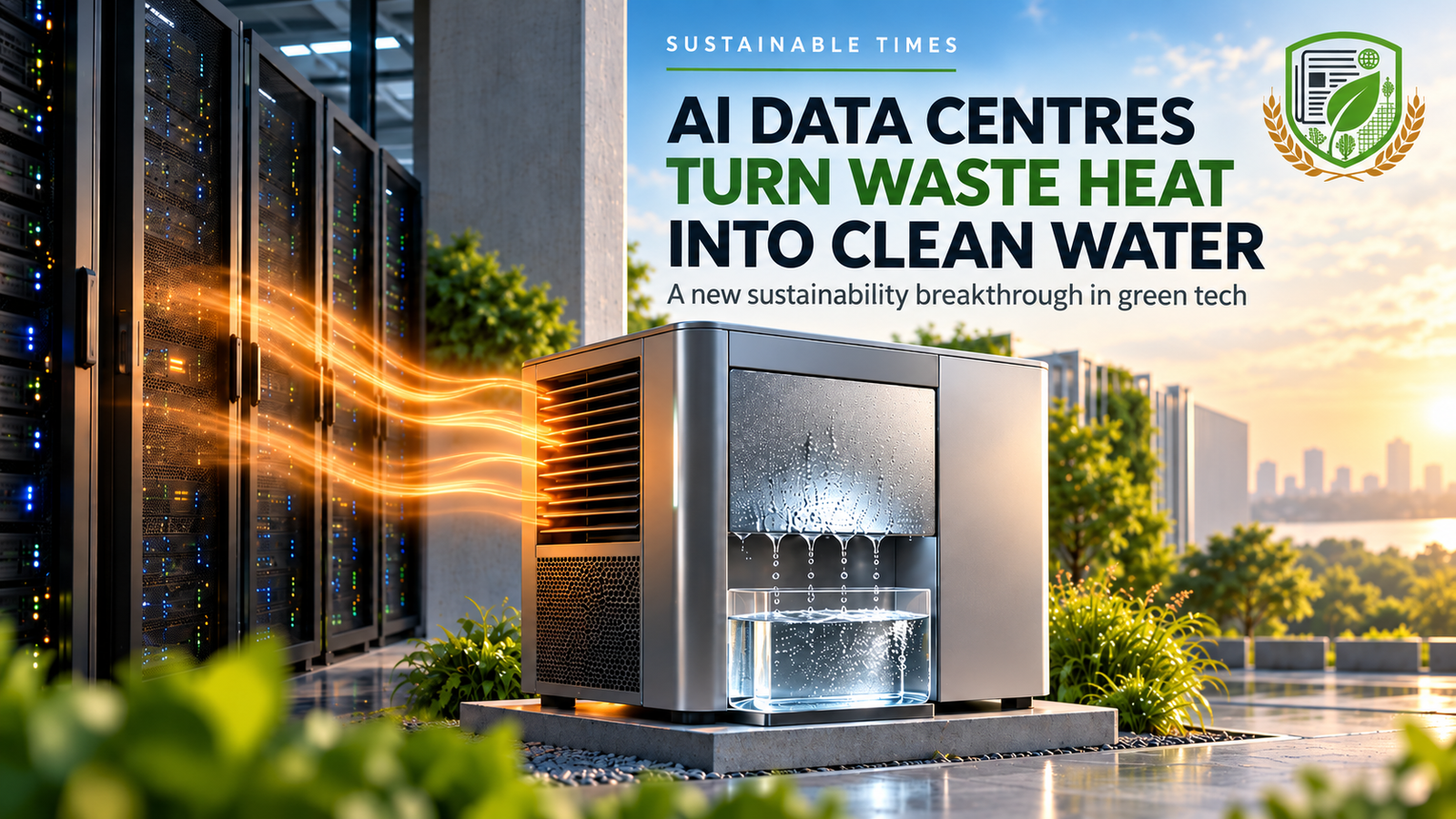
Artificial intelligence has two growing environmental problems: it consumes enormous amounts of electricity, and the infrastructure powering it often needs substantial quantities of water to stay cool.
But what if one of those problems could help solve the other?
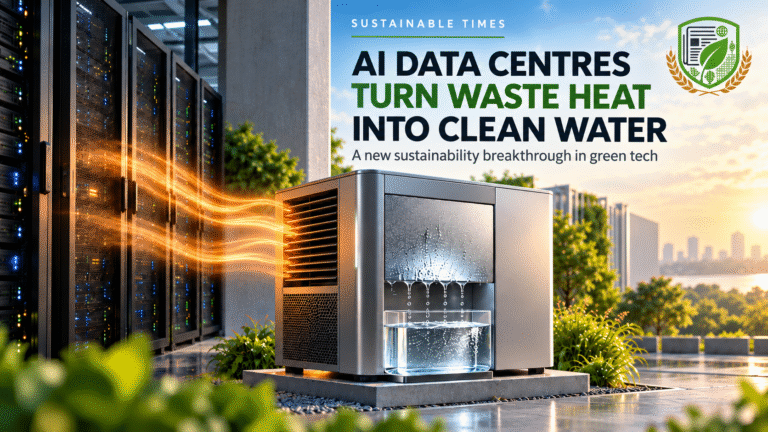
A California-based startup called Atoco is developing a technology that uses waste heat from data centres to extract water directly from the atmosphere. The system relies on a class of highly porous materials known as metal-organic frameworks (MOFs), which can capture moisture from the air even under relatively dry conditions.
The technology gained fresh attention after a report published by WIRED on 7 October described the company’s latest off-grid prototype. Atoco says its demonstration system can produce up to 300 litres of water per day, while a planned commercial version aims for approximately 1,000 litres daily.
What makes the project particularly interesting is that its founder, chemist Omar Yaghi, shared the 2025 Nobel Prize in Chemistry for pioneering the development of metal-organic frameworks.
Now, the science behind that Nobel Prize is moving toward a practical sustainability application.
Turning a Problem Into a Resource
Data centres generate considerable heat while running the servers that support artificial intelligence, cloud computing and digital services.
Operators must continuously remove that heat to protect sensitive equipment and maintain reliable performance. Depending on their cooling systems, they may also consume large volumes of water.
Atoco sees an opportunity in the heat that data centres normally discard.
Instead of treating it solely as something to remove, the company wants to use low-temperature waste heat as an input for water production.
Its atmospheric water-harvesting technology captures moisture from surrounding air and uses heat to release that moisture as water.
The company says the system can operate with heat temperatures as low as approximately 38°C (100°F).
That makes waste heat from data centres and other industrial facilities a potentially useful energy source.
The concept could create a more productive relationship between industrial cooling and water management, although Atoco still needs to demonstrate how well it works at commercial scale.
The Science Behind Water From Air
At the centre of the technology are metal-organic frameworks, or MOFs.
These materials contain networks of microscopic pores that provide an exceptionally large internal surface area.
Scientists can design their molecular structures to interact with specific substances. Some MOFs attract water molecules, allowing them to capture moisture from air.
Once the material has collected enough moisture, a relatively small amount of heat can release the water molecules for collection.
Unlike conventional systems that primarily rely on cooling humid air until water condenses, this approach uses the adsorption properties of specially engineered materials.
That difference becomes particularly interesting in dry environments, where conventional atmospheric water generation can require substantial electricity.
Atoco’s system uses heat to drive the main water-harvesting cycle, potentially avoiding the need for grid electricity for that process.
However, the wider equipment may still require auxiliary systems, and the technology needs a dependable source of thermal energy.
It does not create water without an energy input.
From Nobel Prize Research to Industrial Technology
The research has a history that extends well beyond the current AI boom.
Omar Yaghi spent decades developing metal-organic frameworks and exploring how their molecular structures could capture different substances.
In 2025, Yaghi shared the Nobel Prize in Chemistry with Susumu Kitagawa and Richard Robson for their contributions to the field.
The Royal Swedish Academy of Sciences highlighted the ability of these materials to capture carbon dioxide, store gases and harvest water from dry air.
Atoco is now attempting to turn that scientific capability into commercial equipment.
During a demonstration at the company’s Irvine facility, engineers operated a large prototype using a simulated source of industrial waste heat.
The experiment illustrates an important transition in materials science: moving from discovering useful molecular properties to building equipment that industries can actually operate.
But successful demonstrations are only one stage.
Manufacturing, reliability, maintenance and cost will ultimately determine whether the technology becomes commercially useful.
Why Water Could Become AI’s Next Big Sustainability Challenge
The environmental debate around artificial intelligence has focused heavily on electricity demand.
That discussion remains important, but water is becoming an equally significant concern.
Many data centres depend on water-consuming cooling systems, while the facilities themselves are expanding into regions already experiencing water stress.
This creates difficult decisions for local authorities.
A new data centre may bring investment, employment and digital infrastructure, but it can also increase competition for electricity and water.
Atoco’s approach could offer an additional water source without directly drawing the same volume from municipal networks, reservoirs or groundwater.
The company proposes using the recovered water for cooling and other industrial processes.
In suitable locations, it could also provide supplemental water to nearby communities.
However, the technology’s ability to reduce pressure on local water supplies will depend on how much water it can produce relative to a facility’s actual consumption.
A small prototype cannot yet solve the water requirements of a hyperscale data centre.
The Biggest Challenge Is Scale
Atoco’s current waste-heat demonstration system can generate up to 300 litres of water per day.
That is a meaningful engineering milestone, but large data centres can consume vastly greater quantities of water.
The company is therefore developing systems that could produce around 1,000 litres per day per unit, with the possibility of installing multiple units together.
According to the latest reporting, Atoco has also conducted five on-grid prototype trials with partners in the United States and Gulf Cooperation Council countries.
The company hopes to begin taking commercial orders before the end of 2026 and is discussing potential data-centre pilot projects with technology companies.
Those plans remain subject to further testing.
The economics also present a challenge. Atoco estimates a water-production cost of approximately $5 per metric tonne, while some modern desalination facilities can deliver water at lower costs.
For atmospheric water harvesting to compete, it will need to demonstrate advantages in suitable locations, particularly where freshwater infrastructure is limited but usable waste heat is readily available.
Could This Technology Help Water-Stressed Communities?
The wider opportunity extends beyond artificial intelligence.
Industrial facilities generate waste heat across many sectors, including manufacturing, energy production and processing.
If atmospheric water-harvesting systems can use that heat efficiently, they could potentially supplement water supplies in areas where conventional infrastructure is expensive or difficult to develop.
Remote communities are another possible application.
Atoco’s founder has spoken publicly about experiencing water scarcity while growing up in Jordan, where his family depended on periodic water deliveries.
That experience helped shape his interest in technologies that could give communities more control over their water supply.
Still, remote deployment presents practical challenges.
Locations without industrial waste heat would need another reliable energy source. Equipment would require maintenance, and any water intended for drinking would need appropriate quality testing and treatment.
These considerations will determine where the technology makes economic and environmental sense.
The Circular Economy Opportunity Hidden Inside Data Centres
One of the most compelling aspects of this development is its potential to make better use of an industrial by-product.
Data centres currently spend considerable resources managing heat.
Atoco wants to turn some of that otherwise discarded thermal energy into a productive input.
If the approach succeeds, a portion of the heat generated by computing could support water production rather than simply being released into the surrounding environment.
That would not eliminate the energy or water footprint of AI.
But it could improve resource efficiency.
The idea also reflects a broader direction in sustainable industrial design: facilities increasingly need to consider not only what resources they consume, but whether their unused energy and material streams can serve another purpose.
In that sense, Atoco is exploring a potentially useful connection between two industries that rarely appear together in sustainability discussions.
Water production and digital computing.
The Next Test Will Happen Outside the Laboratory
Atoco’s technology remains at an early commercial stage.
The company has demonstrated that its materials can capture water from air and release it using low-grade heat. It still needs to prove that larger installations can deliver reliable output, competitive costs and acceptable environmental performance over time.
Those results will matter more than ambitious production targets.
A successful system could reduce demand for conventional water supplies at some industrial facilities and give operators another way to reuse waste heat.
An unsuccessful scale-up would illustrate how difficult it remains to turn promising laboratory materials into commercially viable infrastructure.
Either outcome will provide valuable lessons for the rapidly developing atmospheric water-harvesting industry.
For now, the project offers an unusual glimpse of what the next generation of sustainability innovation could look like.
Instead of inventing an entirely new source of energy, engineers are finding ways to use energy that industries already discard.
Instead of drawing all their water from rivers or reservoirs, facilities may eventually be able to recover part of it from the atmosphere.
And instead of treating AI infrastructure solely as an environmental burden, companies could begin exploring how its waste streams might support other essential resources.
The most interesting part of Atoco’s technology is not simply that it can pull water from air. It is the possibility that the heat we currently throw away could become a resource in an increasingly water-stressed world.
About The Author