The world’s largest climate negotiations have reached a critical moment, and an unexpected group is demanding stronger action.
Not environmental campaigners. Not climate scientists. This time, some of the world’s biggest businesses are asking governments to move faster.
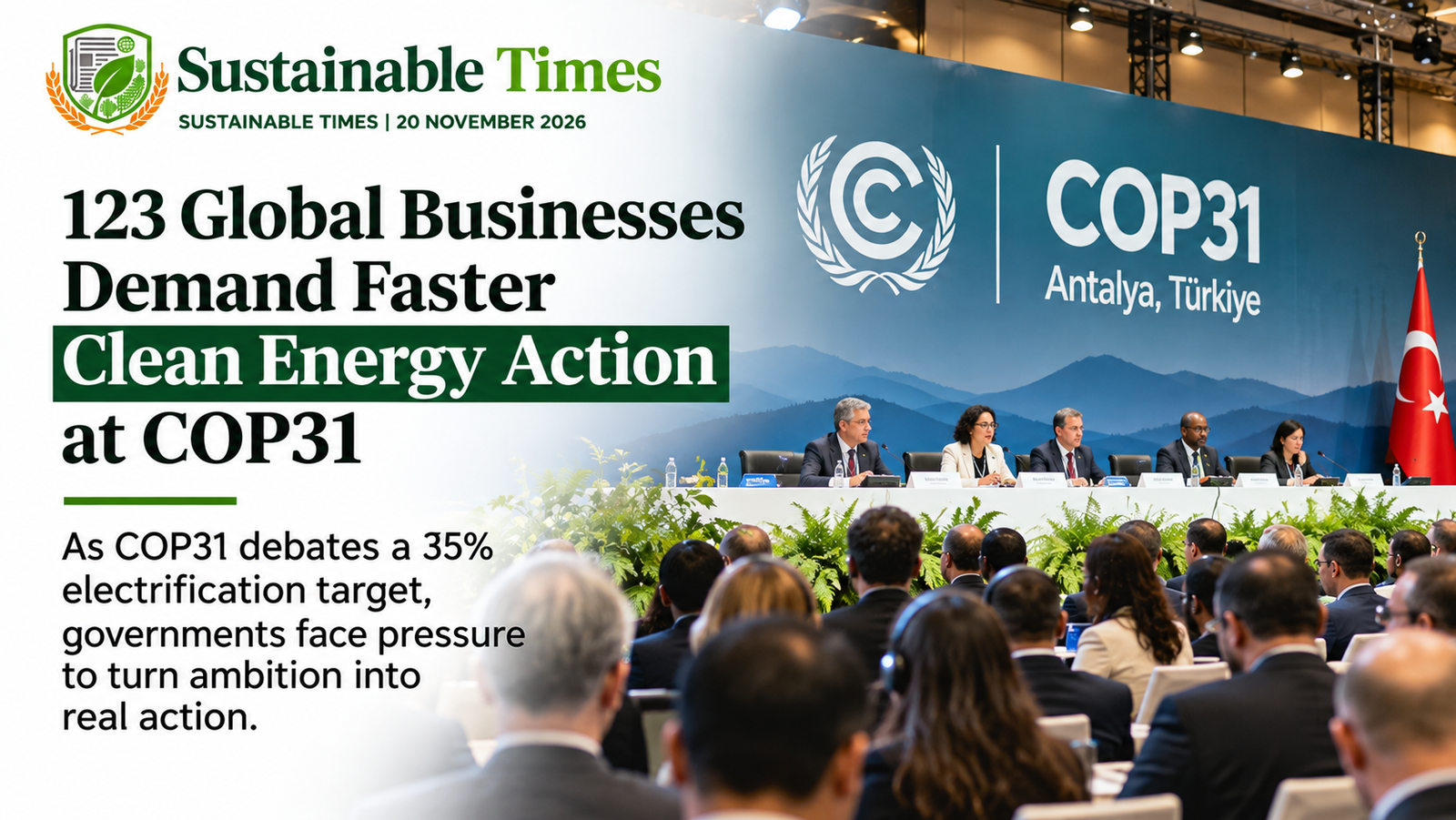
As COP31 approaches its scheduled conclusion in Antalya, Türkiye, 123 companies, investors and business organisations have urged world leaders to accelerate the transition toward electricity-powered economies.
The group includes major names such as Siemens, BNP Paribas, Fortescue, ING and Nestlé. Their intervention follows the publication of a revised climate agreement that preserves an ambitious electrification target but weakens the language asking governments to achieve it.
At the centre of the debate is a proposal to increase electricity’s share of global final energy consumption to 35% by 2035, compared with roughly one-fifth today.
But the negotiations have taken a controversial turn.
While governments continue discussing the expansion of electrification, the latest draft agreement has removed explicit references to transitioning away from fossil fuels.
That creates a difficult contradiction.
The world wants to use more electricity to fight climate change. But what happens if that electricity still comes from coal, oil and gas?
Why Businesses Are Demanding Faster Climate Action
For years, the business community has often been portrayed as an obstacle to stronger climate regulation.
Some industries have resisted environmental requirements because they fear higher operating costs, expensive infrastructure upgrades or reduced competitiveness.
But the latest intervention at COP31 reveals another side of the economic debate.
Companies investing in electrification increasingly want governments to establish clear, predictable policies.
Manufacturers need to know whether future industrial equipment should run on electricity or fossil fuels. Transport operators must decide whether to invest in electric vehicle fleets and charging networks. Utilities need to plan electricity infrastructure that could operate for decades.
These decisions involve substantial capital.
Businesses cannot easily reverse investments in factories, industrial machinery or power infrastructure once construction begins.
That makes policy uncertainty expensive.
Andrew Prag, managing director for policy at the We Mean Business Coalition, which organised the statement, emphasised that businesses need certainty to make investment decisions.
The coalition argues that stronger government commitments would encourage investment in clean power, electric transport, industrial equipment and supporting infrastructure.
The message is straightforward: businesses are increasingly prepared to electrify, but many want clearer signals before committing additional capital.
What Does the 35% Electrification Target Actually Mean?
The proposal being discussed at COP31 could become an important milestone in global energy policy.
Electricity currently supplies approximately 20% to 23% of the world’s final energy consumption, depending on the measurement and reporting period.
Most remaining energy demand comes from fuels used directly in transport, industry, buildings and other activities.
Cars burn petrol and diesel. Industrial facilities use coal and natural gas. Buildings rely on various fuels for heating and cooking.
Increasing electricity’s share to 35% by 2035 would require major changes across these sectors.
Electric vehicles would replace more conventional engines. Heat pumps and electric heating systems would reduce direct fuel consumption in suitable buildings. Industries would adopt electric machinery and production processes wherever technically and economically practical.
The potential environmental benefits are substantial.
Electric motors often convert energy into useful work more efficiently than combustion engines. Heat pumps can deliver several units of heat for each unit of electricity consumed under suitable conditions.
Electrification can therefore reduce overall energy requirements for certain activities.
However, the benefits depend heavily on how electricity is generated.
A transport system powered by renewable electricity offers a different emissions profile from one dependent on coal-fired power.
That distinction has become one of the central disagreements at COP31.
The Missing Words That Have Alarmed Climate Campaigners
The latest negotiating draft contains a striking omission.
Earlier versions included language encouraging countries to accelerate their transition away from fossil fuels.
The revised document released on 19 November removed those references.
It also weakened language that had called on individual governments to contribute directly toward the proposed electrification target.
The changes appear intended to help negotiators reach agreement among countries with sharply different economic and energy interests.
Some governments support stronger language on fossil-fuel reduction, while others remain concerned about energy security, development priorities and the financial costs of transition.
The result is a draft that recognises the benefits of electrification without clearly establishing how rapidly countries should reduce fossil-fuel dependence.
Climate campaigners warn that this could weaken the environmental value of the agreement.
If electricity demand increases while fossil-fuel generation remains substantial, the resulting emissions reductions may fall short of what climate goals require.
The problem is not electrification itself.
It is the possibility of treating electrification as a complete climate solution without ensuring that electricity generation becomes progressively cleaner.
Clean Electricity Is Only Half the Challenge
The global energy transition involves two connected transformations.
First, countries must increase the supply of low-emission electricity.
Second, they must replace direct fossil-fuel use in sectors where electricity can provide an efficient alternative.
Neither transformation can deliver its full potential without the other.
A country might install large amounts of solar and wind capacity but struggle to reduce emissions if transport and industrial systems continue depending heavily on fossil fuels.
Conversely, a country could expand electric vehicles and industrial electrification while continuing to generate much of its electricity from coal.
That would still produce benefits in some applications, but the climate outcome would depend on the electricity mix and the efficiency of the technologies involved.
The strongest strategy combines clean-power expansion with electrification and improvements in energy efficiency.
It also requires electricity networks capable of handling changing demand.
This is why the COP31 debate matters beyond the wording of a diplomatic document.
The policies governments establish now will influence how businesses design and finance energy systems for years to come.
A New UN Package Shows That Electrification Is Already Accelerating
Despite the disagreements inside the formal negotiations, another development at COP31 provides evidence of growing momentum.
On 19 November, UN Climate Change and its partners launched the COP31 Electrification Delivery Package.
The initiative brings together existing progress, investment plans, new commitments and partnerships intended to expand electrification across energy, transport and industry.
According to the UN announcement, the package includes actions involving more than 150 countries plus the European Union, 37 cities and over 260 businesses across six continents.
The participating businesses represent more than $4 trillion in combined annual revenue.
The package also highlights infrastructure development.
Members of the Utilities for Net Zero Alliance reported deploying more than 21,000 kilometres of electricity grid infrastructure during 2025.
They also announced combined annual investment plans of at least $156 billion across electricity grids, renewable generation and energy storage.
These figures demonstrate the scale of activity already underway.
However, the package combines completed work with future targets, investment intentions and announced partnerships.
Not every project has been financed, built or delivered.
Its significance lies in showing that electrification is increasingly becoming a mainstream economic strategy, even as governments disagree over the language of international climate commitments.
Electric Freight and Public Transport Are Moving Forward
Transport provides one of the clearest examples of the shift.
The UN package identifies 13 zero-emission freight corridors under development across six continents, covering more than 29,000 kilometres of roads.
These corridors aim to support cleaner freight transport by expanding the infrastructure needed for zero-emission vehicles.
Electric buses are another area of progress.
Six cities have committed to introducing approximately 2,200 additional electric buses in 2027.
These developments matter because commercial transport and public mobility depend on reliable infrastructure.
A company may want to replace diesel trucks with electric alternatives, but the investment becomes difficult if suitable charging facilities do not exist along major freight routes.
Similarly, cities need dependable charging and maintenance systems before they can expand electric bus fleets.
Electrification therefore requires coordinated investment in vehicles, power networks and operational systems.
The transition cannot succeed through vehicle sales alone.
The Electricity Grid Could Become the Biggest Bottleneck
One of the most important challenges is the infrastructure that connects electricity generation with consumers.
Solar farms, wind turbines and other power plants may produce large quantities of electricity, but that power must reach homes, factories and transport systems reliably.
As countries electrify more activities, electricity demand will grow and its daily patterns will change.
Distribution networks may need upgrades to accommodate vehicle charging, electric heating and industrial loads.
Transmission systems must also connect new generation capacity with major consumption centres.
Energy storage and demand-management technologies can help balance supply and demand.
But these improvements require significant investment.
The International Renewable Energy Agency estimates that global grid investment must more than double, reaching approximately $10 trillion cumulatively by 2035.
That is one reason companies are pushing governments for clearer policies.
Building an electricity network is not a short-term investment.
Utilities and infrastructure developers need confidence that future demand, regulation and financing arrangements will support the projects they undertake.
Without adequate grids, even ambitious clean-energy targets can become difficult to achieve.
Why India Is Cautious About a Global Target
India has emerged as one of the countries expressing concerns about placing new top-down electrification targets into the negotiated COP31 agreement.
The issue is not simply opposition to electric technology.
India is already expanding renewable electricity, electric mobility and domestic clean-energy manufacturing.
However, its policymakers have raised questions about whether global targets adequately reflect differences in national circumstances.
Developing economies face substantial challenges involving affordable electricity, industrial growth, infrastructure investment and access to finance.
A wealthy country with mature electricity networks may be able to expand electrification under very different conditions from a country still working to provide reliable energy access to all communities.
India and other developing-country negotiators have therefore emphasised flexibility and financial support.
They argue that new international ambitions should not create obligations without addressing the investment required to achieve them.
This is an important distinction.
A global target can provide direction, but its implementation must account for the economic and infrastructure realities of different countries.
For India, the practical challenge will be expanding clean electricity while supporting industrial development, affordable energy and reliable power supplies.
Climate Finance Is Still a Major Obstacle
Electrification requires enormous investment, particularly in developing markets.
Governments and businesses must finance renewable power plants, electricity grids, charging networks, storage systems and industrial equipment.
Some projects can generate attractive long-term returns.
Others face high upfront costs, regulatory uncertainty or limited access to affordable loans.
At COP31, financial institutions and development organisations have announced initiatives intended to address these barriers.
One example is AMPLIFi, a financing mechanism associated with the Climate Investment Funds.
The programme has announced an initial £400 million contribution from the United Kingdom and aims to mobilise up to £5 billion for clean electricity, grids, storage and electrification in emerging markets and developing economies.
Such mechanisms could help make projects more attractive to investors.
However, announced financing ambitions should not be confused with money already deployed or environmental results already achieved.
The effectiveness of these programmes will depend on how quickly they support viable projects and whether the benefits reach communities and industries that need them.
The Business Case Is Becoming Harder to Ignore
The companies supporting faster electrification are not relying exclusively on environmental arguments.
They also see potential economic advantages.
Electric technologies can reduce operating costs in suitable applications, improve energy efficiency and limit exposure to volatile fossil-fuel prices.
For businesses operating vehicle fleets, electric mobility may offer lower energy and maintenance costs over time.
For manufacturers, electrified equipment can provide efficiency and operational benefits, depending on the process.
Countries that rely heavily on imported fossil fuels may also strengthen energy security by producing more electricity from domestic renewable resources.
However, these benefits are not automatic.
Electricity prices, equipment costs, financing conditions and infrastructure availability vary widely.
Some industrial processes remain difficult or expensive to electrify.
Businesses therefore need realistic policies that support investment without assuming every sector can transition at the same speed.
The growing corporate demand for electrification reflects these economic opportunities as well as the pressure to reduce emissions.
The Final COP31 Agreement Is Still Uncertain
As of 20 November, the revised COP31 text remains a negotiating draft.
Governments have not yet adopted the proposed 35% electrification goal as a final consensus decision.
Nor has the removal of fossil-fuel language from the draft necessarily settled the issue for the final agreement.
Negotiators are still working through disagreements involving mitigation, adaptation finance, just transition policies and other climate priorities.
The COP31 presidency has urged countries to find compromises before the summit concludes.
That means the final outcome could differ from the draft currently under discussion.
For businesses and investors, the uncertainty is frustrating.
For governments, it reflects the difficulty of negotiating policies among nearly 200 countries with different economic circumstances.
The next decisions will show whether COP31 can turn the growing interest in electrification into a meaningful international commitment.
Looking Ahead: The Energy Transition Needs More Than a Target
The debate at COP31 reveals an important shift in global climate policy.
Electrification is no longer simply an emerging technology trend.
It is becoming a major industrial, financial and economic strategy.
Companies are investing in electric vehicles, clean power, grid infrastructure and industrial equipment because they see long-term opportunities.
But those investments depend on government policies that provide confidence and support.
The proposed 35% target could help establish a common direction.
However, its environmental value will depend on whether countries expand low-emission electricity, improve infrastructure and reduce fossil-fuel dependence.
The world cannot measure progress solely by the share of energy supplied through electricity.
It must also examine the emissions associated with producing that electricity.
The 123 businesses calling for stronger action have made one thing clear: parts of the private sector are ready to move faster.
Now governments must decide whether they can provide the policy certainty and financial conditions needed to turn that momentum into lasting progress.
The future of clean energy will not be decided simply by how much more electricity the world uses. It will be decided by how clean that electricity becomes—and whether governments make it possible for everyone to benefit from the transition.
About The Author