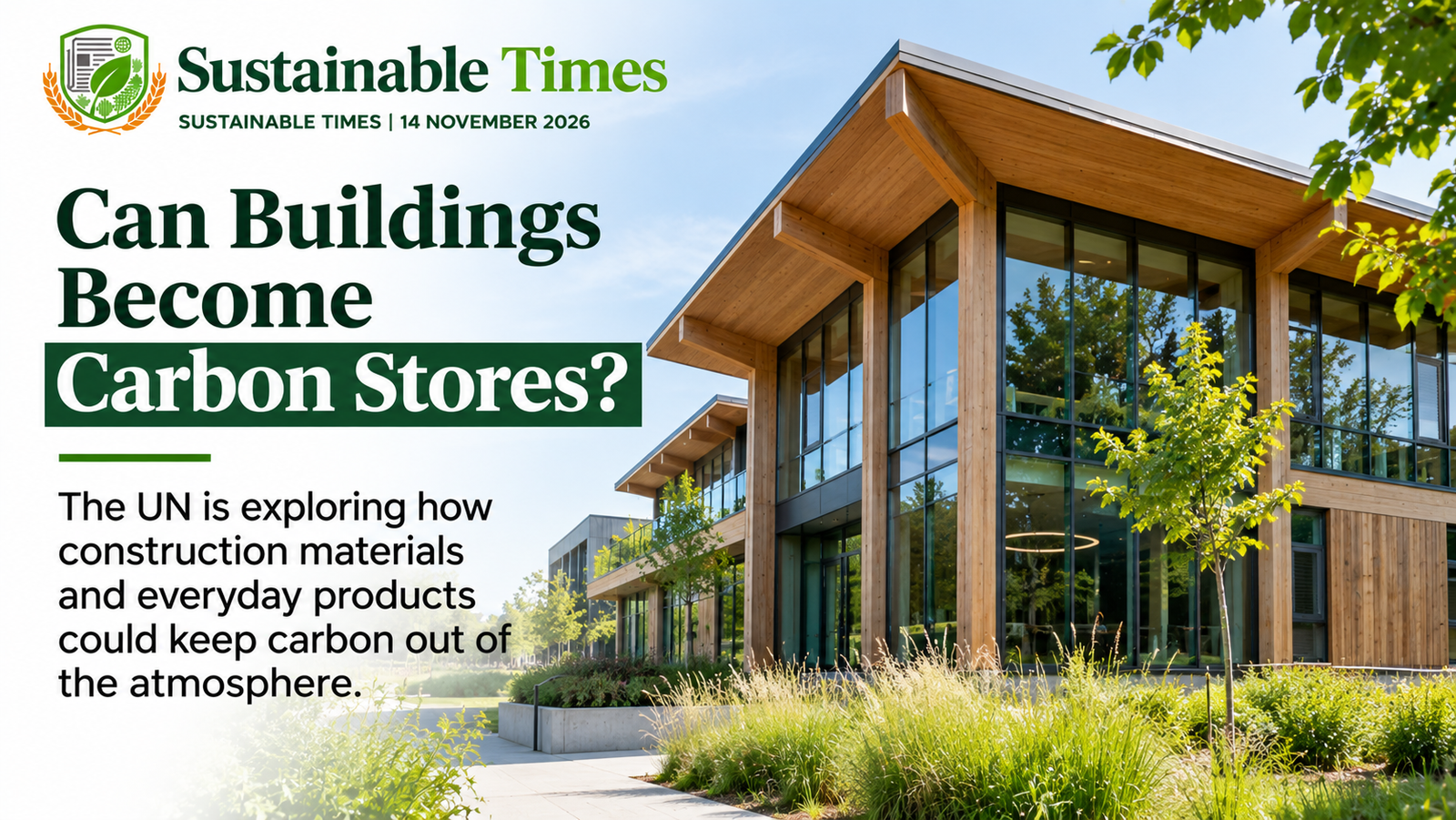
Imagine a future where the walls of a building do more than provide shelter, the materials inside a bridge do more than support traffic, and everyday manufactured products help keep carbon dioxide out of the atmosphere.
It sounds like an ambitious idea, but scientists and environmental policymakers are beginning to examine how it could work.
At the ongoing COP31 climate summit in Antalya, Türkiye, the United Nations Environment Programme (UNEP) has introduced a new approach to carbon management that could change how industries think about the materials they produce.
A working paper titled Retaining Atmospheric and Biogenic Carbon in the Global Materials Economy, published on 12 November and presented at COP31 on 13 November 2026, explores whether construction materials, infrastructure and manufactured products could become long-term stores of carbon.
Instead of focusing exclusively on reducing emissions during manufacturing, the research examines how industries might incorporate carbon captured from the atmosphere or obtained from sustainably managed biological resources into useful materials.
If these approaches prove environmentally credible and commercially practical, they could create new opportunities for the construction and manufacturing sectors.
But the idea also raises an important question.
Can the materials we use to build the modern world become part of the solution to climate change, rather than simply contributing to the problem?
The Climate Problem Hidden Inside Buildings
Buildings are essential to modern life, but constructing them requires enormous quantities of materials.
Concrete forms foundations, walls and infrastructure. Steel provides structural strength, while timber, insulation, glass and manufactured products complete the built environment.
Producing these materials consumes energy and often generates greenhouse-gas emissions.
Cement manufacturing is particularly challenging because carbon dioxide comes from both the energy used in production and the chemical process that converts limestone into cement ingredients.
Steelmaking also creates substantial emissions when producers rely on coal-based production methods.
For years, the construction industry’s sustainability efforts have focused on reducing these impacts.
Manufacturers have improved energy efficiency, experimented with lower-carbon production methods and increased the use of recycled materials.
Architects and engineers have also begun evaluating the environmental footprint of buildings across their entire life cycles.
However, UNEP’s new working paper explores another possibility.
What if some materials could retain carbon that originally came from the atmosphere?
That would introduce an additional role for construction products in climate strategies.
The building would not merely consume materials with a lower environmental footprint. Certain materials could also serve as reservoirs for carbon that might otherwise return to the atmosphere.
How Can a Building Store Carbon?
The idea begins with understanding where carbon comes from.
Carbon dioxide exists naturally in the atmosphere and moves through ecosystems as plants grow, organisms respire and organic materials decompose.
Plants absorb carbon dioxide through photosynthesis and incorporate carbon into their tissues.
Some industrial technologies can also capture carbon dioxide directly from the atmosphere or from other sources.
Scientists are exploring ways to incorporate carbon from these pathways into materials that remain useful for extended periods.
Wood provides a familiar example.
As a tree grows, it absorbs atmospheric carbon dioxide and stores carbon in its trunk, branches and other tissues.
When harvested wood becomes part of a building, some of that carbon can remain stored in the material throughout its useful life.
The duration depends on how the wood is produced, maintained, reused and eventually disposed of.
Other approaches involve converting captured carbon dioxide into stable mineral compounds or incorporating carbon into manufactured materials.
These methods differ significantly in chemistry, energy requirements and storage durability.
The new UNEP paper examines how such approaches could contribute to climate action when they use suitable carbon sources and provide credible long-term storage.
The central challenge is ensuring that the carbon remains stored long enough to deliver a meaningful climate benefit.
Concrete Could Play an Unexpected Role
Concrete is one of the world’s most widely used construction materials.
Its production has a substantial environmental footprint, particularly because of cement.
However, certain mineral-based processes can react with carbon dioxide and convert it into stable carbonate compounds.
This process, known as mineral carbonation, has attracted attention as a potential method for retaining carbon in construction products.
Some emerging technologies introduce captured carbon dioxide during concrete production or use mineral-rich materials that can chemically bind it.
The resulting carbonates may remain stable for long periods under suitable conditions.
But there is an important distinction.
Using carbon dioxide in a product does not automatically make that product carbon-negative.
The carbon may have come from a fossil-fuel industrial source rather than directly from the atmosphere. Producing and transporting the material may also generate additional emissions.
The quantity of carbon stored must therefore be evaluated alongside the emissions associated with the entire process.
A material only delivers a genuine carbon-removal benefit when the relevant carbon accounting demonstrates that atmospheric carbon has been removed and durably retained, after accounting for associated emissions.
That is one reason UNEP is placing such strong emphasis on scientific standards and verification.
Timber Construction Offers Another Opportunity
Wood-based construction provides a different pathway.
Timber naturally contains carbon absorbed during tree growth.
When responsibly sourced wood becomes part of a building, that carbon can remain in the material for decades or potentially longer.
Engineered timber products have expanded the range of applications where wood can replace or complement conventional building materials.
Cross-laminated timber and other engineered products allow designers to create structural components with useful strength and predictable performance.
However, the climate benefits of timber depend heavily on forest management.
Harvesting trees without maintaining healthy forests can damage ecosystems and reduce carbon stocks.
Expanding timber demand can also create pressure on land and biodiversity if supply chains are poorly managed.
A responsible strategy must therefore examine the complete relationship between forests, harvesting, manufacturing, building use and end-of-life treatment.
Sustainable timber construction is not simply about using more wood.
It is about ensuring that the forest and the finished product together deliver credible environmental benefits.
Everyday Products Could Become Part of the Strategy
UNEP’s working paper extends beyond construction.
It also explores opportunities within the wider materials economy.
Manufacturers use carbon-containing compounds in plastics, chemicals, textiles and numerous industrial products.
Many conventional products depend on fossil-based carbon feedstocks.
Researchers are investigating whether selected applications could instead use carbon obtained from atmospheric capture or sustainable biological sources.
In principle, that could reduce dependence on virgin fossil carbon while creating opportunities to retain atmospheric or biogenic carbon in products.
However, the environmental benefits vary significantly.
A product that lasts only a few weeks before being incinerated cannot provide the same carbon-storage duration as a material designed to remain stable for many decades.
Similarly, a carbon-based product may require substantial energy to manufacture.
Its climate performance depends on where the carbon originated, how much energy production consumes and what happens after the product reaches the end of its useful life.
That makes product design and waste management central to the discussion.
The goal is not simply to put captured carbon into as many products as possible.
It is to identify applications where the carbon can remain stored safely and meaningfully.
Why Long-Term Storage Matters
The global climate challenge involves two connected tasks.
First, countries must rapidly reduce greenhouse-gas emissions.
Second, removing carbon dioxide from the atmosphere will become increasingly important for addressing residual emissions and limiting the consequences of exceeding climate temperature thresholds.
UNEP’s new working paper examines how the materials economy could contribute to the second task.
However, storing carbon in a product presents a difficult accounting problem.
A building may stand for a century, but what happens when it is demolished?
Timber may be reused, recycled, burned or left to decompose.
Some mineral-based materials may retain carbon in stable chemical forms, while other carbon-containing products could release it during disposal.
The eventual climate benefit depends on those outcomes.
A material cannot credibly claim permanent carbon storage simply because it contains carbon when manufactured.
Researchers and regulators must consider the expected storage period, the risk of release and the emissions associated with recycling or disposal.
These questions are essential if carbon-storing products are to become part of credible climate strategies.
The Risk of Turning Carbon Storage Into Greenwashing
The idea of carbon-storing buildings is commercially attractive.
Construction companies could market lower-carbon products, manufacturers could develop new materials and investors could support technologies that promise climate benefits.
But strong environmental claims require equally strong evidence.
A company might describe a product as carbon-storing without explaining where the carbon originated.
Another might count carbon retained in a product while overlooking emissions generated during manufacturing.
Some materials could store carbon temporarily while releasing much of it at the end of their useful lives.
These differences matter.
UNEP is therefore examining the accounting methods, governance frameworks and standards needed to evaluate carbon retention in materials.
The objective is to distinguish products that deliver genuine climate benefits from those that merely contain carbon or displace emissions elsewhere.
This is particularly important as carbon-removal markets develop.
Companies may eventually seek financial recognition for carbon stored in manufactured products.
Without reliable measurement and verification, such claims could undermine confidence in the wider carbon-removal industry.
COP31 Is Bringing Material Scientists and Policymakers Together
The new working paper was presented during a UNEP session at COP31 on 13 November.
The discussion brought together representatives from research, industry and environmental policy to examine how carbon retention in products could become a practical part of climate action.
UNEP is also organising a follow-up discussion with the International Organization for Standardization (ISO) on 17 November.
That session will examine carbon accounting, monitoring, verification and international standards.
The focus on standards is significant.
Industries need clear definitions before they can reliably compare different carbon-storage approaches.
Investors also need confidence that the climate benefits associated with a material can be measured.
Without credible rules, competing environmental claims could make it difficult to identify which technologies deserve investment.
The next stage of development will therefore involve more than laboratory research.
It will require agreement on how carbon storage should be measured, reported and verified across different industrial applications.
What This Could Mean for India
India is expanding its cities, transport networks, industrial facilities and energy infrastructure.
That development will require substantial quantities of construction materials over the coming decades.
The country’s cement, steel and building industries therefore have an important role in its long-term climate strategy.
Lower-emission cement, resource-efficient construction and improved material recovery are already relevant areas of innovation.
Carbon-retaining materials could eventually provide another option.
For example, researchers and manufacturers may investigate whether suitable industrial residues, mineral-based materials or responsibly sourced biological feedstocks can support carbon-storage applications.
However, the potential benefits would depend on local resources, production technologies, energy use and economic feasibility.
India would also need appropriate testing and certification systems before manufacturers could make reliable carbon-removal claims.
The new UNEP research does not establish that a particular carbon-storing construction technology is ready for widespread deployment in India.
Instead, it offers a framework for evaluating future opportunities.
The larger lesson is that sustainable construction will increasingly require attention to both the emissions produced during manufacturing and the long-term environmental behaviour of materials.
The Economics Will Determine Whether the Idea Scales
Even scientifically promising materials face commercial challenges.
Construction companies need products that meet demanding safety and performance requirements.
Engineers must consider strength, durability, fire resistance and compatibility with existing building systems.
Manufacturers also need predictable raw-material supplies and production processes that can operate at competitive costs.
A carbon-storing material that performs well in laboratory testing may struggle to compete if it requires expensive equipment or substantial additional energy.
Long-term monitoring and verification can introduce further costs.
These barriers do not make the concept impractical.
They show why research, investment and policy must develop together.
Governments could support credible innovation through research funding, building standards and procurement policies.
Manufacturers could improve production methods, while independent verification systems could help buyers evaluate environmental claims.
But widespread adoption will depend on proving that these materials work reliably and deliver benefits across their full life cycles.
The Bigger Opportunity Is Rethinking the Materials Economy
For much of the industrial era, manufacturing has followed a largely linear model.
Companies extract raw materials, convert them into products and eventually dispose of those products when they are no longer useful.
The circular economy attempts to improve that system through reuse, repair, recycling and more efficient resource management.
Carbon-retaining materials introduce another dimension.
They encourage manufacturers to consider not only how materials move through the economy but also how carbon moves through those materials.
A product’s environmental value could depend partly on whether it retains atmospheric carbon, how long it remains useful and what happens when it is recycled or discarded.
That could influence future decisions in construction, product development and industrial manufacturing.
However, carbon storage should complement rather than replace the fundamental priority of reducing emissions.
A building containing carbon-storing materials can still have a substantial environmental footprint if its construction and operation depend heavily on fossil fuels.
The strongest strategies will combine lower emissions, efficient resource use and credible carbon retention where appropriate.
Looking Ahead
UNEP’s new working paper does not announce a commercially proven solution capable of removing billions of tonnes of carbon dioxide.
It explores a developing field and identifies the scientific, technical and governance questions that must be resolved before carbon-storing materials can contribute reliably to climate goals.
That distinction is important.
The idea has potential, but its real-world contribution remains uncertain.
Researchers must establish which materials can retain carbon for meaningful periods, how to account for their full environmental impacts and whether production can expand without creating new problems.
Manufacturers must prove that the products meet performance requirements and remain commercially viable.
Policymakers must establish standards that prevent exaggerated environmental claims.
If those challenges can be addressed, the construction and manufacturing sectors could gain an additional way to contribute to climate action.
The opportunity is not to replace emissions reductions with a new category of products.
It is to make the materials already essential to modern life more useful in a low-carbon economy.
The next generation of sustainable buildings may do more than consume less energy and generate fewer emissions. Some of the materials used to construct them could also help keep carbon out of the atmosphere for decades.
And if that potential becomes practical at scale, the way we build our cities could become part of how we protect the climate.
About The Author