For decades, industrial chemicals have entered rivers, lakes and groundwater, leaving behind pollution that can persist long after factories stop using the substances responsible.
Some of these chemicals break down so slowly that scientists have given them a troubling nickname: forever chemicals.
Now, new research from England offers rare evidence that environmental regulations can make a measurable difference.
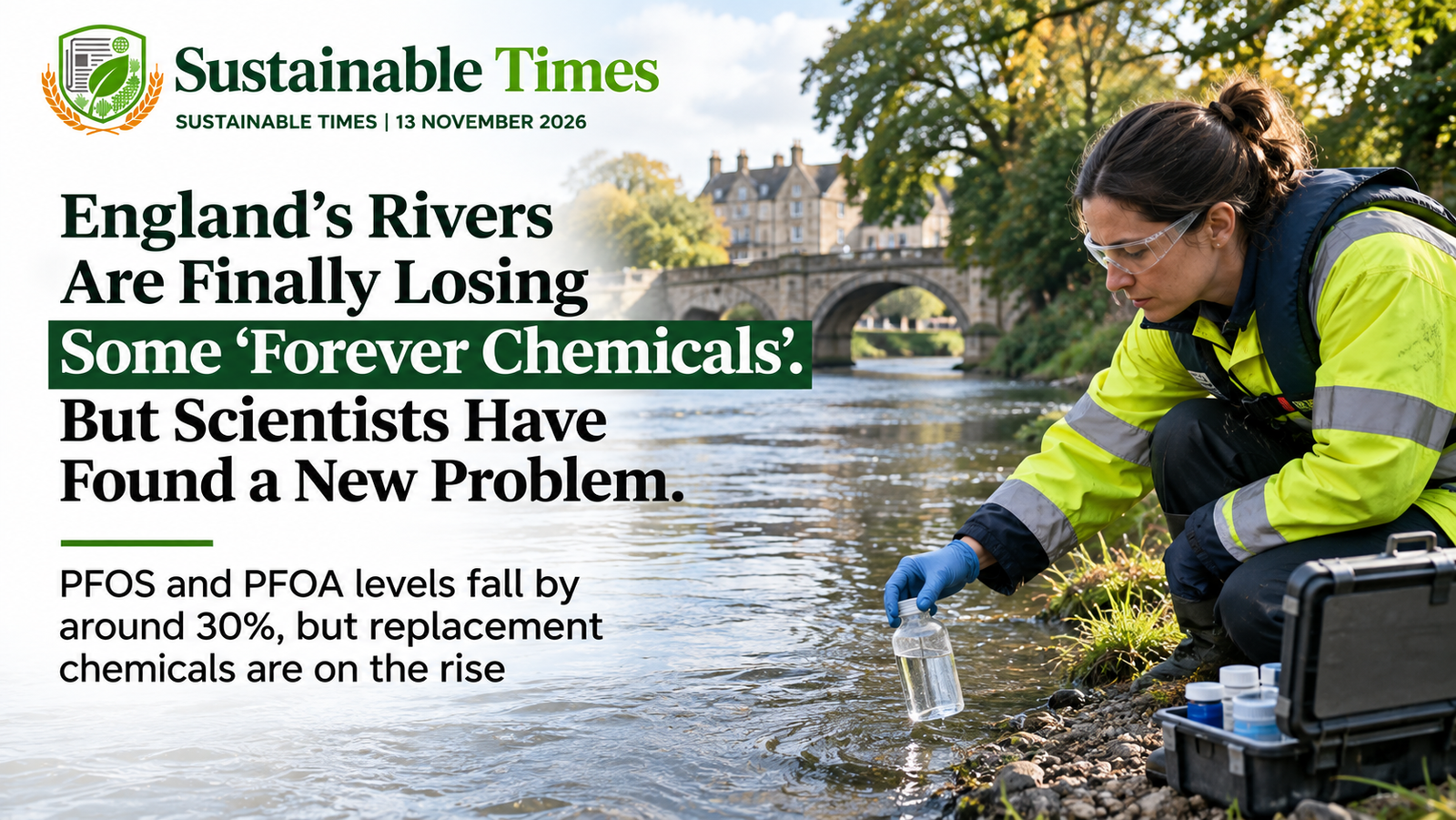
A major report published by the UK’s Environment Agency on 12 November 2026 reveals that concentrations of two widely studied forever chemicals have fallen significantly in English rivers over the past decade.
Between 2016 and 2025, average concentrations of PFOS declined by approximately 30%, while PFOA concentrations fell by 29%. Researchers also recorded a remarkable 49% reduction in PFOS concentrations in freshwater fish.
The findings suggest that restrictions on harmful industrial substances can gradually reduce their presence in the environment.
But the report also exposes an uncomfortable problem.
While older chemicals are declining, other members of the same chemical family remain widespread, and some replacement substances are becoming increasingly common.
The discovery raises a difficult question for regulators and manufacturers: How do we prevent industries from replacing one persistent chemical with another before scientists fully understand its environmental consequences?
The Chemicals That Refuse to Disappear
Forever chemicals belong to a large group of synthetic substances known as per- and polyfluoroalkyl substances, or PFAS.
Manufacturers have used these chemicals for decades because they resist heat, oil, grease and water.
Those properties make them useful in products ranging from waterproof textiles and food packaging to industrial equipment and firefighting foams.
However, the same chemical stability that makes many PFAS useful also creates serious environmental challenges.
Many of these substances resist natural degradation. Once released, they can move through water systems, accumulate in sediments and enter food webs.
Some PFAS have been associated with adverse health effects, although the risks differ considerably between individual compounds and exposure levels.
Scientists have therefore spent years investigating where these chemicals originate, how they move through ecosystems and how long they remain in the environment.
The latest Environment Agency assessment provides one of the clearest pictures yet of how PFAS concentrations are changing across England’s water environments.
A Decade of Restrictions Is Beginning to Show Results
The decline in PFOS and PFOA is particularly significant because both substances were once widely used.
PFOS appeared in applications including industrial processes and firefighting foams, while PFOA played a role in manufacturing fluoropolymer materials and other products.
As scientific evidence of their persistence and potential harm accumulated, governments introduced increasingly strict controls.
The United Kingdom has restricted PFOS and PFOA through international and domestic regulatory measures.
Those restrictions reduced many of the uses that historically released the substances into the environment.
The Environment Agency’s latest monitoring results now show sustained declines in their concentrations at sampled river locations.
For PFOS, researchers calculated an average annual reduction of approximately 3.9% over the study period.
PFOA concentrations declined by an average of approximately 3.7% annually.
The findings do not prove that every reduction resulted directly from a particular regulation. Changes in industrial activity, releases and environmental conditions may also influence concentrations.
Nevertheless, the Environment Agency identifies regulatory restrictions and targeted action as important contributors to the improvements.
For environmental policymakers, that is an encouraging result.
Chemical pollution can persist for decades, but preventing further releases can still lead to measurable improvements.
The Most Encouraging Finding Came From Fish
The report’s findings extend beyond river water.
Researchers also examined PFAS contamination in aquatic organisms.
They found that PFOS concentrations in freshwater fish had declined by approximately 49% between 2016 and 2025.
This matters because waterborne pollution does not remain confined to water.
Fish and other aquatic organisms can absorb certain contaminants through their environment and food.
Some substances accumulate in tissues and move through food webs as predators consume contaminated prey.
Monitoring fish therefore helps scientists understand how chemical pollution interacts with living ecosystems.
The decline in PFOS concentrations provides evidence that reduced environmental contamination can coincide with lower levels in aquatic wildlife.
However, scientists caution against interpreting this finding as proof that fish populations are now free from PFAS-related risks.
Different species and locations experience different levels of exposure, while many other persistent chemicals remain present.
The result is best understood as meaningful progress rather than complete recovery.
The Problem Is That Thousands of Other Chemicals Still Exist
The encouraging results come with an important warning.
PFOS and PFOA represent only two substances within a much larger chemical family.
Thousands of PFAS compounds have been identified, and many remain poorly understood.
The Environment Agency’s updated assessment draws on expanded monitoring that now covers more than 60 PFAS across different environmental settings.
These include rivers, lakes, estuaries, coastal waters, groundwater and aquatic organisms.
That wider monitoring reveals a more complicated picture than the decline of two legacy pollutants might suggest.
PFAS contamination remains widespread.
Some chemicals continue entering the environment through industrial activities, wastewater, landfill leachate and other pathways.
Meanwhile, newer compounds are receiving increasing attention as manufacturers move away from substances that governments have restricted.
The central concern is that replacing one persistent chemical with another does not necessarily eliminate the underlying environmental problem.
It may simply change which substances scientists need to monitor.
The Rise of Replacement Chemicals
One of the emerging concerns involves shorter-chain PFAS and related persistent fluorinated substances.
Manufacturers have introduced alternatives to some older compounds, partly in response to regulatory restrictions and growing environmental concerns.
However, these alternatives do not automatically behave more safely in the environment.
Some are highly mobile in water, while others may remain persistent even if they accumulate differently in organisms.
Trifluoroacetic acid, commonly known as TFA, has become an important example in discussions about persistent fluorinated pollution.
TFA can enter the environment through several pathways, including the degradation of certain fluorinated chemicals.
Scientists are increasingly detecting it in environmental samples, raising questions about its sources, long-term accumulation and potential ecological effects.
The problem is not that every replacement chemical has been proven equally harmful.
It is that scientific understanding and regulation have not always kept pace with the development and use of new substances.
For manufacturers, the lesson is significant.
Replacing a restricted chemical should involve examining the full environmental behaviour of the alternative, rather than focusing only on whether it meets existing legal requirements.
Cleaner Rivers Do Not Mean the Pollution Has Vanished
There is another important limitation in the new findings.
The Environment Agency measured declining concentrations of selected chemicals in monitored river water.
That does not necessarily mean the total quantity of those substances across the environment has declined by the same proportion.
Persistent chemicals can move between environmental compartments.
River currents can transport pollutants downstream into estuaries and coastal waters.
Some substances may enter sediments, while others move through groundwater or remain associated with contaminated land.
Changes in rainfall and water flow can also influence measured concentrations.
This means lower concentrations at particular monitoring locations do not prove that all historical contamination has been destroyed or removed.
The report therefore reinforces the need for monitoring across connected environmental systems.
Scientists must understand not only how much pollution appears in a river but also where the chemicals travel afterward.
Without that information, apparent improvements in one location could conceal continuing contamination elsewhere.
Why This Matters for the Water Industry
The findings have important implications for water utilities and wastewater-management companies.
PFAS can enter wastewater systems from industrial processes, household products and other sources.
Conventional treatment methods do not necessarily remove every PFAS compound effectively.
Some advanced treatment technologies can reduce concentrations, but their performance varies depending on the chemical involved and the composition of the water.
Treatment also creates another challenge: captured contaminants must be managed responsibly.
Removing PFAS from water does not automatically destroy them.
Concentrated residues, spent filters and other treatment materials may still require specialised handling or disposal.
That is why preventing pollution at its source can be more effective than relying entirely on expensive treatment after contamination occurs.
For regulators, identifying the industries and activities responsible for releases is therefore essential.
The latest assessment provides a stronger evidence base for determining where future interventions could deliver the greatest environmental benefits.
The Business Case for Safer Chemistry Is Growing
Chemical regulation is increasingly influencing how businesses design products and manage supply chains.
Manufacturers in sectors such as textiles, packaging, electronics and industrial materials may need to evaluate whether their products contain substances that could face future restrictions.
The decline in legacy PFAS provides evidence that regulatory action can influence environmental outcomes over time.
But the persistence of replacement chemicals highlights the risks of responding only when individual substances become restricted.
A more durable approach involves assessing entire chemical functions and identifying alternatives with better-established environmental profiles.
This could encourage innovation in materials that provide water resistance, durability or other useful properties without relying on highly persistent compounds where safer alternatives are available.
However, developing those materials requires investment, testing and collaboration between manufacturers, researchers and regulators.
The challenge is not simply finding a chemical that performs the same industrial task.
It is finding one that performs that task without creating another long-term pollution problem.
What India Can Learn From England’s Experience
India faces its own challenges involving industrial wastewater, chemical manufacturing, urban pollution and the protection of freshwater resources.
As industries expand, understanding the environmental behaviour of persistent chemicals will become increasingly important.
England’s experience offers a useful lesson about long-term monitoring.
The reductions reported in the new assessment became visible because researchers collected environmental data over many years.
Without consistent measurements, policymakers would have struggled to identify the trend or evaluate whether restrictions were producing meaningful results.
For India, strengthening monitoring of emerging contaminants could help identify risks before they become more difficult and expensive to manage.
Industrial pollution prevention, responsible chemical substitution and better wastewater management can all contribute to that objective.
However, England’s results should not be treated as evidence that identical policies would produce the same outcomes in India.
Different industrial activities, water systems, regulatory frameworks and monitoring capabilities require locally appropriate responses.
The broader principle remains valuable: effective environmental protection depends on reliable data and sustained action.
The Next Challenge Is Regulating Chemicals Before They Become a Crisis
The new Environment Agency assessment represents an important step forward.
It shows that restrictions on certain persistent substances can coincide with substantial declines in environmental concentrations.
But it also demonstrates why chemical regulation cannot remain focused exclusively on substances that have already caused widespread concern.
Thousands of PFAS compounds exist, and scientific information about many of them remains incomplete.
Regulators must decide how to manage that uncertainty without waiting decades for every potential environmental effect to become fully established.
That may require broader chemical assessments, improved reporting from manufacturers and stronger monitoring of emerging substances.
It also means evaluating how chemicals behave throughout their life cycles, from manufacturing and product use to disposal and environmental release.
The most effective approach would prevent harmful contamination before it spreads through ecosystems.
A Rare Environmental Success Story With an Important Warning
Environmental news often focuses on pollution getting worse.
Rivers become contaminated, ecosystems deteriorate and governments struggle to respond.
England’s latest findings offer a different perspective.
They show that sustained restrictions and monitoring can contribute to measurable environmental improvements, even for substances known for their extraordinary persistence.
A 30% decline in PFOS and a 29% reduction in PFOA concentrations are meaningful developments.
The nearly 49% decline in PFOS concentrations in freshwater fish is equally encouraging.
But the wider PFAS problem remains unresolved.
Other persistent chemicals continue circulating through the environment, while new substances create additional scientific and regulatory questions.
The findings therefore provide both evidence of progress and a warning against complacency.
For governments, the lesson is that chemical controls can work.
For manufacturers, it is that replacing a problematic substance requires more than selecting a legally acceptable alternative.
And for the public, it is a reminder that environmental recovery often happens gradually, through years of monitoring, regulation and changes in industrial practices.
England’s rivers are showing that some forever chemicals can decline. The next challenge is making sure the chemicals replacing them do not become the environmental crisis of tomorrow.
About The Author