Five thousand years ago, parts of Mozambique’s coastline looked very different. Forests and wetlands occupied land that now lies beneath the Indian Ocean. As sea levels rose, water gradually swallowed those landscapes, leaving behind the remains of trees, vegetation and carbon-rich soils.
Scientists have now discovered that these ancient forests did not simply disappear.
They became the foundation of an extraordinary underwater ecosystem.
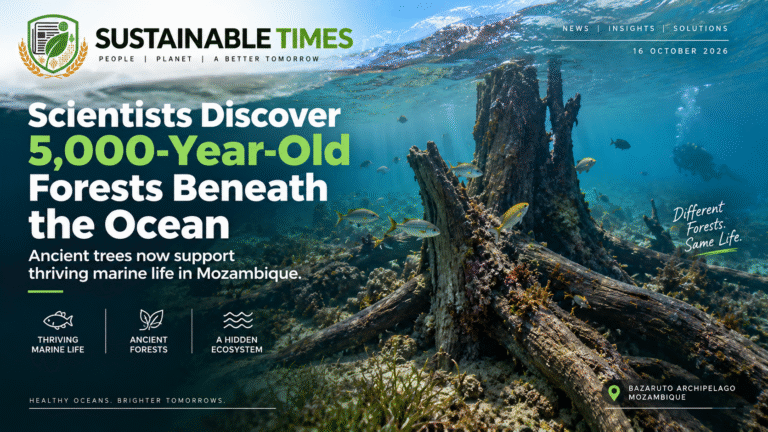
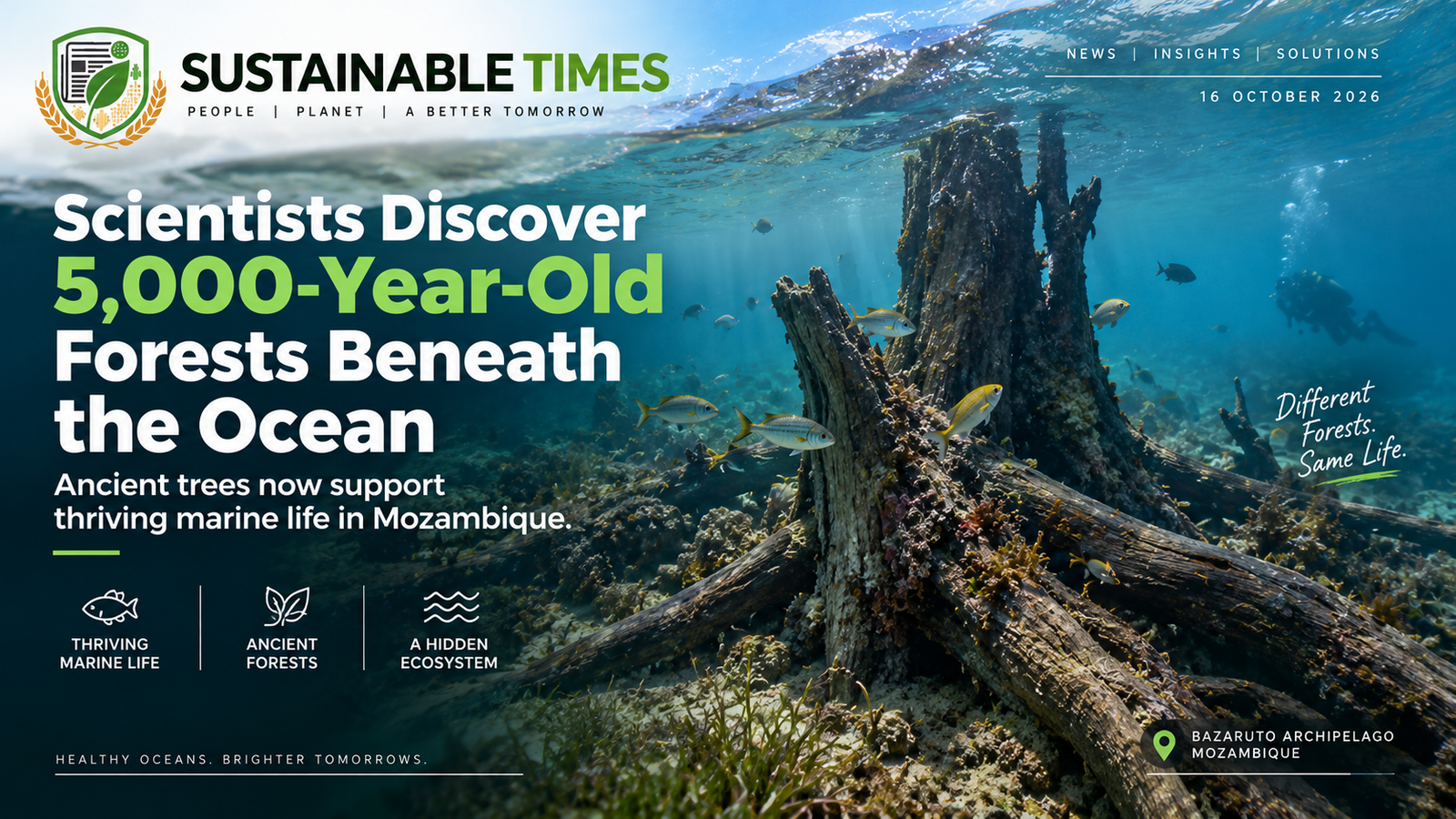
A new study published in Scientific Reports has documented previously understudied tropical peat reefs in Mozambique’s Bazaruto Archipelago. Formed from the remains of ancient coastal forests, these submerged structures now support fish, sponges, seagrasses and numerous other marine organisms.
What surprised researchers most was the richness of the life they found.
Despite containing no living reef-building corals, the peat reefs supported biodiversity comparable to nearby coral reef habitats.
The discovery challenges conventional ideas about what makes a reef valuable and raises an important conservation question: How many thriving marine ecosystems remain hidden because scientists have not known where to look?
How an Ancient Forest Became an Underwater Reef
The story begins thousands of years before modern Mozambique existed.
During the Holocene, changing sea levels reshaped coastlines around the world. Rising seas gradually flooded low-lying forests, wetlands and coastal plains.
As vegetation accumulated in waterlogged conditions, organic material formed thick deposits of peat.
Peat develops when dead plant material decomposes slowly because oxygen is limited. Over time, it can store substantial amounts of carbon.
When the ocean advanced across these landscapes, some of the peat deposits became submerged beneath layers of sediment.
Later, waves and coastal erosion exposed portions of that ancient material on the seafloor.
Instead of disappearing completely, the hardened peat created an irregular surface where marine organisms could settle.
The resulting formations resemble reefs, but their foundations are entirely different from those of conventional coral reefs.
Researchers used radiocarbon dating to determine that the peat deposits they studied ranged from approximately 300 to 5,000 years old.
In other words, the structures supporting marine life today began forming when parts of the coastline were still terrestrial ecosystems.
A Reef Without Corals
When people imagine a healthy reef, they usually picture colourful corals surrounded by tropical fish.
The Mozambique discovery tells a different story.
The researchers found no living hard or soft corals on the surveyed peat reefs.
Instead, the ancient peat provided a foundation for seagrasses, macroalgae, sponges and numerous invertebrates.
These organisms created a complex habitat with crevices, ledges and sheltered areas where fish and other animals could feed and hide.
Marine surveys showed that the peat reefs supported distinctive biological communities, with levels of species richness comparable to the neighbouring coral habitats.
The scientists also observed substantial overlap between the fish and larger marine animals using the two reef types.
That suggests the peat reefs are not isolated underwater curiosities.
They form part of a connected coastal ecosystem where different habitats support different stages of marine life.
The discovery could change how conservationists identify valuable reef environments.
A habitat does not necessarily need living coral to provide important ecological functions.
The Underwater Forests Are Providing Shelter for Young Fish
One of the most important findings concerns the role of peat reefs as potential nursery habitats.
Young fish face enormous risks in open water.
Predators can capture them easily, while strong currents and limited shelter make survival difficult.
The irregular surfaces of the peat reefs provide spaces where small fish can hide.
Researchers recorded juvenile fish associated with reef environments, suggesting that these submerged formations may support the early life stages of species that later move into surrounding habitats.
They also observed spiny lobsters sheltering inside crevices formed by the consolidated peat.
Those details matter because marine conservation depends on protecting the places animals need throughout their lives.
An adult fish may live near a coral reef but depend on nearby seagrass, mangrove or other sheltered habitats during its juvenile stage.
Protecting one habitat while overlooking the others can weaken the wider ecosystem.
The newly documented peat reefs may provide another important connection in that network.
Sea Turtles and Dugongs Could Benefit Too
Mozambique’s Bazaruto Archipelago is already known for its diverse marine environments.
Its coastal waters contain coral reefs, mangroves, seagrass meadows and habitats used by endangered and threatened marine species.
The researchers found that peat reef environments include seagrass patches that could provide feeding opportunities for herbivorous animals.
Green turtles and dugongs occur in the wider Bazaruto region, and researchers occasionally observed them around peat areas.
Dugongs depend heavily on seagrass, making the condition of coastal vegetation particularly important for their survival.
The discovery therefore adds another layer to the region’s conservation priorities.
Peat reefs may help connect feeding grounds, shelter and movement pathways across the coastal landscape.
Scientists still need additional research to determine exactly how different species use these formations over time.
But the evidence already suggests that the habitats deserve more attention.
The Carbon Mystery Beneath the Water
The ecological discovery comes with another intriguing possibility.
The peat reefs contain ancient organic carbon that accumulated long before the deposits became part of the marine environment.
Some samples contained up to 40% organic carbon by dry weight.
That is significant because peatlands are among the world’s important natural carbon stores.
However, the researchers emphasise that measuring carbon in individual samples does not establish how much carbon the entire reef system contains.
Scientists have not yet quantified the total carbon stock of these habitats or determined how their exposure, erosion and biological activity affect long-term carbon storage.
That distinction is crucial.
It would be premature to describe the newly discovered reefs as proven large-scale carbon sinks.
Instead, the findings reveal a potential research opportunity.
If scientists can understand how submerged peat behaves over centuries, they may discover another important connection between coastal ecosystems and the global carbon cycle.
Why These Reefs Have Been Overlooked
Conventional marine conservation often concentrates on habitats that scientists can readily identify and map.
Coral reefs, mangroves and seagrass meadows receive substantial attention because their ecological roles are well established.
Peat reefs are different.
They can resemble dark rocky formations or irregular underwater surfaces rather than familiar biological reefs.
Some become exposed or buried depending on wave activity, storms and coastal erosion.
That makes them difficult to recognise without detailed field surveys and geological analysis.
The Mozambique researchers combined underwater observations, ecological sampling, satellite imagery and radiocarbon dating to understand the formations.
Their work suggests that similar habitats may exist in other tropical coastal regions with ancient peat deposits.
Possible locations include Southeast Asia, the Caribbean and West Africa.
Those regions also contain extensive coastal wetlands that have experienced significant changes in sea level over thousands of years.
The discovery raises the possibility that scientists have underestimated the ecological importance of other submerged peat formations.
Climate Change Makes the Discovery More Relevant
Rising sea levels are changing coastlines around the world.
Low-lying coastal ecosystems face erosion, saltwater intrusion and flooding, while habitats gradually shift as environmental conditions change.
The Mozambique study offers an unusual perspective on that process.
It shows how the remains of ancient terrestrial ecosystems can become part of functioning marine environments.
However, the finding should not be interpreted as evidence that sea-level rise benefits ecosystems overall.
Coastal flooding can destroy habitats, damage infrastructure and threaten communities.
The new research instead demonstrates that ecological change can produce complex outcomes that scientists do not always anticipate.
Ancient peat deposits may provide new habitat when they become exposed underwater, but their long-term stability remains uncertain.
Storms, erosion and changing ocean conditions could also damage or remove these formations.
Understanding those processes will be essential before conservationists can determine how best to protect them.
A New Challenge for Marine Protected Areas
The discovery has practical implications for coastal conservation.
Marine protected areas often rely on habitat maps to identify locations that need stronger protection.
If important ecosystems remain undocumented, conservation plans may overlook them.
The researchers argue that peat reefs deserve consideration in future marine habitat mapping and coastal-management strategies.
Their findings are particularly relevant because the surveyed sites were located outside existing marine protected areas.
That means potentially valuable habitats may not currently benefit from the same protections as better-known ecosystems.
Improving marine conservation will therefore require more than increasing the size of protected areas.
It will also require a better understanding of what those areas contain and which habitats remain vulnerable beyond their boundaries.
The Ocean Still Holds Ecological Surprises
The Mozambique discovery arrives at a time when scientists are increasingly using advanced monitoring technologies to study marine ecosystems.
Satellite imagery, underwater cameras, environmental sensors and improved mapping tools are helping researchers explore areas that previously received limited scientific attention.
Yet this study demonstrates that important discoveries can still begin with something relatively straightforward: closely examining an unfamiliar formation on the seafloor.
Researchers did not discover an entirely new ocean.
They discovered a new ecological role for a material that had been present for thousands of years.
That distinction is important.
The natural world may contain many overlooked habitats that already support biodiversity but remain absent from conservation priorities.
Recognising them could improve marine spatial planning, fisheries management and ecosystem protection.
What Happens Next?
The researchers want to understand how widespread tropical peat reefs may be and how their ecological functions change over time.
Further studies could investigate whether these formations consistently serve as nurseries for young fish, how they connect with coral reefs and seagrass meadows, and whether their ancient carbon deposits remain stable.
Scientists also need to assess how coastal erosion and future sea-level rise may affect the habitats.
For Mozambique, the findings add another reason to protect the ecological diversity of the Bazaruto Archipelago.
The region is already recognised for its valuable marine environments, but the latest research shows that some of its most unusual ecosystems have only just begun to receive scientific attention.
The wider lesson extends far beyond one coastline.
Marine conservation has traditionally focused on protecting habitats that scientists already understand.
This discovery suggests that protecting the ocean may also depend on identifying ecosystems that have remained hidden in plain sight.
Five thousand years ago, rising seas transformed coastal forests into underwater peat deposits. Today, those ancient remains support thriving marine communities. The forests may be gone, but their ecological story is far from over.
About The Author