What if protecting a rainforest could become a better financial decision than clearing it?
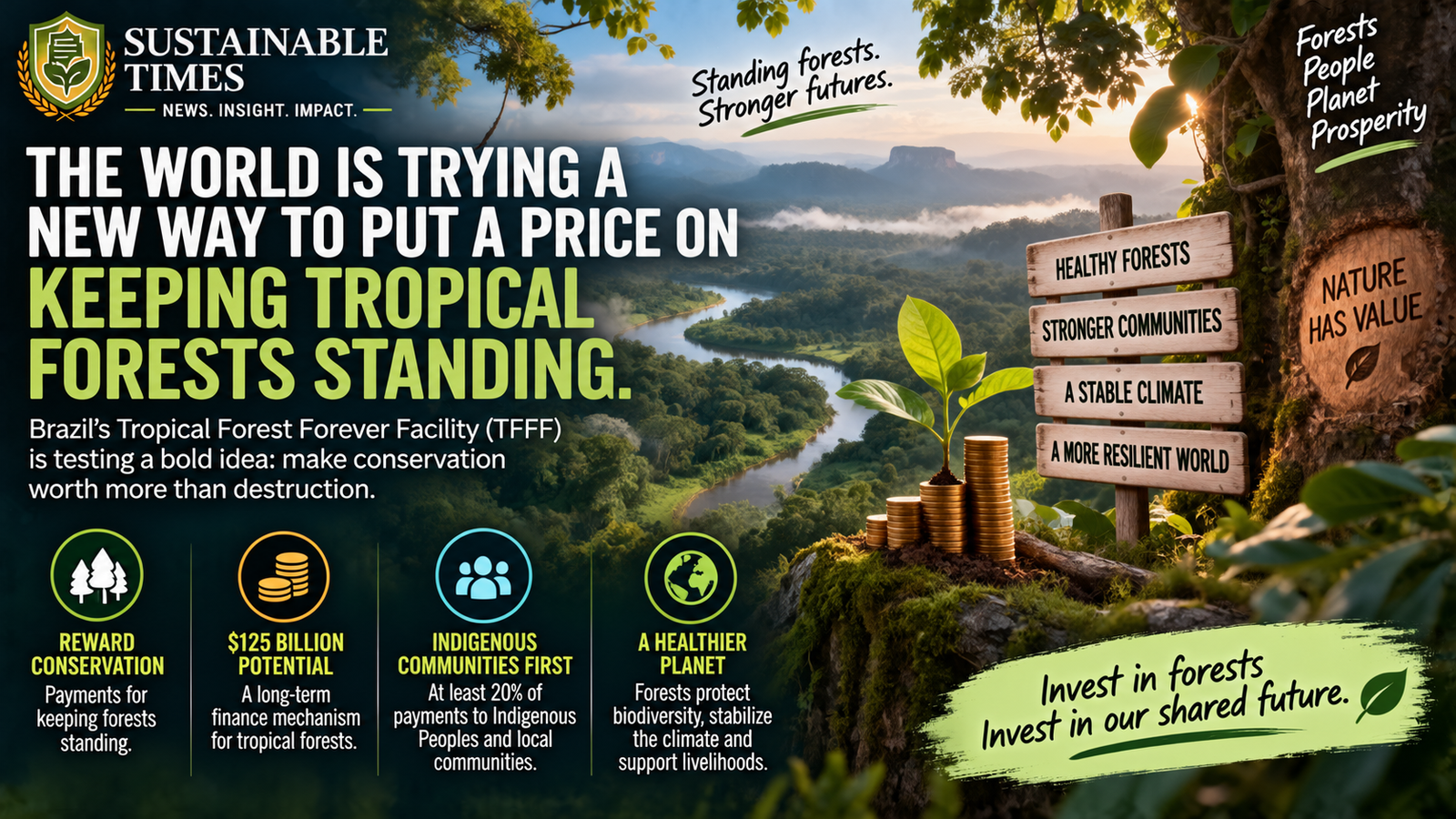
That is the idea behind Brazil’s Tropical Forest Forever Facility (TFFF), one of the more ambitious experiments in climate finance now moving from concept toward implementation.
The idea is different from a traditional conservation grant. Instead of paying only for projects or compensating countries for individual emissions reductions, the facility aims to create a long-term investment mechanism that rewards tropical forest countries for keeping forests standing.
And now the experiment is reaching an important moment.
The facility needs to mobilise $10 billion in sponsor capital by the end of 2026 to unlock Norway’s conditional commitment of up to $3 billion. The United Kingdom announced another £400 million loan commitment this month, bringing announced commitments closer to that initial target.
A financial model built around standing forests
The basic problem the TFFF is trying to solve is familiar.
Tropical forests provide enormous benefits to the global economy and environment, from carbon storage and rainfall regulation to biodiversity, soil protection and livelihoods. Yet many of those benefits do not generate enough direct income for the countries and communities protecting them.
Brazil’s proposal tries to change that equation.
The facility plans to raise capital and invest it in financial markets. Returns generated by those investments would then help provide payments to tropical forest countries based on verified conservation and restoration performance. Brazil’s government describes it as a model designed to make conservation economically attractive rather than treating forests simply as a source of raw materials.
The long-term ambition is substantial.
The TFFF ultimately aims to mobilise around $125 billion, with public capital helping attract much larger volumes of private investment.
If that scale can be achieved, the mechanism could represent a significant shift in how international forest finance works.
Why the timing matters
The world’s tropical forests continue to face intense pressure from agriculture, commodity production, infrastructure development and other forms of land-use change.
Traditional conservation finance has often struggled with a basic problem: funding is frequently too short-term or too small compared with the economic incentives driving deforestation.
The TFFF is attempting to address that imbalance by creating a long-term financial stream rather than relying entirely on annual aid budgets.
That distinction matters.
A forest can take decades to grow, but conservation programmes often operate on much shorter funding cycles. A permanent financial mechanism could give governments and communities a stronger reason to protect forests over generations.
The World Bank is serving as interim secretariat host and trustee for the facility, while the FAO is helping develop environmental eligibility and forest-monitoring requirements.
Indigenous communities are central to the model
A conservation fund cannot succeed simply by protecting trees on a map.
Indigenous Peoples and local communities manage and depend on enormous areas of tropical forest, making their participation critical to whether conservation efforts actually work on the ground.
The TFFF framework says at least 20% of payments should go directly to Indigenous Peoples and local communities.
But this is also an area where questions remain.
Recent reporting has highlighted concerns about how much decision-making power Indigenous representatives will have within the fund’s governance structures. That means financial inclusion and representation will be just as important as the headline funding target.
For the TFFF to establish credibility, communities protecting forests will need more than financial recognition. They will need meaningful participation in decisions about how conservation money reaches the ground.
The $10 billion test
The immediate challenge is much smaller than the eventual $125 billion ambition.
The facility is trying to reach $10 billion in sponsor capital during 2026.
Norway has made its potential $3 billion contribution conditional on the facility reaching that minimum capitalisation, among other requirements. The Norwegian government says more than $6.8 billion in contributions and loans had been announced as of June.
Then came the UK’s £400 million announcement in September.
The UK says its contribution will be made as a loan rather than a grant and remains subject to final due diligence, governance arrangements and other conditions.
That makes the next few months important.
The question is no longer whether governments like the concept. The real test is whether enough countries and investors are willing to commit capital to make the financial structure work.
Could forests become an investment asset?
That is the bigger question behind the experiment.
Climate finance has traditionally focused heavily on grants, carbon markets and project-based funding. The TFFF is attempting something different by connecting forest conservation with investment returns.
If the model works, it could demonstrate that protecting natural ecosystems does not always have to compete with financial interests.
Instead, conservation itself could become part of the investment architecture.
But that promise comes with a responsibility.
The system will need credible forest monitoring, transparent rules, strong safeguards and clear accountability. Payments must reflect genuine conservation performance rather than creating another mechanism vulnerable to greenwashing.
FAO is already working with countries on monitoring systems and methods that can verify the forest areas eligible for TFFF payments.
The experiment is bigger than Brazil
The TFFF began as a Brazilian initiative, but its ambition is global.
Tropical forests in the Amazon, Congo Basin, Southeast Asia and other regions provide environmental services that extend far beyond national borders.
That means protecting them cannot be financed by forest countries alone.
The TFFF is essentially asking the international financial system a difficult but important question:
If the world depends on tropical forests, should the countries that protect them be financially rewarded for doing so?
The answer could influence the future of conservation finance.
For now, the facility remains an ambitious experiment still being built.
But if it can turn billions of dollars of investment into a reliable incentive for keeping forests standing, it could change the economics of conservation.
And that may be one of the most important sustainability experiments to watch as the world moves deeper into the climate-finance era.
Key Takeaway
Brazil’s Tropical Forest Forever Facility is attempting to make forest conservation financially competitive with forest destruction. Its success will depend on reaching its initial funding target, attracting private capital, protecting Indigenous rights and proving that conservation payments can be monitored transparently and delivered at scale.
About The Author