What if one of the oldest organisms in the ocean could help repair some of its most damaged habitats?
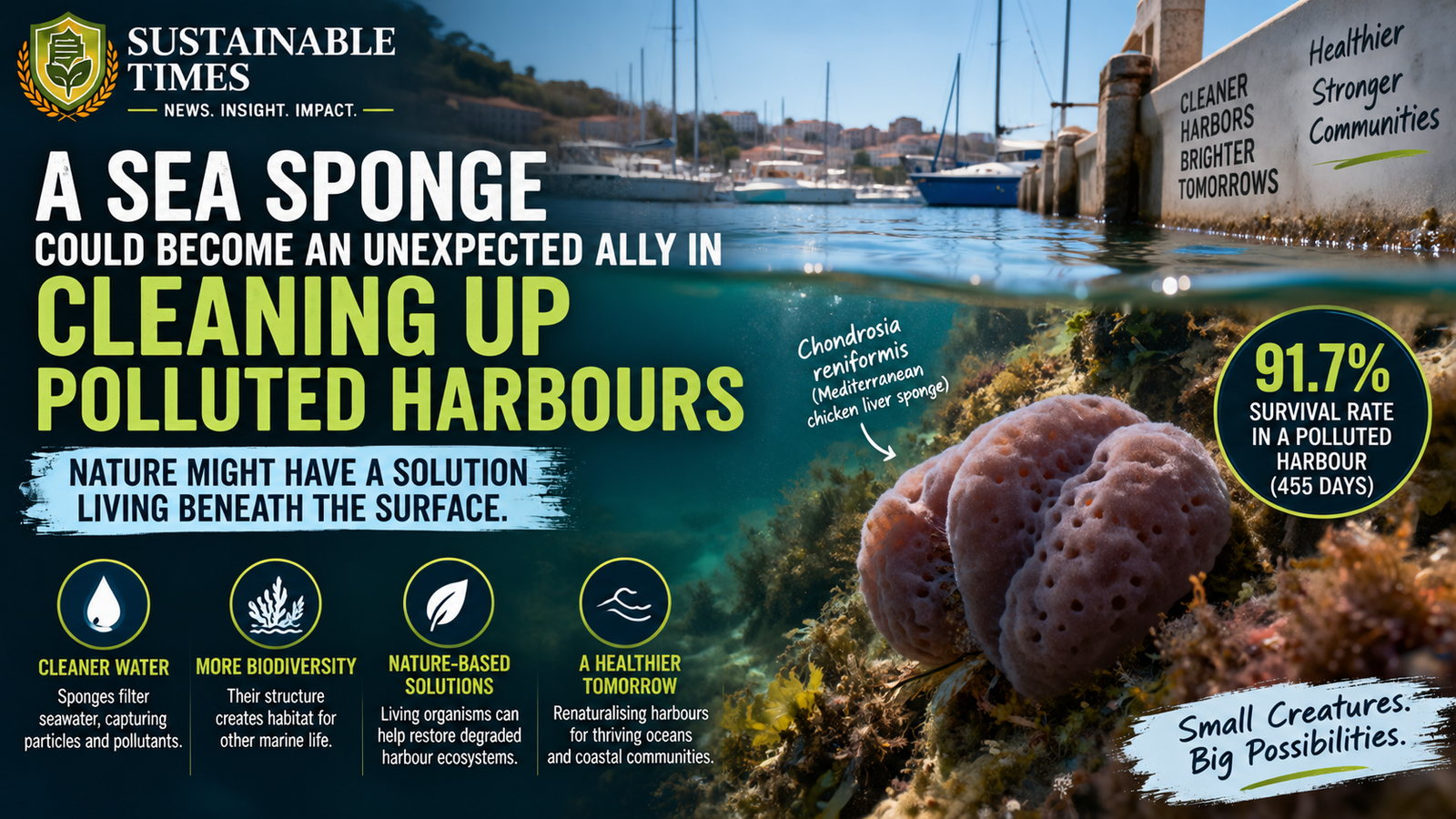
Scientists working on Spain’s Costa Brava have found a surprisingly resilient candidate: the Mediterranean chicken liver sponge, Chondrosia reniformis.
In a 455-day experiment inside Marina Palamós, a recreational harbour near Girona, researchers transplanted several Mediterranean sponge species into an environment affected by pollution and other human pressures. Only Chondrosia reniformis showed strong long-term resilience. About 91.7% of the individuals survived, while the other tested species failed to make it through the experiment.
The researchers now see the sponge as a promising candidate for future harbour-renaturalisation projects.
And that could open an unusual new chapter in marine restoration: using living organisms as part of environmental infrastructure.
Why Harbours Are So Difficult to Restore
Harbours give cities access to the sea, but that comes with an environmental cost.
Concrete seawalls replace natural habitats. Restricted water circulation can allow pollutants and contaminated sediments to accumulate. Boats introduce additional pressure through fuel, antifouling chemicals, noise and physical disturbance.
These conditions make it difficult for many marine species to establish themselves.
That creates a frustrating cycle. A damaged harbour loses biodiversity, and without enough organisms capable of surviving there, the ecosystem struggles to recover naturally.
The Spanish research team is exploring whether particularly resilient species could help break that cycle.
The Sponge That Refused to Give Up
The researchers tested five Mediterranean sponge species and monitored their performance after transplantation.
The results were striking.
Chondrosia reniformis not only survived but adapted to the harbour environment. Researchers observed the sponge changing its shape and even moving across its artificial substrate, with some individuals travelling up to 12.7 centimetres. Some also reproduced through body fission, producing clonal offspring and nearly doubling the experimental population.
That adaptability is important because restoration projects cannot simply place organisms into a damaged ecosystem and expect them to stay healthy.
A useful restoration species needs to tolerate difficult conditions, establish itself and ideally help create conditions in which other organisms can return.
Nature Is Doing More Than Cleaning Water
Sponges have a particularly interesting role in marine ecosystems.
They constantly filter seawater through their bodies, capturing particles and interacting with dissolved nutrients. Their structures also create small refuges that can provide habitat for other marine organisms.
The researchers describe sponges as “ecosystem engineers” because their presence can influence the physical structure and biological functioning of their surroundings.
That makes the idea more ambitious than simply using sponges as natural filters.
The goal is to see whether resilient species can become pioneers in degraded habitats, creating a foundation for broader ecological recovery.
But Scientists Are Not Calling It a Cleanup Solution Yet
This distinction matters.
The experiment did not demonstrate that transplanting these sponges will clean an entire harbour or remove pollution at a commercially useful scale.
Instead, the research answered an earlier and essential question: Can a potentially useful sponge species survive and establish itself in a highly disturbed harbour?
The answer appears to be yes for Chondrosia reniformis.
The researchers now want to monitor the transplanted sponges for longer and investigate how their microbial communities help them tolerate stressful conditions. They also plan to test additional sponge species.
That makes this an early-stage nature-based restoration technology rather than a finished environmental product.
A Different Way to Think About Green Technology
The story is interesting because it challenges the usual definition of environmental technology.
When people hear “green technology,” they often think about batteries, solar panels, carbon capture or smart sensors.
But sometimes the most sophisticated solution may already exist in nature.
Instead of building another machine to perform every environmental function, restoration scientists are increasingly asking whether living systems can work alongside engineered infrastructure.
In this case, researchers installed experimental structures on a harbour seawall and used them to support transplanted sponges. The approach combines artificial structures with biological restoration rather than replacing engineering with nature altogether.
That hybrid model could become increasingly important as coastal cities look for ways to adapt existing infrastructure rather than attempting to rebuild entire shorelines.
The Opportunity Goes Beyond One Spanish Harbour
The researchers are deliberately cautious about the next step.
A sponge that performs well in Marina Palamós may not perform the same way in a harbour with different temperatures, pollutants, currents or ecological conditions.
But the underlying concept has much wider relevance.
Thousands of ports and marinas around the world occupy heavily modified coastal environments. Completely restoring these places to their original condition is often unrealistic because they must continue supporting shipping, fishing, tourism and industry.
Renaturalisation offers another possibility: make working infrastructure more biologically functional.
That could mean adding habitat structures, restoring native organisms and designing coastal infrastructure that supports biodiversity while continuing to serve its economic purpose.
The Bigger Sustainability Lesson
The most interesting part of this research may not be the sponge itself.
It is the idea that restoration does not always require returning an ecosystem to exactly what existed before human development.
In heavily modified environments, a more practical goal may be to rebuild some ecological functions within the infrastructure that already exists.
That approach could bring together marine biology, engineering and urban planning in ways that are still relatively new.
And if future experiments demonstrate that resilient sponge communities can improve water quality, biodiversity and ecosystem functioning at meaningful scales, the humble sponge could become part of a much bigger conversation about how cities coexist with the oceans.
Looking Ahead
For now, the chicken liver sponge remains a promising research candidate—not a proven harbour-cleaning technology.
But that is precisely what makes the discovery worth watching.
The researchers have found a species capable of surviving where many others cannot. The next question is whether that resilience can translate into measurable ecological recovery.
If it can, some of the world’s most artificial coastlines may eventually begin to look a little more like living ecosystems again.
Sometimes the next generation of environmental technology does not need to be invented. It may simply need to be understood.
Key Takeaway
A 455-day experiment in Spain found that 91.7% of transplanted Chondrosia reniformis sponges survived in a polluted harbour, while the other tested species did not. Researchers now see the sponge as a promising candidate for future marine-renaturalisation projects, although much more research is needed before it can be considered a practical pollution-management solution.
About The Author