For years, 1.5°C has been treated as one of the most important numbers in the climate debate. Now, the United Nations Environment Programme says the world is likely to cross that threshold within the next few years.
But the latest warning comes with an important distinction: crossing 1.5°C does not mean climate action has failed or that every effort from this point is meaningless. Instead, the climate challenge is entering a new and much harder phase: limiting how far temperatures rise, adapting to the damage already becoming unavoidable, and eventually bringing global temperatures back down.
1.5°C is no longer the finish line we can simply stay below
The new UNEP report, Limiting Overshoot: Navigating exceedance of 1.5°C and pathways towards return, describes an increasingly likely period of climate overshoot.
In simple terms, overshoot means global temperatures rise above 1.5°C, remain there for some period, reach a peak and eventually decline.
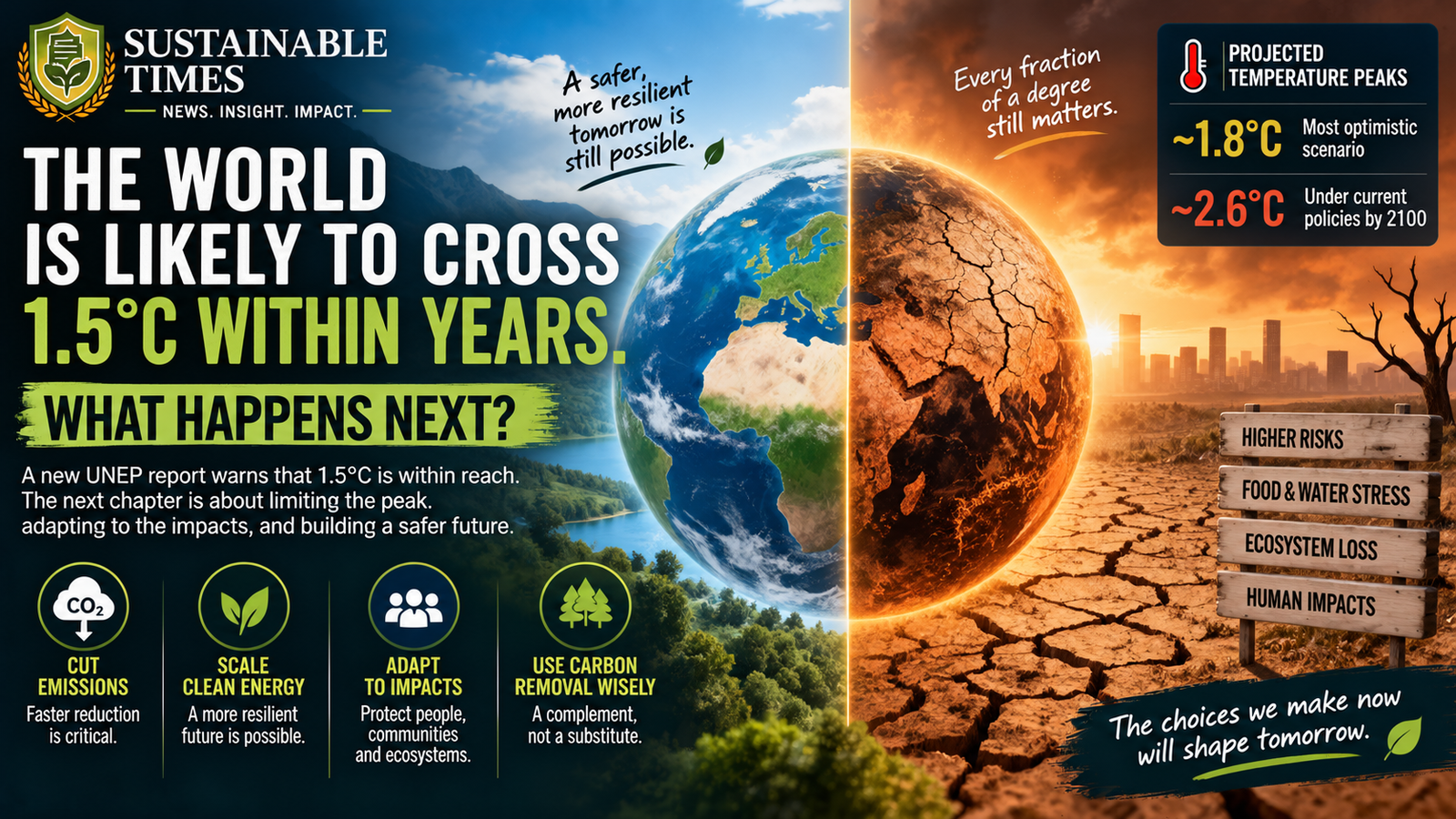
UNEP says the most optimistic scenario now puts peak warming at around 1.8°C above pre-industrial levels. Under current policies, however, warming could reach approximately 2.6°C by 2100.
That gap matters enormously.
Every additional fraction of a degree increases pressure on ecosystems, food systems, water supplies, infrastructure and human health. Longer periods of elevated temperatures also increase the risk of crossing climate tipping points that could create difficult or irreversible changes.
The next battle is about limiting the peak
The message from UNEP is not to accept a warmer planet as inevitable and move on.
Quite the opposite.
The lower the temperature peak, and the shorter the time the planet spends above 1.5°C, the lower the overall damage is likely to be. UNEP therefore proposes an “overshoot, peak and decline” pathway built around immediate emissions reductions, adaptation and eventually net-negative emissions.
This changes the question facing governments and businesses.
Instead of asking only, Can we stay below 1.5°C?, the more urgent questions become: How high will warming peak? How long will it remain elevated? And how quickly can societies reduce the risks?
Those questions have very practical consequences.
Carbon removal becomes part of the conversation, but it cannot replace emissions cuts
UNEP says carbon dioxide removal will eventually be an important part of bringing temperatures back down.
That could include approaches such as restoring forests and other forms of carbon removal that capture CO₂ from the atmosphere and store it.
But there is a major warning here. Carbon removal is not a substitute for cutting emissions. UNEP says it needs to complement sustained reductions in greenhouse gases, and credible carbon removal will require strong governance to protect environmental integrity and address questions around equity and scale.
The priority therefore remains straightforward: reduce fossil-fuel emissions, cut methane, accelerate clean energy and protect natural carbon sinks.
Adaptation can no longer wait
Even if humanity succeeds in eventually bringing temperatures back below 1.5°C, some impacts will not simply disappear.
UNEP warns that communities will face increased climate risks during the overshoot period, including threats to food security, water availability, infrastructure, ecosystems and livelihoods. Some communities may also face relocation or major changes to how they live and work.
That makes adaptation just as important as mitigation.
Cities need stronger heat resilience. Agriculture needs climate-resilient production systems. Water infrastructure needs to prepare for changing rainfall patterns. Coastal communities need better protection and planning.
For developing countries and vulnerable communities, finance will be particularly important.
This is a warning, but it is not a surrender
The most important part of the UNEP report may be what it does not say.
It does not say that crossing 1.5°C makes climate action pointless.
UNEP’s assessment is that the world can still influence the height of the temperature peak, the length of the overshoot and the eventual trajectory of global temperatures. Every fraction of a degree still matters.
That makes the next decade less about defending a single number and more about preventing a much hotter future.
The climate race has entered a different phase. The goal is no longer simply to avoid the threshold. It is to make the overshoot as small and as short as possible, while building societies capable of surviving the changes already underway.
Key Takeaway
Crossing 1.5°C would be a serious climate setback, but it is not a reason to stop acting. The choices made now will determine whether warming peaks closer to 1.8°C or climbs much higher.
About The Author