Europe’s wind industry has started 2026 with a result that would have looked ambitious only a few years ago.
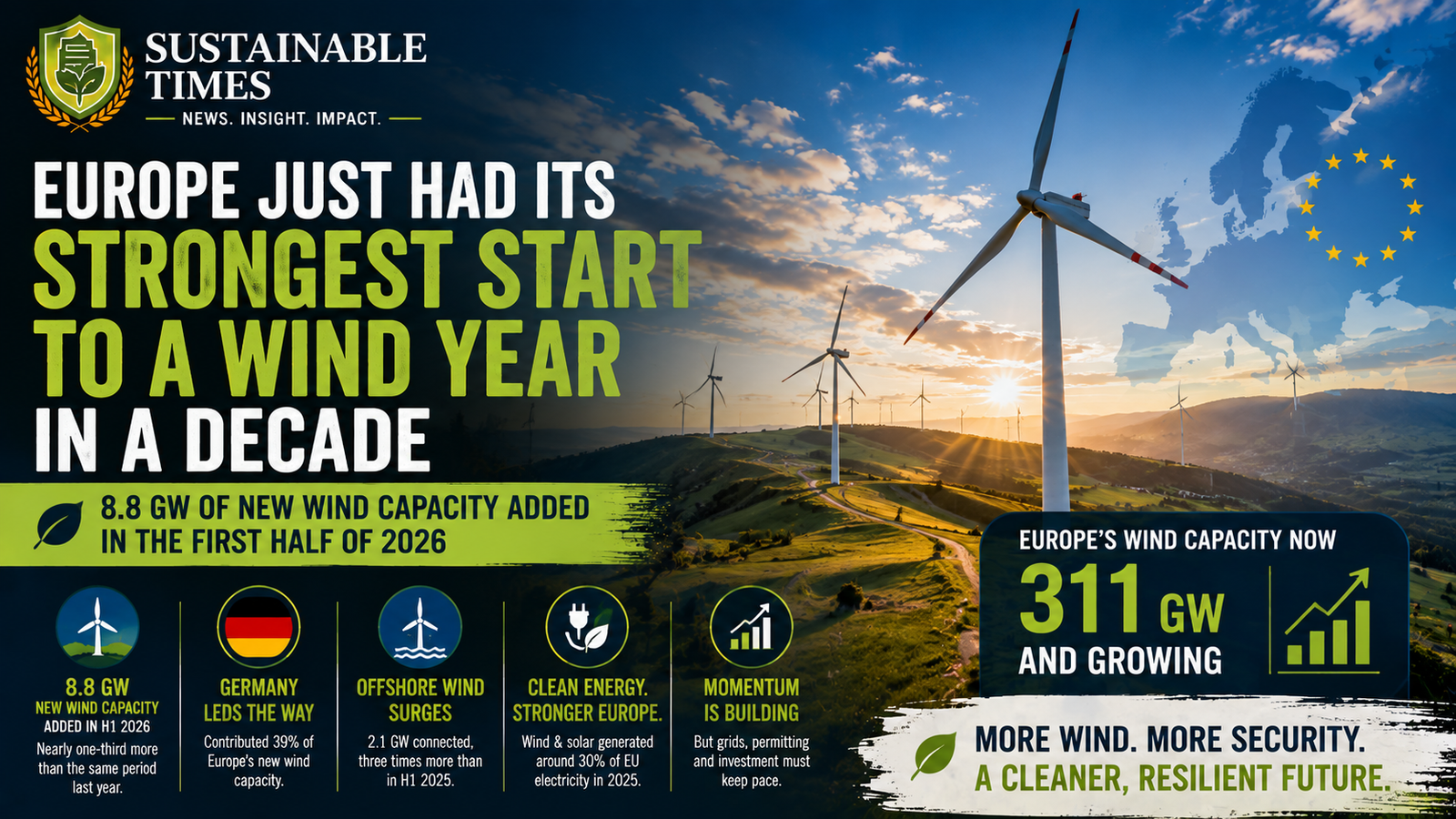
The continent installed 8.8 gigawatts (GW) of new wind-power capacity during the first half of 2026, almost one-third more than during the same period last year, according to new figures from WindEurope released today. Germany led the expansion, while offshore wind connections also accelerated sharply.
Europe now has around 311 GW of installed wind capacity, and the latest numbers suggest the industry could be heading for another record year.
But the bigger story is not simply how many turbines Europe installed.
It is what this growth says about the continent’s changing relationship with energy.
Germany Is Driving the Momentum
Germany accounted for 39% of Europe’s new wind capacity during the first half of the year, making it the strongest contributor to the latest expansion.
The country has been moving faster than many of its European neighbours on permitting and new wind development. That matters because Europe’s wind industry has faced a frustrating bottleneck for years: demand for clean electricity is growing, but projects can still spend years waiting for approvals, grid connections and suitable auction conditions.
Germany’s progress suggests that when permitting systems become more efficient, projects can move from planning to construction much faster.
The challenge now is getting the rest of Europe to match that pace.
Offshore Wind Is Finally Showing More Momentum
One of the most encouraging numbers in the latest data comes from the sea.
Europe connected 2.1 GW of new offshore wind capacity during the first six months of 2026, roughly three times the amount added during the same period last year.
Offshore wind has enormous potential because turbines can operate in stronger and more consistent winds than many land-based projects.
But the sector has also faced rising costs, supply-chain pressures and complicated permitting processes.
The latest acceleration therefore matters beyond the headline capacity figure. It suggests that some of Europe’s offshore projects are beginning to overcome the barriers that slowed development in recent years.
Wind Is Becoming Part of Europe’s Energy Security Strategy
Europe’s renewable-energy expansion is no longer driven by climate policy alone.
Energy security has become equally important.
The continent still depends on imported fossil fuels, exposing households and industries to international price shocks and geopolitical disruption. Wind, by contrast, uses a domestic resource that does not need to be imported every time electricity demand rises.
The European Commission says clean energy helped generate 70% of EU electricity in 2025, with wind and solar alone reaching around 30% and overtaking fossil fuels at 26%.
That changes the strategic value of renewable power.
Every additional wind farm can potentially reduce exposure to volatile fossil-fuel markets while supplying electricity to European homes and businesses.
The Grid Is Becoming the Next Big Test
There is, however, a catch.
Europe can build turbines faster than it can sometimes build the infrastructure needed to connect and manage them.
WindEurope has repeatedly identified permitting, electricity grids, electrification and auction design as major barriers to faster deployment.
That problem becomes more important as renewable generation grows.
A wind farm cannot deliver its full value if the grid cannot move its electricity to where consumers need it.
The next stage of Europe’s energy transition will therefore require much more than new turbines. It will require transmission lines, interconnections, storage, flexible demand and smarter electricity markets.
The Numbers Are Encouraging — But Europe Still Has a Long Way to Go
The latest growth is impressive, but Europe’s own targets remain demanding.
The EU wants to significantly expand renewable energy this decade, while its electricity system must also accommodate growing demand from electric vehicles, heat pumps, industry and data centres.
Eurostat reported that renewables supplied 45.5% of EU electricity generation in the first quarter of 2026, with wind remaining the largest renewable source.
That means Europe’s clean-energy system is already becoming fundamentally different from the one that existed a decade ago.
Yet the transition still needs to accelerate.
The European Commission’s energy strategy notes that electricity currently represents only about 23% of final energy consumption, meaning much of the energy used for transport, heating and industry still needs to shift from fossil fuels to electricity.
Why This Matters for Industry
Cheap, reliable electricity could become one of Europe’s biggest competitive advantages—or one of its biggest weaknesses.
Manufacturers are looking for ways to reduce emissions while keeping production costs under control. More domestic renewable power can help companies reduce exposure to fossil-fuel prices and support industrial electrification.
That creates a feedback loop.
More renewable electricity encourages more electrification. More electrification increases electricity demand. Higher demand creates stronger incentives to build renewable generation and grids.
The transition is gradually becoming an industrial transformation, not simply an environmental programme.
A New Energy Race Is Taking Shape
Europe’s wind expansion also reflects a much larger global trend.
China continues to dominate renewable-energy manufacturing and deployment, while the United States, India and other major economies are expanding their own clean-energy capacity.
Europe therefore faces two challenges at once: decarbonising its energy system and maintaining a competitive clean-technology industry.
Wind power sits directly at the intersection of both.
The continent has engineering expertise, established turbine manufacturers, offshore development experience and a large electricity market.
What it needs now is the infrastructure and policy environment to turn those advantages into sustained deployment.
Looking Ahead
The first half of 2026 has given Europe’s wind industry something it has been waiting for: momentum.
But momentum can disappear if permitting slows, grids remain congested or investment conditions deteriorate.
The coming months will reveal whether today’s strong start becomes a genuinely record-breaking year or simply a temporary improvement.
Either way, the direction is clear.
Europe is building more wind, connecting more offshore projects and increasingly treating renewable electricity as a pillar of both climate policy and energy security.
The next challenge is no longer proving that Europe can build wind power.
It is building everything around the turbines fast enough to use it.
Key Takeaway
Europe installed 8.8 GW of new wind capacity in the first half of 2026, nearly one-third more than during the same period last year. Germany led the expansion, while offshore wind connections tripled year-on-year. The numbers show strong momentum—but Europe’s ability to expand grids, accelerate permitting and electrify the wider economy will determine how far that momentum can go.
About The Author