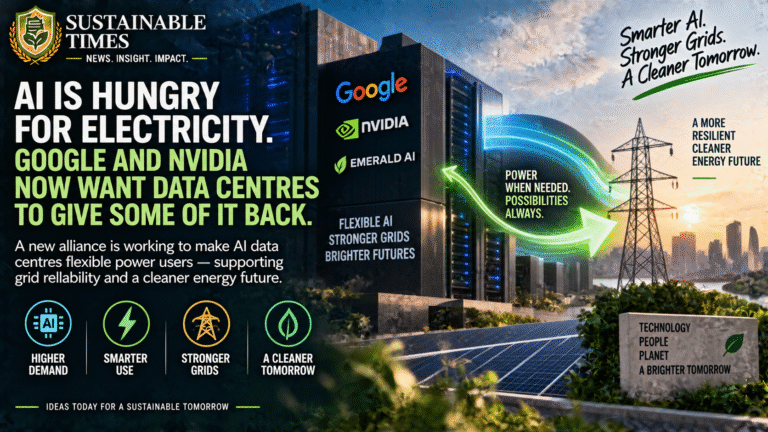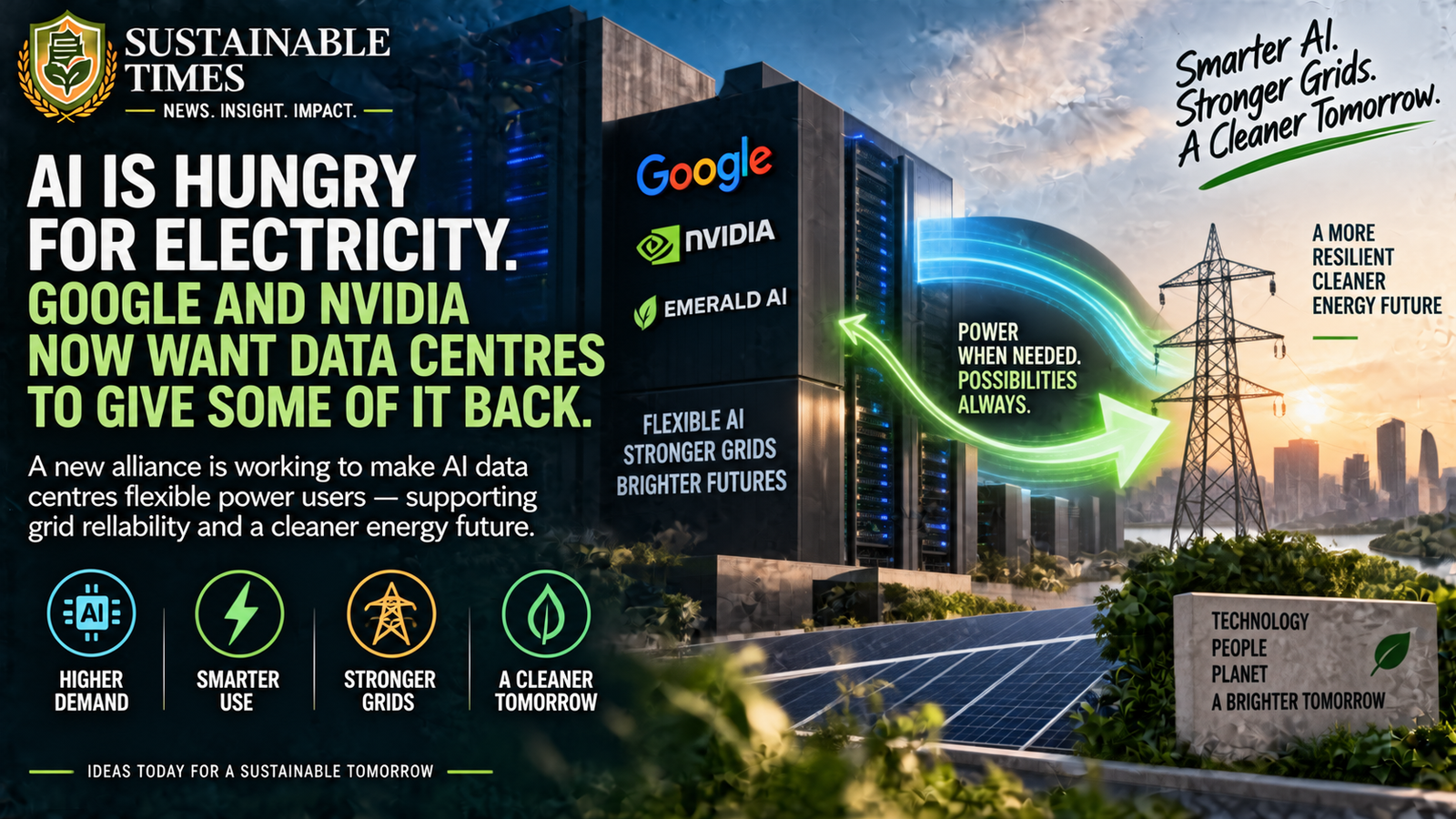
Artificial intelligence has a power problem.
The data centres driving the AI boom need enormous amounts of electricity, and utilities are struggling to build new generation and grid infrastructure quickly enough to serve them. In some regions, a new data centre can face years of waiting before it receives a grid connection.
Now, some of the biggest names in AI are proposing an unusual solution.
Instead of treating data centres as electricity users that demand constant power 24 hours a day, Google, NVIDIA and Emerald AI want them to become flexible participants in the power grid, reducing or shifting their electricity use when the system comes under pressure.
The three companies launched the AI Energy Management Alliance on September 16, bringing together companies from the AI, semiconductor, utility and power industries. The alliance says flexible data centres could help accelerate grid connections while supporting reliability and electricity affordability.
It is a significant change in the way the AI industry’s energy problem is being approached.
The question is no longer simply, Where will we find enough electricity for AI?
It is becoming:
Can AI learn to use the electricity system more intelligently?
The electricity demand behind the AI boom
The rapid expansion of generative AI has created a new infrastructure race.
Companies are building enormous computing facilities packed with specialised processors. Those machines need electricity not only to perform calculations, but also to run networking equipment, cooling systems and the wider infrastructure surrounding them.
The problem becomes particularly difficult during periods when the electricity grid is already under stress.
On a very hot afternoon, for example, households may increase air-conditioning use at exactly the same time that businesses and industrial facilities are consuming power. Utilities have to maintain enough capacity to handle those peaks even though demand falls considerably during other hours.
That leaves a potentially valuable resource sitting largely unused.
Flexibility.
What if a data centre could move its electricity demand?
This is the idea behind the new alliance.
Not every computing task needs to happen at exactly the same second.
Some workloads can potentially be delayed, shifted or temporarily reduced. Batteries can provide additional power during periods of grid stress. Software can coordinate computing loads with electricity conditions.
Instead of demanding the same amount of electricity continuously, a flexible data centre could respond to signals from the grid.
When electricity is abundant, it can operate normally.
When the grid becomes constrained, it can temporarily reduce its demand or use alternative resources.
Once the pressure passes, computing can return to normal.
The goal is not to switch off AI.
It is to make some parts of AI computing more responsive to the electricity system around them.
NVIDIA says the alliance is intended to accelerate the deployment of flexible, grid-enhancing data centres while maintaining reliability and protecting affordability.
Why this could change the data-centre race
The electricity connection itself is becoming a bottleneck for AI infrastructure.
Emerald AI CEO Varun Sivaram said in a statement accompanying the alliance’s launch that new US data centres can face waits of a decade or more for grid connections. The company argues that flexible facilities could help utilities connect large loads more quickly because those facilities would not require the grid to provide their maximum electricity demand at every moment.
That creates an unusual bargain.
The data centre gets electricity sooner. The grid gets a more manageable customer.
If the model works, utilities may not need to build every piece of new infrastructure around the assumption that an AI facility will always consume its maximum possible load.
The alliance is therefore trying to turn flexibility into something with economic value.
Data centres that can demonstrably reduce demand when the grid needs relief could potentially receive faster or larger grid connections.
Google is already testing the idea
This is not entirely theoretical.
Google says it already operates a nationwide demand-response portfolio of roughly one gigawatt, allowing parts of its electricity consumption to respond to grid conditions. Emerald AI and NVIDIA have also completed demonstrations of flexible data-centre operations.
Another demonstration is planned in Virginia later this year.
NVIDIA, Digital Realty and Emerald AI intend to operate a nearly 100-megawatt power-flexible AI facility, designed to show that a data centre can behave as a controllable electricity load rather than a permanently fixed one.
That demonstration could become an important test.
It is one thing to show that a small computing facility can reduce its electricity consumption.
It is another to do it at the scale of a major AI installation without disrupting the performance of the systems running inside it.
The technology behind flexible AI factories
Making a data centre flexible does not necessarily mean simply turning computers off.
There are several ways operators can manage demand.
Software can move less urgent computing workloads to another time.
Batteries can temporarily supply electricity during periods of peak demand.
On-site generation can provide additional power.
Computing resources can be adjusted so that the facility consumes less electricity without interrupting critical operations.
NVIDIA’s recent work with Emerald AI demonstrates how software can receive signals about grid conditions and automatically adjust flexible computing workloads.
That introduces a new concept into the AI infrastructure industry:
tokens per watt.
The objective is not simply to build bigger AI systems.
It is increasingly about getting more useful computing from every unit of electricity.
There is a climate story here, but it is not as simple as “AI goes green”
This development should not be mistaken for proof that AI is becoming environmentally friendly.
AI data centres will continue to consume large quantities of electricity.
More computing means more infrastructure, more cooling and more power demand.
The environmental benefit depends heavily on what electricity supplies the grid and what happens to the electricity demand that is shifted elsewhere.
If flexible computing allows utilities to avoid expensive new fossil-fuel generation or reduces the need for major grid expansion, the climate benefits could be meaningful.
But if operators simply shift consumption from one period to another without reducing emissions, the climate benefit could be much smaller.
That is why the most important part of this experiment may be how the flexibility is measured.
A data centre should not receive sustainability benefits merely for claiming that it can reduce demand.
Utilities and regulators need to know when it reduced demand, by how much and whether the reduction actually helped the grid.
The alliance is bringing the power industry into the AI conversation
The new coalition includes organisations from both sides of the equation.
Its launch partners include AI and semiconductor companies as well as utilities and power producers such as National Grid, AES, RWE, Constellation and NRG, alongside companies including Anthropic.
That matters because the AI electricity challenge cannot be solved by technology companies alone.
Utilities control the networks.
Power producers supply electricity.
Regulators decide how large customers connect to the grid.
Data-centre operators control when and how computing takes place.
The alliance is effectively trying to create a common language between these industries.
Could flexibility lower electricity costs?
There is a potentially important economic argument behind the idea.
Electricity grids are expensive partly because they have to prepare for peak demand.
A utility may need enough generation and transmission capacity to handle a few extremely demanding hours, even though that infrastructure sits less heavily used during much of the year.
If large AI facilities can reduce their demand during those critical periods, the existing grid could potentially serve more customers before expensive new infrastructure becomes necessary.
Emerald AI cites research from the Brattle Group suggesting that a 10% improvement in grid utilisation could reduce electricity rates by around 3.4%. That figure is an estimate rather than a guaranteed outcome, and its applicability will depend on local market conditions.
Still, the underlying idea is compelling.
The cleanest megawatt may sometimes be the one that does not require a new power plant or transmission line because the existing system was used more intelligently.
But regulators will have to trust the machines
There is a catch.
Grid operators cannot rely on promises.
If a data centre receives preferential treatment because it says it can reduce electricity consumption during emergencies, that reduction must actually happen when required.
A failure could create problems precisely when the grid is already under pressure.
That means flexible data centres will need measurable performance standards, clear obligations and reliable communication with utilities.
The alliance is pushing for policies that reward facilities capable of providing verified flexibility to the electricity system.
This could eventually create a new category of infrastructure.
Instead of asking:
How much electricity does this data centre need?
Utilities could also ask:
How flexible is this data centre?
That would be a significant change.
The bigger lesson for the AI era
For years, the digital economy treated electricity as something that would simply be available whenever computing demand increased.
The AI boom is challenging that assumption.
The next generation of data centres will have to compete not only for chips, land and fibre connections, but also for electricity and grid capacity.
That pressure could force the industry to become much more creative about how it consumes power.
The AI Energy Management Alliance is one attempt to solve that problem.
Its success is far from guaranteed.
The technology must work at commercial scale. Utilities must trust the systems. Regulators must establish enforceable rules. Data-centre operators must accept that flexibility can sometimes be more valuable than constant maximum consumption.
But if those pieces come together, something interesting could happen.
AI data centres could stop being viewed purely as enormous new electricity loads.
They could become active participants in the electricity system itself.
And that may be one of the most important developments in the sustainability story of AI.
The future of artificial intelligence may depend on having more electricity.
But it may also depend on learning how to use the electricity we already have much better.
About The Author