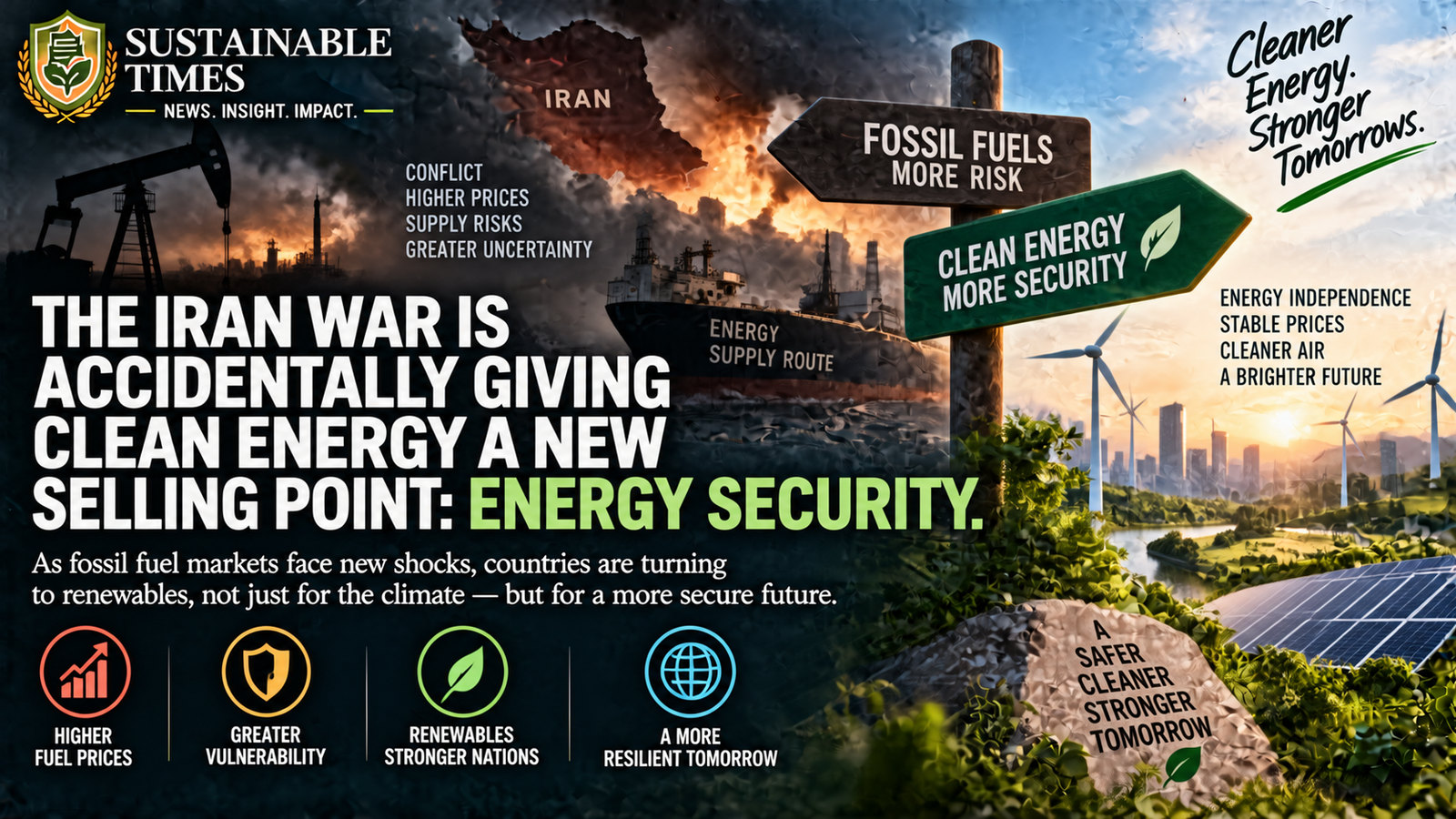
For years, the argument for renewable energy was largely about climate change.
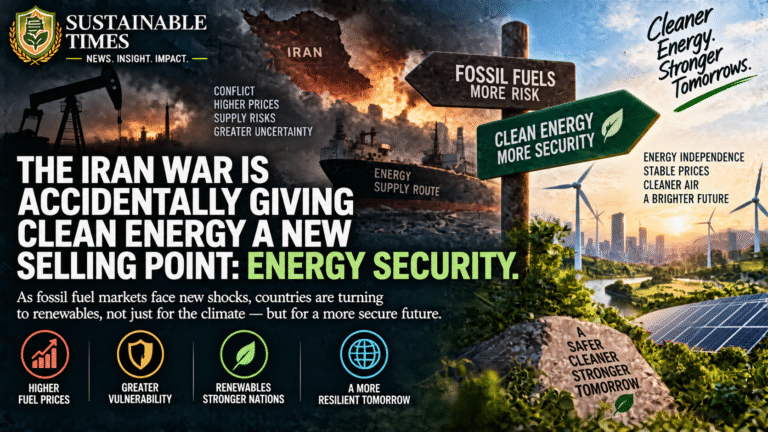
Now, an entirely different argument is becoming impossible to ignore: security.
The continuing conflict involving Iran has disrupted major fossil-fuel supply routes, pushed oil and gas prices sharply higher and exposed how vulnerable countries can become when they depend heavily on imported energy.
At the same time, governments that have invested in solar, wind, batteries, electric vehicles and energy efficiency are discovering something unexpected.
Those investments are not only helping them cut emissions.
They can also reduce their exposure to geopolitical shocks.
A new analysis reported by The Associated Press this week shows that more than 30 governments have introduced policies promoting renewable energy or efficiency since the conflict began, even though global clean-energy investment fell during the first half of 2026. The picture is far from a straightforward clean-energy victory, but the crisis is changing the way governments think about energy independence.
The question now is whether this shift will survive after the immediate crisis fades.
Fossil fuel dependence suddenly has a much bigger price tag
The scale of the financial shock is striking.
Research from the Centre for Research on Energy and Clean Air estimates that fossil-fuel importing countries paid around $330 billion more for seaborne crude oil, oil products and LNG during the six months following the strikes than they would have paid based on pre-war market expectations. The European Union, China and India were among the biggest absolute losers.
That number changes the climate conversation.
A solar panel does not become more expensive because a shipping route in the Middle East is disrupted.
A wind turbine does not suddenly require more fuel because an oil-producing region becomes inaccessible.
Once renewable infrastructure is operating, its energy source is not exposed to the same daily price volatility as imported fossil fuels.
That does not make renewable energy completely immune to geopolitical risks. Equipment, minerals, manufacturing capacity and international supply chains still matter.
But the fuel itself is free.
And that distinction is becoming increasingly valuable.
The countries that invested earlier are already seeing the difference
The same CREA research estimates that clean electricity capacity added since 2020 saved importing countries approximately $36 billion in avoided fossil-fuel imports during the first five months of the crisis.
That is perhaps the most interesting number in the entire story.
The clean-energy investments were made before the current crisis.
Governments did not build those solar farms and wind projects knowing exactly what was going to happen in 2026.
But when fossil-fuel prices surged, those earlier investments suddenly became a form of economic protection.
China and Japan recorded some of the largest estimated savings, while countries including Spain, France, Italy, the Netherlands, Brazil and India also benefited.
The lesson is straightforward.
Energy security can be built before a crisis, or paid for during one.
Asia is getting the message particularly quickly
Asian economies have been among the most exposed to the disruption because many depend heavily on imported oil and LNG.
The International Energy Agency says governments are responding in different ways. Some are increasing fossil-fuel supply or switching from gas to coal, while others are accelerating renewable energy and electrification.
That difference is important.
A country facing an immediate electricity shortage cannot simply replace an LNG shipment with a solar farm overnight.
But the crisis can influence what that country decides to build over the next five, ten or twenty years.
Thailand, for example, is increasing its renewable ambitions, while other Asian economies are looking more closely at rooftop solar, batteries and domestic electricity generation. India and other major importers also face growing pressure to reduce their exposure to international fossil-fuel prices.
The result could be a gradual change in national energy strategies.
Instead of asking only, “What is the cheapest energy today?”
Governments may increasingly ask:
“What energy system leaves us least vulnerable tomorrow?”
But the crisis is also pushing some countries backwards
This is where the story becomes complicated.
The energy shock has not automatically produced a global rush toward clean energy.
Some countries are burning more coal because LNG has become expensive or difficult to obtain.
Others are increasing domestic oil and gas production.
Governments have also introduced fuel subsidies and tax measures to protect consumers from higher energy costs.
The International Energy Agency’s policy tracker shows that governments have adopted very different responses to the crisis, ranging from energy conservation and fuel switching to increased supply and accelerated renewable deployment.
That means the conflict could produce two opposing effects at the same time.
Some governments may conclude that renewable energy and electrification are the safest long-term path.
Others may decide that the immediate priority is simply securing more fossil fuels.
The climate outcome will depend on which response becomes permanent.
The clean-energy transition is facing an unusual contradiction
There is another problem.
The geopolitical crisis is increasing the economic appeal of renewable energy while simultaneously making parts of the clean-energy supply chain more difficult.
Solar panels, batteries, transmission equipment and electric vehicles depend on global manufacturing networks and raw materials.
Disruptions to shipping and industrial production can therefore increase the cost of building clean infrastructure just when governments want to accelerate it.
The conflict has also pushed up the price of some materials and transport, creating a new challenge for countries trying to build clean-energy systems quickly.
So the answer cannot simply be “build more renewables.”
Countries also need stronger domestic manufacturing, diversified supply chains, electricity storage and modern transmission networks.
Energy independence is not achieved by replacing one dependency with another.
The electricity system may become the real battlefield
The most important long-term shift may actually happen beyond solar panels and wind turbines.
It could happen in the electricity grid.
The world is becoming increasingly electrified. The IEA’s Fatih Birol said this week that global electricity demand is growing around three times faster than overall energy demand, with 61% of global energy investment in 2026 directed toward electricity.
That means countries will need far more generation, transmission and storage capacity.
AI data centres are adding another layer of demand.
Electric vehicles are moving transportation toward electricity.
Heat pumps and electric industrial equipment are increasing electricity use.
At the same time, countries want to reduce their exposure to imported oil and gas.
The electricity grid is therefore becoming the backbone of both economic growth and energy security.
India’s position is particularly interesting
India sits at the centre of this discussion.
The country remains one of the world’s major energy importers, leaving it exposed to international oil and gas price movements.
At the same time, India has rapidly expanded renewable-energy capacity and continues to invest in solar power, batteries, electrification and domestic clean-energy manufacturing.
The current crisis makes those investments more than climate policy.
They become part of an economic risk-management strategy.
Every additional unit of electricity generated domestically from solar or wind can potentially reduce the amount of imported fuel required to meet future demand.
That does not mean India can immediately move away from fossil fuels.
It cannot.
India’s electricity demand is rising rapidly, and coal and other conventional sources remain important to the country’s energy system.
But the economics of reducing fossil-fuel dependence become easier to explain when the alternative is not just lower emissions.
It is also greater control over the country’s energy future.
Clean energy still has to prove it can deliver reliability
There is a reason governments remain cautious.
A modern economy cannot run on energy that is cheap but unreliable.
Factories need predictable electricity.
Hospitals cannot wait for the sun to return.
Data centres require continuous power.
Cities cannot afford large-scale outages.
That means the next phase of the transition will depend heavily on batteries, transmission, flexible demand, energy storage and better grid management.
Solar and wind can provide enormous amounts of electricity, but countries need systems capable of balancing variable generation with demand.
This is also why the recent growth of battery storage is so important.
Storage can turn electricity generated during periods of abundant renewable production into power available later, reducing the need to rely on fossil-fuel plants during some periods of high demand.
The clean-energy transition is therefore becoming less about installing individual projects and more about building an entire resilient energy ecosystem.
The biggest question is what happens when oil prices fall again
This may determine whether the current moment becomes a genuine turning point.
Energy crises have a short memory.
When fuel prices rise, consumers and governments look for alternatives.
When prices fall, urgency can disappear.
That pattern has happened before.
The current crisis could produce another temporary rush toward renewable energy, followed by a return to business as usual once fossil fuels become cheaper.
Or governments could treat the experience as a warning and continue investing in domestic electricity generation, efficiency, storage and electrification even after markets stabilise.
The difference will depend on policy.
If countries build long-term incentives around clean electricity and energy efficiency, today’s crisis could accelerate structural change.
If they respond only with temporary subsidies and emergency fossil-fuel measures, much of the momentum could disappear.
Climate policy is becoming energy-security policy
Perhaps the most important change is happening in the language itself.
Renewable energy is no longer only being sold as a tool for reducing carbon emissions.
It is increasingly being presented as a way to reduce exposure to geopolitical risk, protect consumers from fuel-price shocks and strengthen national energy independence.
That argument can reach audiences that traditional climate messaging sometimes struggles to reach.
A government does not need to agree on every aspect of climate policy to understand the economic danger of depending on a vulnerable international fuel supply.
And a business does not need to be motivated primarily by environmental concerns to value predictable energy costs.
That could make energy security one of the strongest drivers of the next phase of the clean-energy transition.
The irony is difficult to miss.
A war centred on fossil-fuel geopolitics is creating new reasons for countries to reduce their dependence on fossil fuels.
Whether those reasons are strong enough to overcome short-term political and economic pressures remains uncertain.
But one lesson is becoming increasingly clear.
The clean-energy transition is no longer only about saving the climate. For many countries, it is becoming a way to protect the economy from the next energy crisis.
About The Author