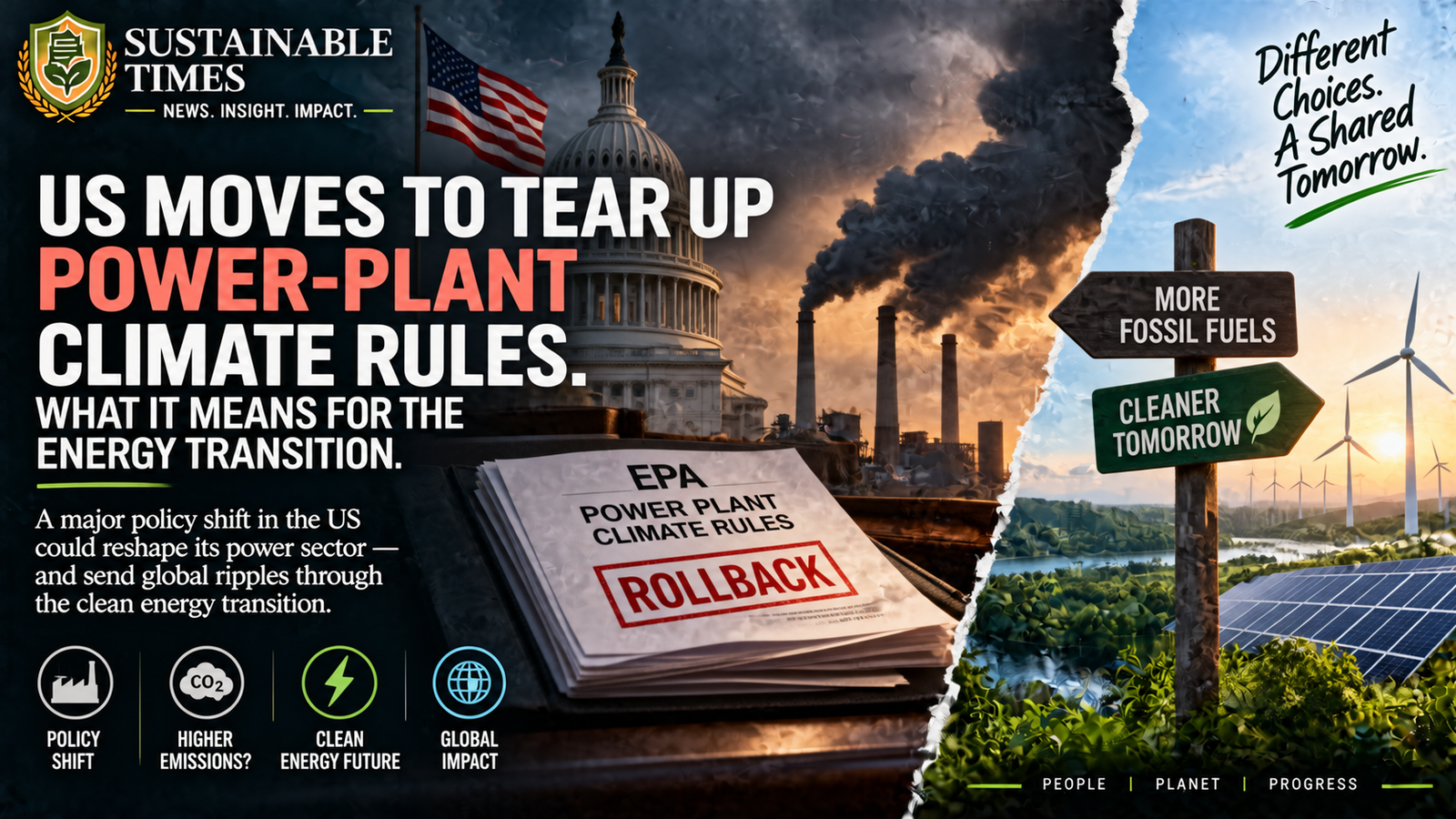
The United States has taken another major step away from federal climate regulation of the power sector, and the decision could have consequences well beyond American power plants.
The U.S. Environmental Protection Agency under Administrator Lee Zeldin is moving to rescind the legal findings underpinning federal greenhouse-gas regulation of fossil-fuel power plants and repeal associated carbon standards. The action was unveiled as the G20 energy ministers met in Houston and represents a sharp reversal from the power-sector climate rules finalized under the previous administration.
The significance goes beyond one country’s electricity policy. The United States remains one of the world’s largest energy producers and consumers, while its regulatory decisions influence investment, technology deployment and expectations across global energy markets.
A major reversal for the US power sector
The rules now targeted by the EPA were finalized in 2024. They established carbon standards for existing coal-fired power plants and new natural-gas-fired plants, with requirements based partly on technologies such as carbon capture and storage.
When the rules were finalized, the EPA estimated that they could prevent 1.38 billion metric tons of carbon dioxide emissions through 2047. The agency also projected as much as $370 billion in combined climate and public-health benefits over the same period.
The current EPA argues that those regulations exceeded the agency’s legal authority and imposed unnecessary costs on the electricity sector. Its latest proposal argues that greenhouse gases from fossil-fuel power plants do not meet the statutory threshold required for regulation under the relevant section of the Clean Air Act.
The administration has presented the change as an effort to reduce regulatory costs, strengthen electricity reliability and encourage greater energy production.
That argument is central to the policy shift. The EPA’s earlier 2025 proposal to repeal the power-sector greenhouse-gas standards estimated that the move could save the power industry around $19 billion in regulatory costs over two decades, or roughly $1.2 billion annually.
But the climate consequences are the bigger question
For climate scientists and environmental groups, the concern is straightforward.
Removing federal carbon standards does not automatically mean every coal or gas plant will suddenly increase emissions. Electricity markets, state regulations, economics and the continued expansion of renewable energy will still influence how utilities operate.
But federal standards can establish a common baseline across the country. Removing them potentially gives fossil-fuel generators greater flexibility to continue operating without having to meet the carbon-control requirements previously established by Washington.
That matters because the US power sector is already undergoing a complicated transformation.
Solar, wind, batteries and other low-carbon technologies are expanding rapidly, while electricity demand is also rising because of data centres, manufacturing, electric vehicles and building electrification. The policy question is therefore no longer simply whether the US needs more electricity.
It is increasingly about what kind of electricity system the country builds to meet that demand.
The timing makes the decision even more important
The rollback arrives at a moment when the global energy system is moving in two directions at once.
Countries are adding renewable generation at unprecedented scale, but they are also confronting concerns about grid reliability, transmission capacity, energy security and rapidly growing electricity consumption.
That tension has made natural gas particularly important in some markets. Gas-fired generation can provide dispatchable electricity when renewable generation falls, while batteries and stronger transmission networks are still being deployed.
The US administration argues that restricting fossil-fuel generation could make it harder to meet rising electricity demand.
Critics counter that weakening carbon regulation could lock in higher-emitting infrastructure precisely when investment is moving toward cleaner technologies.
The disagreement is therefore not simply about coal versus solar. It is about how quickly an electricity system can move toward lower emissions while remaining affordable and reliable.
States could become the next battleground
Federal deregulation does not mean the entire US electricity system will suddenly operate under one less-restrictive standard.
Individual states can maintain their own climate and air-pollution policies, and several states already have significantly stronger emissions requirements than the federal government.
That creates the possibility of an increasingly fragmented US energy landscape.
A power company operating in one state could face very different climate requirements from a similar facility in another. For utilities and investors, that could make long-term planning more complicated.
It could also intensify legal battles.
The EPA’s current action is built around questions of statutory authority and the scope of federal regulatory power. Given the importance of the Clean Air Act and the scale of the climate regulations involved, the policy is likely to face significant scrutiny and potential litigation.
What this means for clean energy
There is an important part of the story that can easily get overlooked.
The US decision does not stop the economic forces pushing renewable energy forward.
Solar and wind projects can still be cheaper than fossil-fuel alternatives in many locations. Battery storage continues to improve. Corporations continue to sign clean-energy contracts. States continue to pursue their own climate targets.
That means America’s clean-energy transition will not necessarily stop because federal carbon rules are being weakened.
Instead, the transition could become more dependent on economics, state policy, corporate procurement and investment decisions.
That distinction matters.
If clean technologies continue to become cheaper and more reliable, they can keep gaining market share even without stronger federal carbon regulation. But if policy uncertainty discourages investment in clean infrastructure or encourages additional long-lived fossil-fuel capacity, the country’s emissions trajectory could become harder to change later.
A global signal
The United States’ climate policy has consequences beyond its borders.
Developing countries are watching how major economies balance energy security, industrial competitiveness and emissions reduction. At the same time, international companies are making investment decisions based on expectations about future carbon regulation and clean-energy demand.
A weaker US federal climate framework could therefore send a complicated signal.
It may reassure fossil-fuel producers and energy-intensive industries that policymakers are prioritizing energy supply and regulatory flexibility.
But it could also make global climate coordination more difficult at a time when governments are already struggling to close the gap between current policies and the emissions reductions needed to limit warming.
The bigger story is not simply that one set of regulations is being dismantled.
It is that the world’s largest economies are increasingly pursuing different pathways through the energy transition.
The US is putting greater emphasis on energy production, deregulation and reliability. Other economies are doubling down on renewable deployment, electrification, carbon pricing and industrial decarbonisation.
The outcome of those competing approaches will be measured not only in tonnes of carbon dioxide, but also in electricity prices, industrial competitiveness, investment flows and the speed at which cleaner technologies become the backbone of the global energy system.
For the climate transition, that makes the US decision one to watch very closely.
About The Author