For years, the global palm oil debate has focused on international buyers. Food companies, cosmetics brands and retailers have faced growing pressure to ensure their products do not contribute to tropical deforestation.
But new research suggests that much of the attention may have been directed toward only part of the problem.
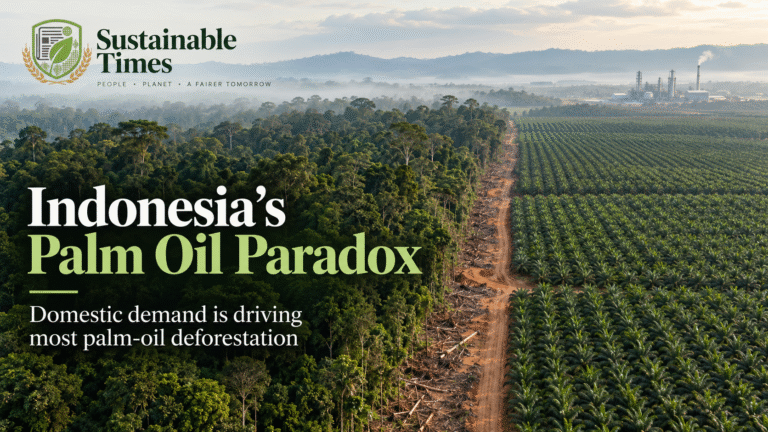
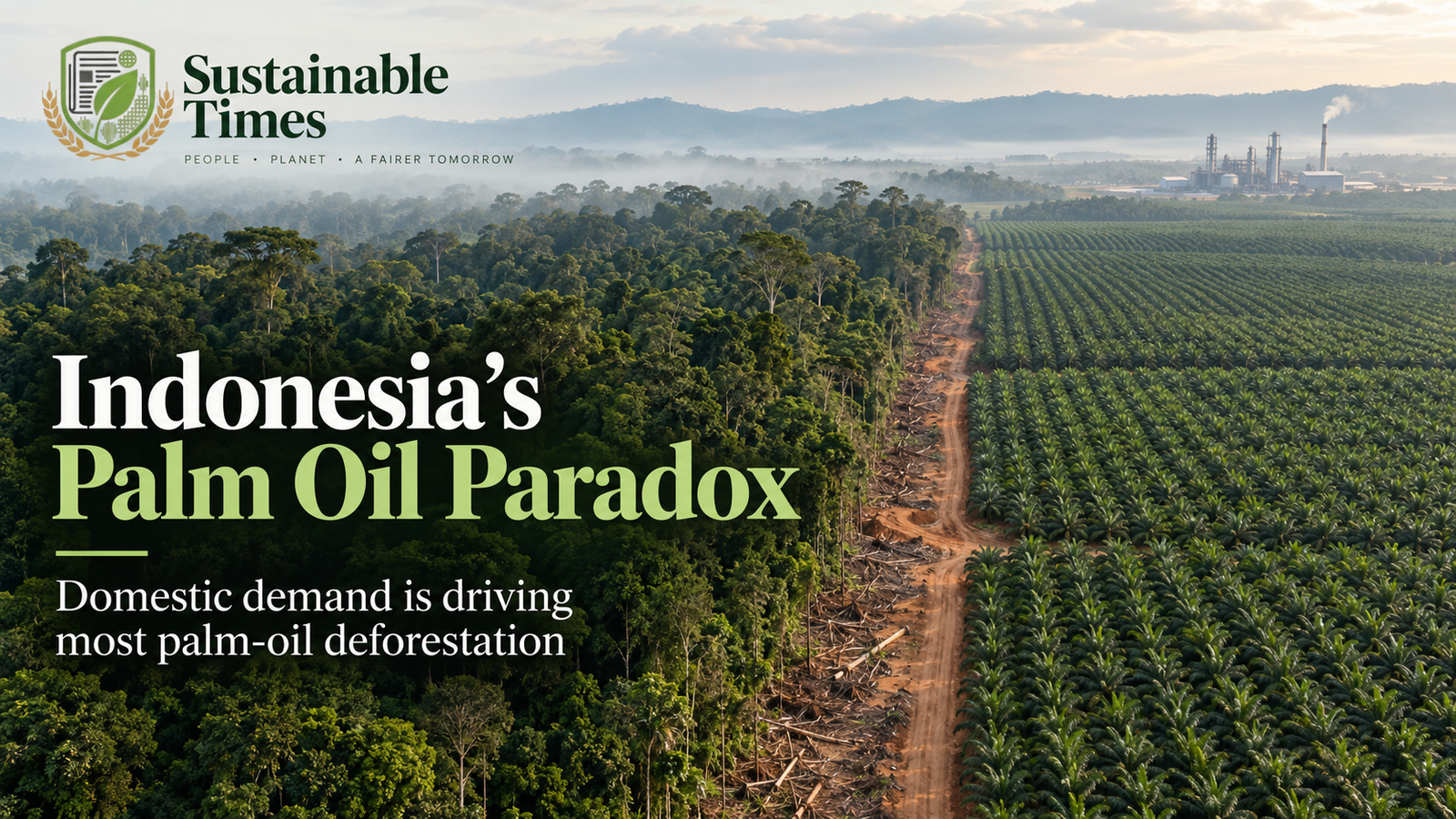
A supply-chain analysis released on 13 October 2026 by Trase, an initiative led by Global Canopy and the Stockholm Environment Institute, reveals that Indonesia’s domestic market was linked to 67% of the deforestation associated with palm oil production in 2024.
That is nearly nine times the deforestation exposure linked to exports to India, Indonesia’s largest foreign palm oil market.
The findings challenge a long-standing assumption about the industry’s environmental footprint. While international buyers continue to influence sustainable sourcing, Indonesia’s growing consumption of palm oil at home has become an increasingly important factor in the future of its forests.
The World’s Largest Palm Oil Producer Is Also Becoming Its Biggest Customer
Indonesia dominates global palm oil production.
In 2024, the country produced approximately 47 million tonnes of palm oil, supplying food manufacturers, industrial processors and energy producers across international markets.
Yet the latest figures show that Indonesia consumed more than half of that production domestically.
Local consumption reached approximately 24.6 million tonnes, accounting for 53% of national output.
That marks an important change for an industry traditionally associated with international exports.
Palm oil remains a valuable source of export earnings, but domestic demand is now shaping a growing share of the market.
Food consumption and industrial processing contribute to that demand. However, one of the most significant drivers is Indonesia’s expanding biodiesel programme.
As the country seeks to reduce dependence on imported fossil fuels, palm oil has become an important ingredient in its transport-fuel strategy.
And that creates an uncomfortable sustainability question.
Can a policy designed to improve energy security also increase pressure on tropical forests?
Biodiesel Is Changing the Economics of Palm Oil
Indonesia has spent years increasing the proportion of palm-based biodiesel blended into conventional diesel.
Its B35 programme required diesel fuel to contain a 35% biodiesel blend, while subsequent policy developments have pushed the country toward higher blending levels.
These programmes aim to support domestic agriculture, reduce fossil-fuel imports and strengthen national energy security.
But producing more biofuel also requires feedstock.
When domestic demand rises, producers may have an incentive to increase yields or expand cultivation.
Expansion becomes environmentally damaging when it replaces natural forests or carbon-rich ecosystems.
The new Trase analysis does not suggest that every litre of Indonesian biodiesel directly causes deforestation.
Instead, it demonstrates why policymakers need to examine the entire supply chain when assessing the environmental benefits of biofuel policies.
A fuel may reduce dependence on petroleum while still creating land-use emissions elsewhere.
The overall climate benefit therefore depends on where the feedstock comes from and how it is produced.
Deforestation Has Fallen, but the Risk Has Not Disappeared
There is encouraging news in the research.
Indonesia’s palm oil-driven deforestation has declined substantially from historical levels.
The analysis estimates that palm oil expansion caused approximately 32,000 hectares of forest loss in 2024, far below the annual average recorded between 2008 and 2015.
That decline suggests previous efforts to control expansion, improve supply-chain practices and protect forests have delivered meaningful progress.
However, the latest data also reveals worrying regional trends.
In Papua, palm oil-driven deforestation more than doubled between 2024 and 2025, increasing from approximately 3,600 hectares to 7,300 hectares.
Meanwhile, Kalimantan accounted for around 56% of Indonesia’s palm oil-related deforestation in 2025.
These regional differences matter.
A national decline can conceal growing pressure in particular landscapes, especially where intact forests remain vulnerable to agricultural expansion.
For conservation organisations, the challenge is now to prevent renewed expansion from reversing earlier progress.
Peatlands Are Another Major Climate Concern
Forest clearing is only one part of palm oil’s environmental footprint.
Indonesia also contains extensive tropical peatlands, which store enormous quantities of carbon accumulated over long periods.
When developers drain peatlands for plantations, the exposed peat can gradually decompose and release greenhouse gases.
Dry peat can also become highly vulnerable to fire.
According to the new analysis, peat subsidence associated with palm oil plantations generated approximately 148 million tonnes of CO₂-equivalent emissions in 2024.
Peat subsidence and peat burning together accounted for nearly 85% of the greenhouse-gas emissions assessed for the sector.
That makes peatland protection a crucial part of any credible palm oil sustainability strategy.
Preventing additional forest conversion matters, but protecting existing carbon-rich landscapes may deliver equally important climate benefits.
Why International Supply-Chain Rules Are Not Enough
Over the past decade, major international buyers have introduced stronger sustainability commitments.
Companies have adopted deforestation-free sourcing policies, improved satellite monitoring and expanded traceability programmes.
European regulations are also increasing expectations around the environmental origins of agricultural commodities.
But the Trase findings expose a limitation in strategies focused primarily on exports.
If international buyers improve their sourcing requirements while domestic markets continue purchasing palm oil without equivalent transparency, significant environmental risks can remain outside international monitoring systems.
The researchers therefore argue that Indonesia needs stronger reporting on domestic buyers and more accessible information about sourcing locations.
This does not reduce the responsibility of overseas companies.
Instead, it shows that deforestation-free production must become an industry-wide objective rather than a standard applied only to selected export markets.
Small Farmers Cannot Be Left Behind
Any serious effort to improve the palm oil industry must also address the people who produce it.
Smallholder farmers account for approximately 35% of Indonesia’s palm oil production.
Many face difficulties obtaining secure land tenure, financing plantation improvements and complying with increasingly demanding traceability requirements.
These challenges can limit their ability to participate in sustainable supply chains.
For some farmers, improving productivity on existing plantations may offer a more practical alternative to expanding into new land.
But higher yields require access to quality planting materials, agricultural training and long-term investment.
Sustainability programmes that overlook those financial realities risk excluding smaller producers while favouring larger plantation operators.
The most effective reforms will need to combine forest protection with economic opportunities for farming communities.
India Remains an Important Part of the Story
Although the new research places greater attention on Indonesia’s domestic market, international buyers still play a significant role.
India remained the largest export destination for Indonesian palm oil in 2024.
Pakistan moved ahead of China to become the second-largest market.
For India, palm oil remains an important ingredient in the food industry and a major component of edible-oil imports.
That makes responsible sourcing relevant to Indian manufacturers, retailers and consumers.
Companies can strengthen supplier due diligence, improve traceability and work with producers that demonstrate credible forest-protection practices.
However, the latest research suggests that international purchasing standards alone cannot solve Indonesia’s deforestation challenge.
Domestic policy, agricultural productivity and land-use governance will also determine the industry’s environmental future.
The Real Question Is How Palm Oil Grows From Here
Palm oil presents a difficult sustainability dilemma.
It is a highly productive vegetable-oil crop that supports millions of livelihoods and provides important raw materials for food and industry.
Replacing it indiscriminately with other vegetable oils could require additional agricultural land, depending on the crops and production systems involved.
The challenge is therefore not simply to eliminate palm oil.
It is to prevent further destruction of natural ecosystems while producing the oil that markets continue to demand.
The new Trase findings suggest that future progress will depend on stronger domestic supply-chain transparency, better protection of peatlands and forests, improved yields on existing plantations and more meaningful support for smallholders.
Indonesia has already demonstrated that palm oil-related deforestation can decline significantly.
Maintaining that progress while domestic demand grows will be the harder test.
And the latest research has made one point especially clear.
Protecting Indonesia’s forests is no longer only about what the world buys from the country. It is increasingly about what Indonesia consumes itself.
About The Author