For years, residents of Pamarawan, a small fishing village on the edge of Manila Bay, watched floodwater enter their streets and homes whenever strong monsoon winds pushed waves toward the coastline.
The village already had a concrete breakwater. It stood several metres high, yet powerful waves could still cross the barrier during severe weather.
Now, an unusual coastal protection project is beginning to change that experience.
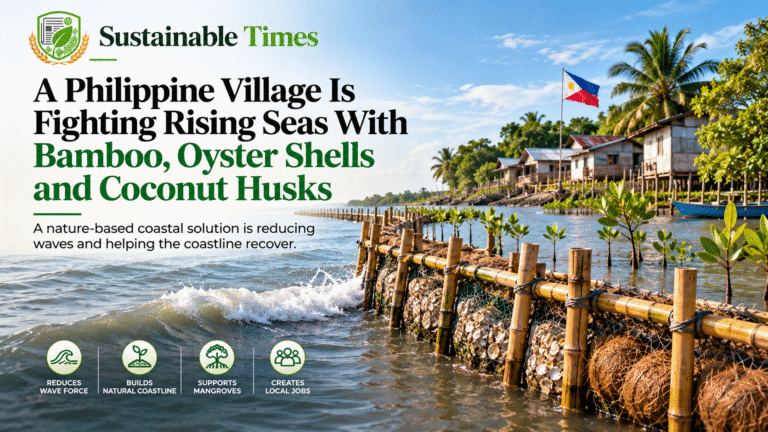
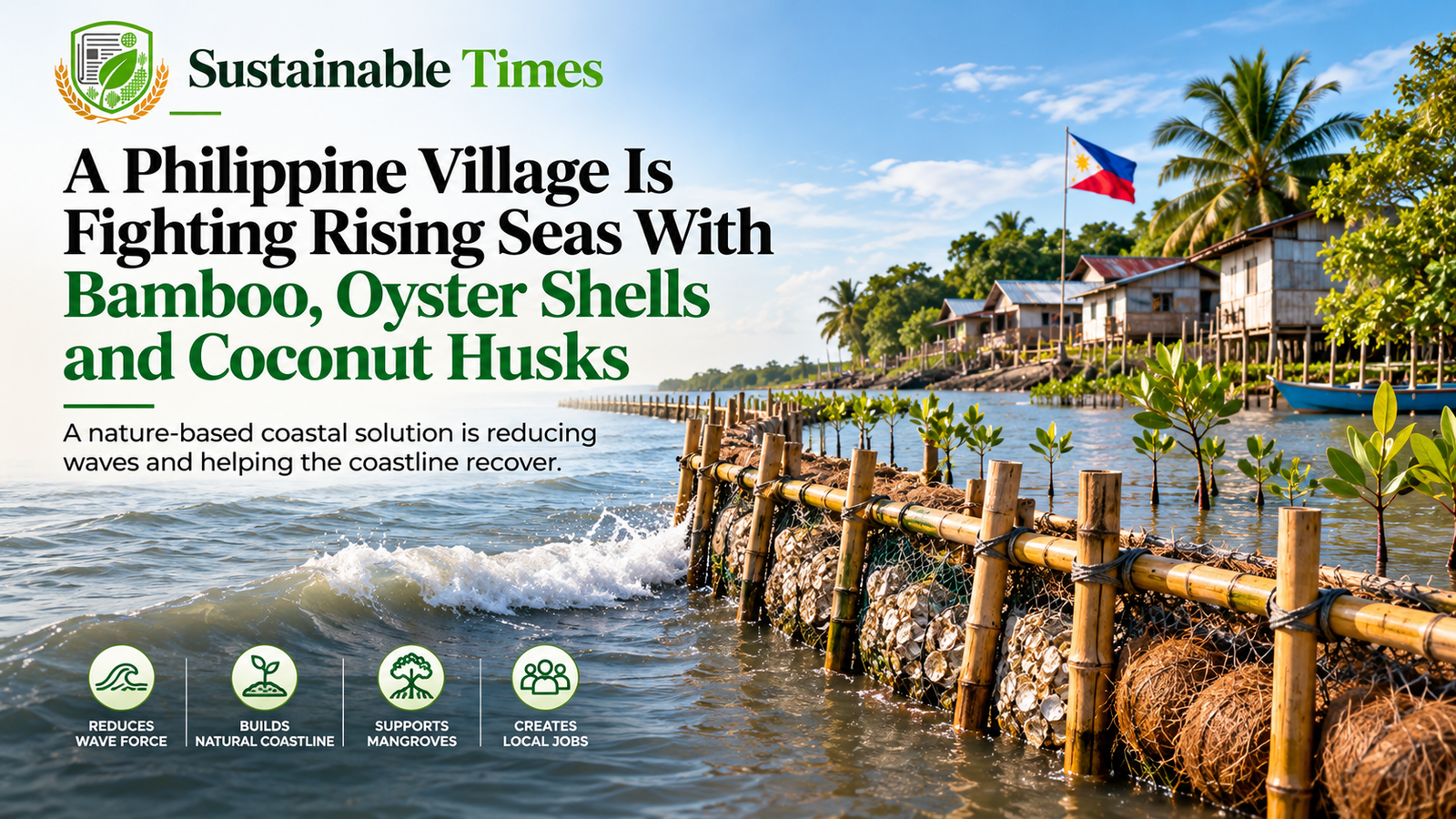
Instead of relying entirely on concrete, engineers and local workers have built a network of structures using bamboo poles, discarded oyster shells and coconut-husk fibres.
The project covers approximately 14 hectares of coastal waters near Pamarawan, in the Philippine province of Bulacan. Residents say the new barriers have noticeably weakened incoming waves, while engineers report early signs of sediment accumulating around the structures.
The initiative, featured in new reporting published on 30 October, is being developed as one of the Philippines’ first nature-based coastal protection pilots.
Its most interesting feature is not simply the materials used.
The project is designed to let natural processes gradually strengthen the coastline rather than depending on a permanent wall alone.
A Village Where Flooding Became Part of Everyday Life
Pamarawan sits in a low-lying coastal area of Malolos City, north of Manila.
The community depends heavily on fishing and other coastal livelihoods. Residents travel by boat, while tidal conditions influence daily activities and access to nearby areas.
For years, flooding disrupted homes, income and essential services.
The risks come from several interacting problems.
High tides and storm surges push water toward the village. Sea-level rise adds pressure, while land subsidence means parts of the coastline are gradually sinking.
That combination makes conventional flood protection increasingly difficult.
Residents previously depended on a concrete breakwater approximately three to four metres high. But waves still overtopped the structure during severe weather, leaving some homes exposed.
Local authorities concluded that strengthening the existing concrete infrastructure alone might not provide a sustainable long-term answer.
They began exploring an alternative that could reduce incoming wave energy while helping rebuild parts of the coastal environment.
The Solution Starts With Bamboo
The new coastal defence uses interlocking bamboo structures installed offshore.
These structures form a network of barriers that reduce the force of incoming waves before they reach the village.
Bamboo is particularly useful because it is locally available, relatively lightweight and suitable for constructing modular structures.
But its role extends beyond blocking waves.
The barriers also slow the movement of water, allowing suspended mud and sand to settle.
Over time, this accumulated sediment could gradually raise parts of the seabed.
That process is central to the project’s long-term design.
As sediment builds up, engineers hope the area will eventually become suitable for mangrove restoration.
Mangroves can help stabilise shorelines, reduce erosion and provide habitat for coastal wildlife.
The goal is therefore to create a system that becomes more ecologically functional as it develops.
The bamboo provides an initial structure.
Sediment builds around it.
Vegetation may eventually establish itself.
And the restored coastal environment could offer additional protection against waves and erosion.
Oyster Shells Are Playing an Unexpected Role
Another important component comes from a material that many people would consider waste.
Discarded oyster shells.
Workers place the shells inside mesh bags made from coconut-husk fibres, creating barriers that complement the bamboo structures.
These bags help reduce wave energy while also providing surfaces where marine organisms may establish themselves.
The project aims to encourage oyster reef recovery, although researchers still need to determine how successfully those habitats develop over time.
Oyster reefs can provide valuable ecological functions.
They create shelter for marine organisms and can help reduce wave energy under suitable conditions.
By incorporating discarded shells into the coastal defence, the project connects waste recovery with ecosystem restoration.
The coconut-husk netting also provides an alternative to relying exclusively on conventional synthetic materials.
However, natural materials are not automatically impact-free.
Their sourcing, durability and replacement requirements still matter.
A Different Approach to Coastal Engineering
The Pamarawan project was developed with support from Dutch engineering firm Haskoning, the Netherlands Enterprise Agency and Philippine partners.
The initiative began in 2024, drawing inspiration from sediment-trapping and mangrove-restoration techniques used in Indonesia.
Engineers adapted those concepts to the conditions of North Manila Bay, where typhoons, tides, river flows and coastal erosion create complex challenges.
Instead of designing a single rigid barrier, the team combined several elements.
Bamboo structures reduce wave energy. Oyster-shell bags provide additional protection and potential habitat. Sediment traps encourage gradual seabed development, while planned mangrove regeneration could help create a more resilient coastal ecosystem.
This approach is often described as nature-based coastal protection.
It does not reject engineering.
Instead, it combines engineered structures with ecological processes.
That distinction is important because conventional infrastructure and nature-based approaches do not have to compete.
In many locations, the strongest protection may come from using both.
The Early Results Are Encouraging
The project has already produced changes that residents can observe.
Local fishing families report that incoming waves have become weaker since the first phase of construction.
Some residents say flooding has reduced during recent periods of rough weather, offering relief after years of repeated disruption.
Haskoning also reports early sediment accumulation within the project area.
These observations suggest that the system is beginning to perform some of its intended functions.
But there is an important qualification.
Early improvement does not yet prove that the coastal defence will remain effective through decades of storms, sea-level rise and changing shoreline conditions.
Independent, long-term monitoring will be necessary to measure changes in flood frequency, wave energy and sediment stability.
Researchers will also need to determine whether the accumulated sediment can support successful mangrove growth.
For now, Pamarawan offers promising early evidence rather than a completed scientific verdict.
Could Nature-Based Protection Cost Less Than Concrete?
The project’s financial model has attracted attention.
Malolos Mayor Christian Natividad has estimated that the nature-based installation costs approximately 70 million Philippine pesos, including maintenance provisions, compared with roughly 90 million pesos for a conventional concrete seawall alternative.
Those figures suggest that natural materials could offer a more affordable option in some locations.
However, comparing construction costs alone can be misleading.
Bamboo deteriorates and requires replacement. The mayor estimates that some bamboo components may need replacing approximately every five years.
Natural-material systems also require regular inspection, maintenance and adaptation.
Their long-term economics will depend on durability, labour, maintenance requirements and the degree of protection delivered.
A concrete seawall may perform better in some locations, while a nature-based system may offer greater overall value elsewhere.
The correct choice depends on local conditions rather than a universal assumption that one method is always cheaper or more sustainable.
Local Workers Are Helping Build Their Own Protection
One of the project’s strongest features is its reliance on community participation.
According to Haskoning, approximately 80% to 90% of construction labour has come from Pamarawan itself.
That creates immediate employment opportunities while helping residents understand how the system works.
Local involvement also matters for long-term maintenance.
Communities that depend on coastal infrastructure need practical knowledge of how to inspect and maintain it.
Their understanding of tides, fishing routes and shoreline changes can provide information that outside engineering teams might otherwise overlook.
However, coastal projects can also create trade-offs.
Structures placed in fishing waters may affect access routes and existing fishing or oyster-farming activities.
Those impacts deserve careful attention, particularly in communities whose incomes depend directly on the sea.
Successful climate adaptation must protect livelihoods as well as buildings.
Why Other Coastal Communities Are Watching
The Philippines faces substantial exposure to tropical storms, coastal flooding and other climate-related hazards.
Many communities need improved protection but cannot afford expensive infrastructure projects.
Pamarawan offers an opportunity to investigate whether locally available materials and ecological restoration can provide a practical alternative in suitable locations.
Interest in nature-based solutions is also growing internationally.
Countries are restoring mangroves, wetlands, dunes and coastal reefs to help reduce environmental risks while supporting biodiversity.
In July 2026, the Philippines formally adopted the International Union for Conservation of Nature’s Global Standard for Nature-based Solutions, reflecting a broader effort to integrate ecological approaches into climate and disaster-resilience planning.
But Pamarawan’s design cannot simply be copied everywhere.
Different coastlines experience different waves, sediment movements, ecological conditions and economic pressures.
An approach that works in a sheltered coastal environment may perform differently along an exposed shoreline.
Engineers therefore need to adapt the principles to each location.
The Bigger Lesson for Climate Adaptation
Climate adaptation often brings to mind enormous infrastructure projects.
Higher seawalls.
Larger drainage networks.
New flood barriers.
Major engineering works.
These systems remain important, particularly where cities and critical infrastructure face severe risks.
But the Pamarawan project demonstrates another possibility.
Sometimes protection can begin by helping natural processes perform work that conventional infrastructure would otherwise need to accomplish alone.
Bamboo barriers can slow waves.
Sediment can gradually rebuild coastal elevation.
Oyster habitats may strengthen the shoreline.
Mangroves can eventually provide additional ecological protection.
Each component has limitations, but together they could create a system that delivers more than flood defence.
The project may also improve habitats, support livelihoods and provide communities with a greater role in maintaining their own infrastructure.
That broader combination is what makes the experiment interesting.
What Happens Next?
The Pamarawan pilot is scheduled to reach completion during 2026, but the most important assessments will continue afterward.
Engineers and local authorities will need to examine how the structures perform during severe storms, whether sediment remains stable and how successfully coastal vegetation becomes established.
They will also need to monitor maintenance costs and the effects on fishing activities.
If the project delivers reliable long-term protection, it could provide useful lessons for other low-lying communities across Southeast Asia.
If parts of the system underperform, those findings will be equally valuable for improving future designs.
The aim should not be to prove that bamboo is better than concrete in every situation.
It should be to understand where engineering and ecological restoration can work together most effectively.
For residents of Pamarawan, the significance is much more immediate.
After years of watching waves cross their existing defences, they are beginning to see a different approach take shape offshore.
It is built from materials that are familiar to the community, yet the underlying idea could influence coastal adaptation far beyond the Philippines.
The next generation of flood protection may not always involve building a higher wall against the sea. In some places, it may begin by helping the coastline rebuild itself.
About The Author