A national park can protect thousands of hectares of forest, shelter endangered wildlife and preserve ecosystems that might otherwise disappear.
But what happens when the animals living inside that park need to move somewhere else?
For decades, governments have treated protected areas as one of their most important conservation tools. They establish national parks, wildlife sanctuaries and reserves to safeguard habitats from development and other pressures.
Yet a new international study suggests that protecting individual pieces of land may not be enough.
Researchers from Australia’s Monash University analysed 6,234 conservation sites across 14 countries and found that many areas outside formally protected reserves could help create larger, more connected conservation networks.
The study, published on 26 October 2026 in Nature Ecology & Evolution, reveals an important opportunity as countries work toward protecting 30% of the planet by 2030.
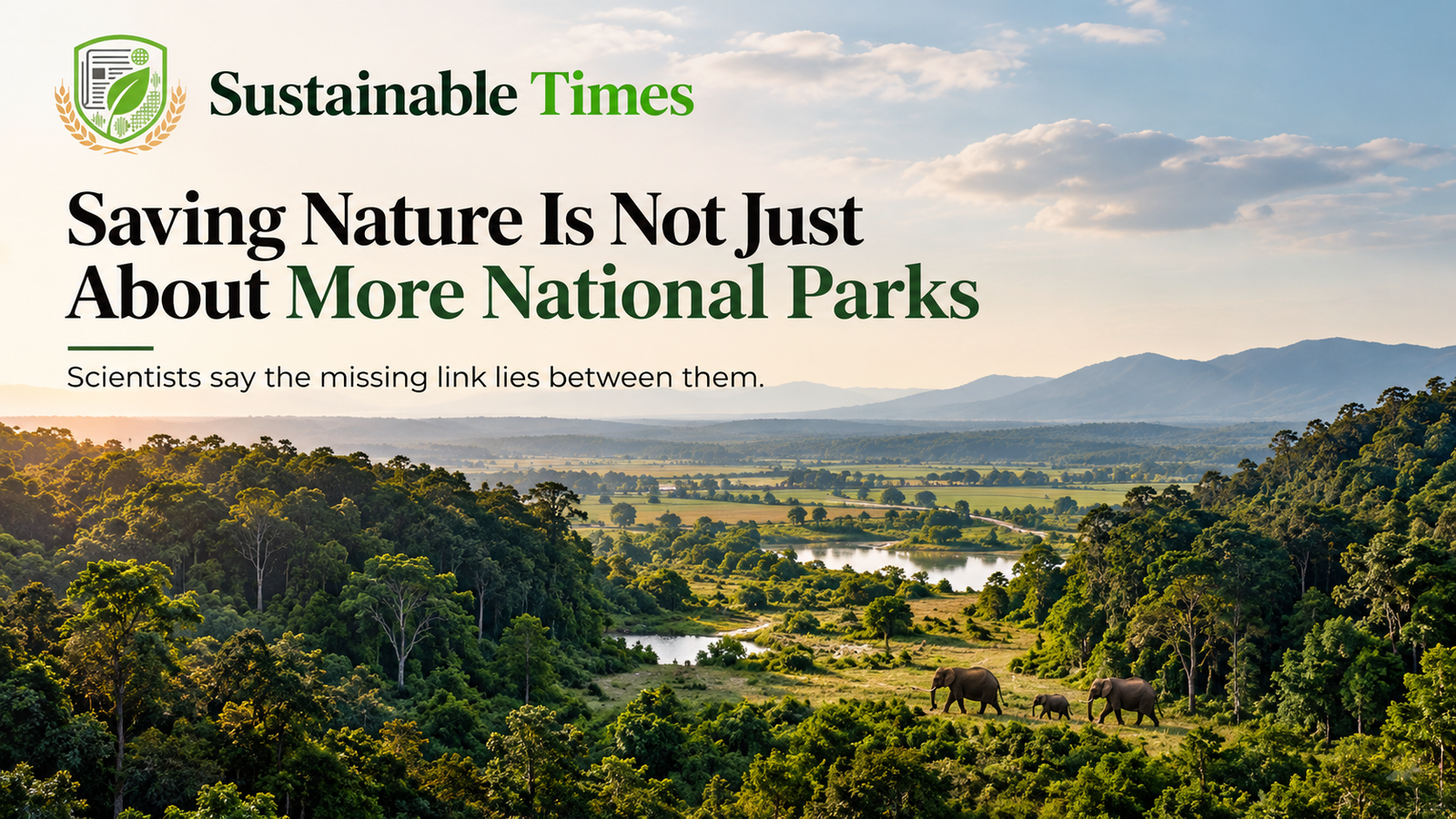
The future of wildlife conservation may depend as much on the land between protected areas as the protected areas themselves.
The Problem With Protecting Nature in Isolated Patches
Imagine two forests separated by farmland, roads and expanding settlements.
Both forests may have legal protection. Each may contain important wildlife populations, native vegetation and functioning ecosystems.
But if animals cannot move safely between them, the two forests may gradually become isolated.
That isolation can create problems.
Animals often need access to different habitats to find food, reproduce or respond to changing environmental conditions.
When roads, fences or intensive land use interrupt those movements, populations can lose access to resources and potential breeding partners.
Over time, isolated populations may become more vulnerable to environmental disturbances and other threats.
This is why conservation scientists increasingly emphasise ecological connectivity.
A protected area does not function independently of the landscape surrounding it. Its long-term value can depend on whether animals, plants and ecological processes can move across the wider region.
The new Monash University study examines how countries could strengthen those connections without relying exclusively on the creation of additional national parks.
Researchers Looked Beyond Traditional Protected Areas
The study focused on conservation sites known as Other Effective Area-Based Conservation Measures, or OECMs.
These are geographically defined areas outside formally designated protected areas that deliver sustained positive outcomes for biodiversity.
An OECM does not necessarily exist primarily for conservation.
Some areas may have cultural, community or other management objectives while also providing important environmental benefits.
For example, a landscape managed by a local community could help protect wildlife even if it is not officially classified as a national park.
Similarly, certain sustainably managed landscapes may help maintain habitats or support ecological connections between reserves.
The researchers wanted to understand how these areas contribute to larger conservation networks.
Rather than simply counting how many sites exist, they examined where the sites are located and how they relate to nearby protected areas.
That approach reveals something that conventional conservation statistics can miss.
The position of a conservation area can sometimes matter as much as its size.
Nearly One-Third of the Sites Already Strengthen Protected Areas
The researchers found that nearly one-third of the OECMs directly adjoin existing protected areas.
This means they can effectively enlarge the landscape managed for conservation, even though they do not share the same formal designation.
That is significant because ecological systems rarely follow administrative boundaries.
A forest ecosystem may extend beyond the official border of a national park.
Wildlife may regularly move between a reserve and surrounding land.
Protecting neighbouring habitats can therefore make the original reserve more ecologically useful.
The study also identified smaller groups of sites that connect or buffer isolated protected areas or help bring fragmented conservation areas into more coherent networks.
However, only around 3% of the analysed sites currently perform these specific connecting, buffering or aggregating roles.
That figure reveals both the limitations of current conservation networks and the opportunities available to improve them.
The world has already recognised many additional conservation sites.
But their placement has not always been coordinated to maximise ecological connections.
Two-Thirds of Sites Are Close Enough to Create New Opportunities
Perhaps the most interesting finding concerns distance.
The researchers discovered that approximately two-thirds of the analysed OECMs lie within 10 kilometres of an existing protected area.
That does not mean animals can automatically travel between every pair of sites.
Ten kilometres of forest can be very different from ten kilometres of highways, cities or heavily developed farmland.
But the proximity creates opportunities.
If governments identify suitable habitat connections between neighbouring sites, they may be able to strengthen conservation networks without starting entirely from scratch.
That could involve protecting vegetation corridors, restoring degraded land or adjusting land-management practices in strategically important locations.
The study therefore shifts attention from simply increasing the number of protected sites toward understanding how those sites can function together.
Why Wildlife Corridors Matter
Wildlife corridors are areas of habitat that help animals move between larger habitat patches.
They can take many forms.
Some follow river systems, forest belts or mountain ranges. Others consist of smaller habitat patches that provide stepping stones across agricultural or developed landscapes.
Their effectiveness depends on the species involved.
An elephant needs a very different movement corridor from a small forest mammal or a pollinating insect.
That makes corridor planning a scientific challenge rather than simply a matter of connecting green areas on a map.
Researchers need to consider animal behaviour, habitat quality, land-use patterns and potential barriers.
The new study suggests that OECMs could play an important role in these wider networks.
Some may expand existing habitat.
Others may provide buffers against surrounding development.
A smaller number may create direct links between otherwise separated protected areas.
Together, these functions can make conservation landscapes more resilient.
The 2030 Biodiversity Target Adds Urgency
Under the Kunming–Montreal Global Biodiversity Framework, countries have committed to effectively conserving and managing at least 30% of terrestrial, inland water, coastal and marine areas by 2030.
The target has encouraged governments to examine how they can expand conservation coverage.
But the new research highlights a potential weakness in focusing too heavily on percentages.
A country could increase its protected-area coverage while still leaving important ecosystems fragmented.
Similarly, adding conservation sites in locations with limited biodiversity value may contribute less than protecting smaller areas that connect critical habitats.
The researchers argue that countries should pay greater attention to how different conservation areas work together.
That means future progress should not be measured only by how much land receives a conservation designation.
It should also consider whether those areas form functioning ecological networks.
India Has an Important Role in This Conversation
India contains an extensive network of national parks, wildlife sanctuaries, tiger reserves, conservation reserves and community-managed landscapes.
Many species depend on habitat extending beyond the boundaries of formally protected areas.
Elephants, for example, can move across forests, agricultural landscapes and human settlements.
Large carnivores also require suitable movement routes between habitat patches.
The new international study does not establish specific connectivity outcomes for India’s protected areas.
However, its broader findings are highly relevant to conservation planning in countries where wildlife and human land use overlap.
Maintaining ecological connectivity may require cooperation between forest departments, local communities, infrastructure planners and agricultural land managers.
It may also require conservation measures outside traditional reserve boundaries.
For countries balancing biodiversity protection with economic development, this approach could become increasingly important.
Conservation Cannot Ignore the People Living Nearby
There is another reason the study’s focus on areas outside national parks matters.
Many landscapes that support biodiversity are also places where people live and work.
Farmers cultivate land.
Communities manage forests.
Local businesses depend on natural resources.
Indigenous Peoples and traditional communities maintain relationships with landscapes that can support long-term conservation.
These areas cannot always be managed using the same approach as strictly protected national parks.
Effective conservation therefore requires governance arrangements that recognise local rights, livelihoods and management responsibilities.
An OECM must demonstrate sustained positive biodiversity outcomes rather than simply receive an attractive label.
That distinction matters because expanding conservation boundaries without credible management can create disappointing environmental results.
The goal should be to support landscapes where conservation and responsible human activity can coexist where appropriate.
Better Planning Could Make Existing Conservation Investments More Valuable
Governments often face limited conservation budgets.
Creating and maintaining protected areas requires funding for management, monitoring, restoration and enforcement.
The Monash University study suggests that strategic planning could help countries make better use of conservation sites that already exist.
Instead of treating every reserve as an isolated project, planners could identify locations where additional protection or restoration would deliver the greatest connectivity benefits.
For example, improving the habitat between two existing conservation areas might strengthen the overall network more effectively than protecting a similarly sized area elsewhere.
Such decisions would still require local ecological evidence.
But the principle is important.
Conservation planning can become more effective when governments evaluate the relationships between sites rather than treating each one independently.
The Study Also Reveals an Important Limitation
The researchers did not claim that all OECMs currently provide strong ecological connections.
In fact, they found that direct contributions to connectivity remain relatively limited.
Their analysis focused on the structural relationships between conservation areas.
That means it examined how sites are arranged across landscapes, not whether wildlife successfully moves through every possible connection.
Actual conservation outcomes depend on habitat quality, species behaviour, management effectiveness and environmental pressures.
Future research will need to examine how these spatial opportunities translate into measurable improvements for biodiversity.
That distinction is essential.
Two protected landscapes appearing connected on a map does not guarantee that animals can safely move between them.
Conservation success still depends on conditions on the ground.
The Future of Conservation May Be More Connected
The findings arrive at an important moment for international biodiversity policy.
Countries are working to expand conservation coverage while facing pressure from land-use change, infrastructure development and climate change.
The traditional response has often been to create additional protected areas.
That remains valuable.
But protecting more land is not the same as building a stronger conservation system.
The Monash University researchers have identified a practical opportunity to improve how protected areas and other conservation measures work together.
Their findings suggest that governments could strengthen existing networks by carefully evaluating nearby landscapes, restoring important connections and coordinating management across different types of conservation areas.
The approach could help wildlife populations access larger and more functional habitats while supporting wider ecosystem resilience.
Most importantly, it changes the way conservation success is measured.
The objective is not simply to draw more protected boundaries on a map.
It is to ensure that the landscapes inside and around those boundaries can continue supporting biodiversity over time.
A national park may protect wildlife within its borders. But the future of that wildlife could depend on what happens just outside them.
About The Author