For decades, agricultural development has followed a familiar idea: larger, better-organised farms can produce food more efficiently.
By combining scattered agricultural plots, improving irrigation networks and creating larger fields, governments have tried to reduce production costs and make farming more profitable.
But a new global study suggests that this approach can come with environmental and social consequences that are too significant to ignore.
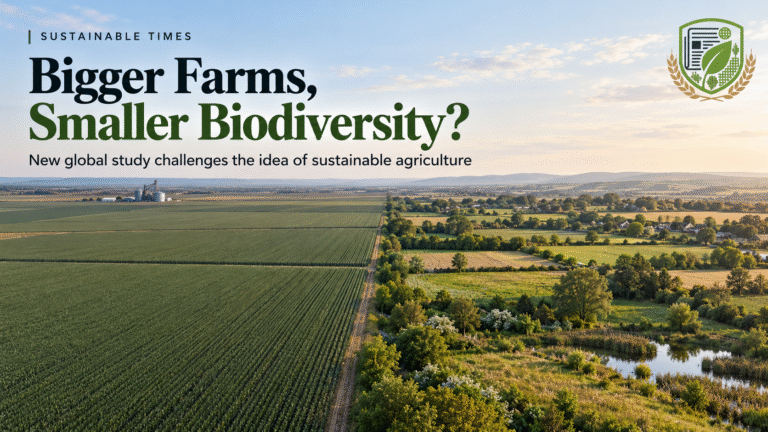
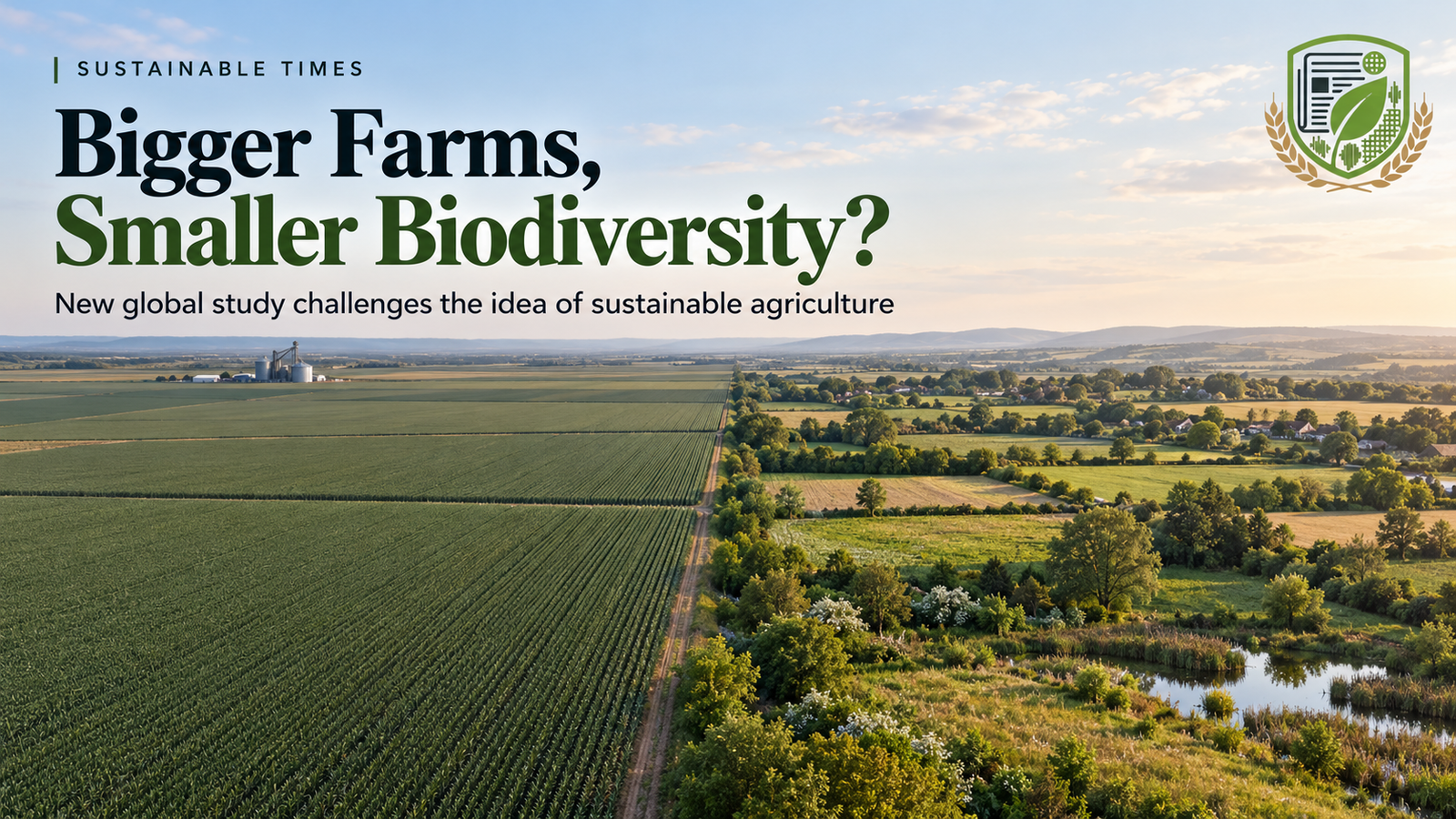
Researchers examining 148 land-consolidation cases across 28 countries found that projects frequently improved agricultural productivity and economic performance. However, biodiversity declined in 81% of the assessed cases, while 57% reported increased social inequality.
The findings, published in the journal Environmental Science and Ecotechnology and highlighted on 26 October 2026, raise an uncomfortable question for agricultural policymakers.
What happens when making farming more efficient also makes rural landscapes less diverse and communities more unequal?
The Promise of Larger, More Efficient Farms
Agricultural land is often divided into numerous small, irregular plots.
This fragmentation can make farming expensive and inefficient.
Farmers may spend additional time moving machinery between fields. Small or oddly shaped plots can complicate irrigation and reduce the efficiency of certain agricultural operations.
Land consolidation attempts to address these problems by reorganising agricultural holdings into more practical arrangements.
Depending on the project, governments may combine fragmented plots, improve roads and irrigation networks, reorganise land ownership or support larger farming operations.
The economic advantages can be substantial.
Better access roads reduce transportation difficulties, while more efficient field layouts can improve machinery use and agricultural management.
For farmers struggling with rising input costs and limited infrastructure, these changes can offer genuine benefits.
But the latest research suggests that assessing only those economic gains provides an incomplete picture of sustainability.
Scientists Examined Agricultural Projects Across 28 Countries
The research team included scientists from Nanjing University, Fujian Agriculture and Forestry University, Fuzhou University and the University of Queensland.
They reviewed 972 research records before analysing 137 peer-reviewed studies covering 148 land-consolidation cases across 28 countries.
Rather than evaluating agricultural productivity alone, the researchers examined three interconnected dimensions: economic performance, environmental outcomes and social impacts.
They also compared the findings with the United Nations Sustainable Development Goals.
The results revealed a significant gap in how agricultural development projects are evaluated.
Approximately 65% of the assessed cases examined only one dimension of sustainability.
That means many evaluations concentrated on economic or agricultural outcomes without adequately considering the broader environmental and social consequences.
The researchers argue that this narrow approach can hide important trade-offs.
A project might improve yields and reduce operating costs while simultaneously damaging habitats or increasing inequality.
If policymakers measure only the first set of outcomes, they may incorrectly describe the project as a sustainability success.
Biodiversity Was Often the Hidden Cost
One of the most concerning findings involved biodiversity.
The study reported biodiversity declines in 81% of the relevant assessed cases.
This does not mean every project involved large-scale forest destruction.
Agricultural biodiversity can decline through more subtle landscape changes.
When fragmented fields are reorganised into larger, more uniform agricultural areas, hedgerows, field margins, small habitats and natural vegetation may disappear.
These features can support insects, birds, small mammals and other organisms that depend on varied agricultural landscapes.
Simplifying the landscape may improve machinery access while reducing the habitats available to wildlife.
That creates a difficult trade-off.
Agricultural efficiency can improve at the same time that ecological diversity declines.
Healthy agricultural landscapes depend on more than crop production. They also rely on soil organisms, pollinators, natural vegetation and ecological relationships that help maintain long-term productivity.
Ignoring those functions may create environmental costs that are not immediately visible in crop yields.
The Social Consequences Were Equally Important
The researchers also examined how land consolidation affects rural communities.
Their analysis found increased social inequality in 57% of the cases where this outcome was assessed.
Larger farms and reorganised landholdings can sometimes create advantages for producers who already possess financial resources, machinery and secure land rights.
Smaller farmers may face greater difficulties adapting to the new system.
Some may struggle to access reorganised plots, negotiate fair compensation or participate in decisions affecting their livelihoods.
The consequences depend heavily on local conditions and the way governments implement the projects.
Land consolidation does not automatically disadvantage smallholders.
However, the study suggests that ignoring land rights, community participation and distributional effects can allow economic gains to benefit some groups more than others.
For agricultural development to remain socially sustainable, policymakers need to consider not only how much value a project creates but also who receives that value.
Not Every Project Produced the Same Results
The research also contained encouraging findings.
Projects that combined agricultural intensification with ecological conservation performed differently from those focused mainly on increasing production.
In the study, 42% of projects that integrated agricultural development with ecological conservation produced benefits across multiple sustainability dimensions, while only 12% recorded negative outcomes under the researchers’ classification.
By comparison, intensification-only projects produced positive and negative outcomes at similar rates.
This suggests that environmental decline is not necessarily an unavoidable consequence of agricultural restructuring.
Project design matters.
When planners incorporate habitat protection, soil conservation, water management and community interests from the beginning, they may be able to improve agricultural performance without creating the same level of environmental damage.
The distinction is important because it shifts the conversation away from whether larger farms are inherently good or bad.
The more useful question is how agricultural landscapes should be organised to support both food production and healthy ecosystems.
Why This Matters for India’s Agricultural Future
India provides an interesting context for the findings.
The country’s agricultural landscape includes millions of small and marginal holdings, many of which face challenges related to fragmented land, limited mechanisation, irrigation and access to infrastructure.
Efforts to improve farm efficiency therefore remain economically important.
However, the international research suggests that increasing field size or reorganising landholdings should not become an objective in isolation.
Agricultural planning also needs to consider biodiversity, water resources, soil health and the rights of farming communities.
India’s diverse agricultural landscapes make this particularly relevant.
The ecological consequences of restructuring farmland in a densely cultivated plain may differ from those in a dryland region or a landscape containing wetlands and natural vegetation.
Similarly, the social effects will depend on land ownership, tenancy arrangements and local economic conditions.
The study does not provide a direct assessment of India’s land-consolidation policies.
Instead, it offers a useful international warning about what governments should measure when planning agricultural reforms.
Sustainable Farming Needs a Broader Definition of Success
The findings reveal a weakness in how agricultural progress is sometimes evaluated.
Higher yields can be valuable.
Lower costs can improve farm incomes.
Better infrastructure can strengthen rural economies.
But those outcomes do not automatically demonstrate environmental sustainability.
A genuinely successful agricultural project should also consider whether it protects biodiversity, maintains soil quality, manages water responsibly and improves opportunities for rural communities.
That requires better monitoring.
Instead of evaluating projects only through productivity and economic indicators, governments can incorporate ecological surveys, social assessments and long-term environmental measurements.
Such evidence would help identify where agricultural efficiency creates genuine benefits and where it simply transfers costs to ecosystems or vulnerable communities.
The Future of Agriculture May Depend on Smarter Landscapes
The world’s food system faces enormous pressure.
Agriculture must support a growing population while responding to climate change, water stress and biodiversity decline.
Improving productivity remains essential, particularly in regions where farmers struggle with low incomes and inefficient infrastructure.
But the latest research shows that efficiency cannot become the only measure of progress.
The strongest agricultural systems may be those that combine productive fields with healthy soils, functioning ecosystems and fair economic opportunities.
That could require protecting habitat connections between farms, maintaining natural vegetation, designing better irrigation systems and ensuring smallholders participate meaningfully in land-management decisions.
These measures may make planning more complex.
But they can also prevent short-term economic improvements from creating long-term environmental problems.
The global study offers a valuable lesson for policymakers and agricultural businesses.
Making a farm larger can improve its efficiency. Making the entire agricultural landscape more sustainable requires a much more thoughtful approach.
As governments continue investing in agricultural modernisation, that distinction may become increasingly important.
The future of food security should not depend simply on producing more from every hectare.
It should depend on producing food in ways that allow the land, the ecosystems around it and the people who manage it to thrive together.
About The Author