Published: 4 November 2026
Category: Sustainable Transport | Green Logistics | Climate Innovation | Global Trade
Every day, thousands of shipping containers move between ports, factories and warehouses, carrying the products that keep the global economy running.
But a surprising number of those journeys involve moving containers with nothing inside them.
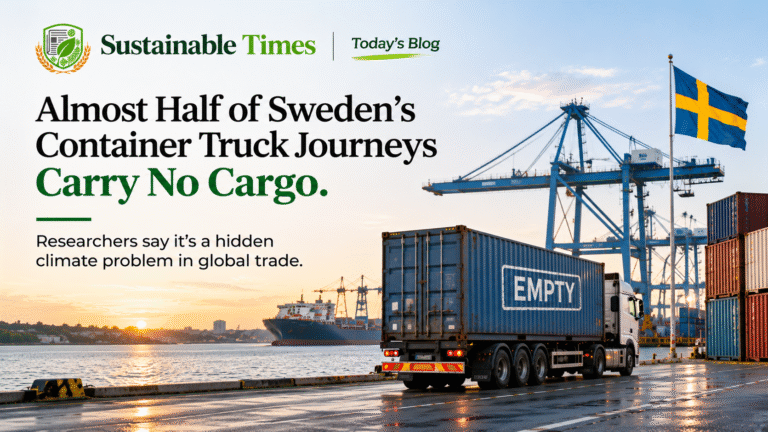
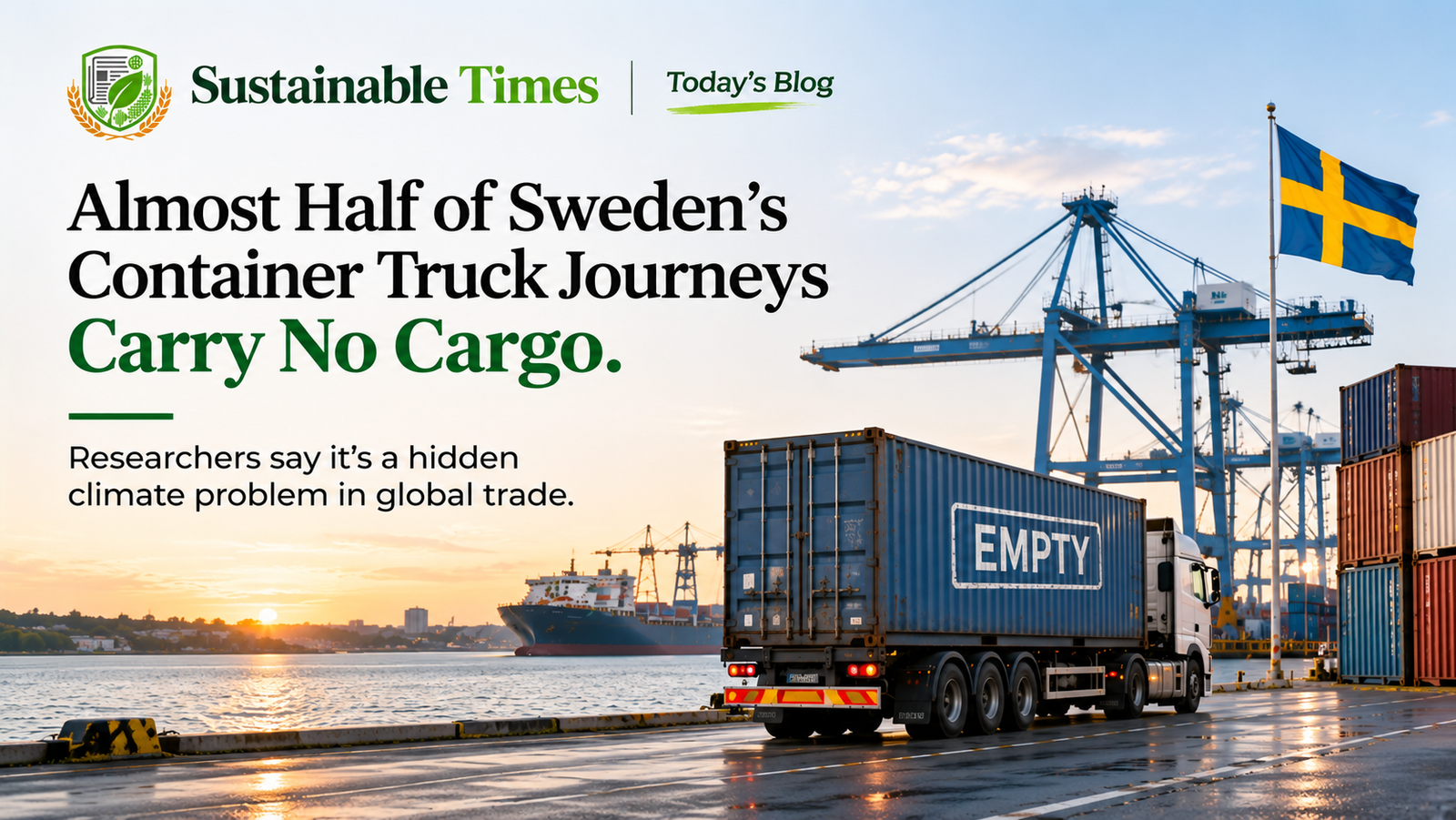
New research highlighted by Sweden’s Chalmers University of Technology on 3 November reveals that 44% to 46% of container-truck journeys in the country’s analysed freight data involved empty containers.
Those movements accounted for approximately one-third of the total distance travelled by the container trucks studied.
The findings expose an often-overlooked source of transport emissions. Even when a container carries no goods, the truck transporting it still consumes fuel, occupies road space and requires drivers, infrastructure and maintenance.
For researchers, the problem presents a significant opportunity.
Instead of focusing only on replacing diesel trucks with cleaner vehicles, the logistics industry could also reduce emissions by eliminating journeys that deliver no cargo.
The Empty Container Problem Behind Global Trade
Shipping containers are among the most important inventions in modern logistics.
Their standardised design allows companies to move goods between ships, trains and trucks without repeatedly unloading and repacking individual products.
This system has helped international trade become faster and more efficient.
However, it creates a difficult challenge once a container reaches its destination.
Imagine a container arriving at a Swedish port carrying manufactured goods from overseas.
A truck transports it to a warehouse, where workers unload the products.
The empty container then needs to return to a port, depot or another location where a shipping company can use it again.
Ideally, the same container would carry another shipment on its return journey.
But international trade rarely works that neatly.
Imports and exports may move in different quantities. A suitable shipment may not be available nearby, or the container may need to return to its owner before another company can use it.
As a result, a significant amount of freight transport involves repositioning empty containers.
The container moves, but no commercial cargo moves with it.
Researchers Found a Pattern Across Swedish Freight Routes
The Chalmers research team analysed Swedish road-freight records collected between 2016 and 2019.
Their study, published in Transportation Journal in August 2026, examined how container movements differ according to location, industry and cargo weight.
Researchers found that empty-container movements accounted for between 44% and 46% of the container-truck journeys recorded during the study period.
However, empty journeys were generally shorter than loaded ones.
Trucks carrying loaded containers travelled approximately 95 kilometres per journey on average, compared with around 53 kilometres when transporting empty containers.
That difference suggests logistics operators were already attempting to minimise unnecessary travel.
Even so, empty movements accounted for approximately 30% to 35% of the total distance travelled.
The finding illustrates why a relatively small operational inefficiency can become an environmental problem when repeated across an entire transport network.
The Geography of Trade Matters More Than Expected
One of the study’s most revealing findings concerns where empty-container journeys occur.
Researchers discovered that the starting and ending locations of journeys were more important in explaining empty movements than the industry transporting the cargo.
Approximately 77% of empty-container journeys took place within the same Swedish county.
The team also found that some regional transport routes had particularly high proportions of empty movements.
In more than one-third of the county-to-county combinations studied, over 40% of container journeys were empty.
Some routes recorded proportions exceeding 90%.
Four counties stood out: Blekinge, Västra Götaland, Skåne and Kalmar.
These regions contain important port infrastructure and experience imbalances between incoming and outgoing container flows.
When imported goods arrive in greater quantities than suitable exports leaving the same region, containers may have to move elsewhere before companies can use them again.
The problem therefore cannot be solved simply by telling drivers to avoid empty journeys.
It requires better coordination across the entire freight network.
Why Trucks Cannot Always Pick Up Another Load
At first glance, the solution appears straightforward.
If a container is empty, why not fill it with goods heading in the opposite direction?
The reality is more complicated.
Shipping containers come in different sizes and specifications. A container used for one type of cargo may not be suitable for another.
Some goods require specialised equipment, refrigeration or particular hygiene conditions.
Ownership also creates restrictions.
Containers often belong to shipping lines or leasing companies, which control when and where their equipment can be used.
Even when suitable cargo exists, the timing may not match.
A truck could finish unloading in the morning while an export shipment becomes available two days later. Waiting may cost more than returning the empty container.
The researchers therefore describe empty-container repositioning as both a transport challenge and an organisational problem.
Reducing unnecessary journeys will require companies to share information and coordinate their operations more effectively.
Better Data Could Become a Climate Solution
The Chalmers team developed statistical models to estimate container-truck movements more accurately.
One model estimates how much cargo a vehicle carries based on factors such as industry, origin, destination and vehicle characteristics.
Another estimates the probability that a container journey will be empty.
Together, they provide a more detailed picture of freight movements than conventional models based primarily on the weight of goods transported.
That distinction matters because the same quantity of freight can require different numbers of truck journeys depending on how efficiently containers are used.
By including empty movements, planners can make more realistic estimates of road use, congestion and transport activity.
The models could eventually support Sweden’s national freight-planning system, Samgods.
Researchers also believe the approach could be adapted to other countries with comparable transport data.
This creates an opportunity for digital logistics systems that help companies identify where empty journeys are most likely to occur.
Rather than applying the same solution across every route, operators could focus on the regions where better coordination would produce the greatest benefit.
Ports Could Play a Bigger Role
Ports are central to the empty-container problem because they connect international shipping with inland transport.
When containers arrive by sea, logistics operators must move them through warehouses, distribution centres and manufacturing facilities.
If the surrounding region imports substantially more goods than it exports, empty containers can accumulate.
Ports and inland terminals could help reduce unnecessary repositioning by improving container storage, exchange arrangements and coordination between different transport operators.
The researchers also highlight the potential of dry ports.
A dry port is an inland freight terminal connected to a seaport, often by rail.
By shifting selected container movements from trucks to rail and coordinating container handling more effectively, dry ports can help reduce road journeys.
In an earlier simulation study published in 2023, the research team found that a dry-port-based strategy could reduce transport costs and carbon dioxide emissions by as much as 70% in the specific system modelled.
That figure does not mean every port could achieve the same result.
It demonstrates how significant the benefits can become when transport networks are redesigned around better coordination and lower-emission transport modes.
The Opportunity Extends Beyond Sweden
Although the study focused on Swedish freight transport, empty-container repositioning is a global problem.
International trade rarely flows equally in both directions.
A region may import large volumes of consumer products while exporting relatively little containerised cargo.
Another may produce substantial quantities of industrial goods but have limited demand for incoming shipments.
These imbalances create empty-container movements across ports, rail networks and highways.
For countries with rapidly expanding manufacturing and logistics sectors, the issue deserves attention.
India, for example, continues investing in freight corridors, ports, multimodal logistics parks and digital infrastructure.
Better information about container availability and cargo demand could help businesses coordinate transport movements more effectively.
However, the Swedish figures should not be treated as estimates for India or the global logistics industry.
The precise proportion of empty journeys will depend on local trade patterns, infrastructure, regulations and commercial practices.
The broader lesson is that countries need reliable data before deciding where to invest in transport-efficiency improvements.
Electric Trucks Alone Will Not Solve Inefficient Logistics
Transport decarbonisation often focuses on cleaner vehicles.
Electric trucks, alternative fuels and more efficient engines can help reduce emissions associated with moving freight.
But vehicle technology addresses only part of the problem.
An electric truck carrying an empty container still consumes electricity, occupies road space and requires infrastructure.
Making the vehicle cleaner does not automatically make the journey necessary.
The Chalmers findings therefore point toward a complementary strategy.
Countries need cleaner transport technologies, but they also need better logistics planning.
Reducing unnecessary movements can lower transport activity itself, while cleaner vehicles reduce the environmental impact of the journeys that remain.
Combining those approaches could deliver greater benefits than pursuing either one alone.
Why Logistics Companies Should Pay Attention
For freight businesses, empty-container movements are not only an environmental concern.
They also represent an operating cost.
Every journey requires driver time, fuel or electricity, vehicle maintenance and access to transport infrastructure.
When vehicles move without cargo, companies incur those costs without directly transporting goods for customers.
Reducing avoidable movements could therefore improve both profitability and environmental performance.
That gives logistics efficiency an advantage over some sustainability investments.
The economic and environmental incentives can point in the same direction.
However, achieving those benefits requires cooperation between organisations that may normally compete or operate independently.
Shipping companies, freight forwarders, port operators, warehouse businesses and cargo owners all possess different pieces of the information needed to improve the system.
Making that information available at the right time, while respecting commercial restrictions, could become an important part of greener logistics.
The Next Step Is Coordination, Not Just Technology
The researchers are careful not to suggest that all empty-container journeys can be eliminated.
Some movements are unavoidable because trade flows are uneven, equipment has specific requirements and operators must manage container availability.
The objective is to reduce avoidable journeys.
That could involve better return-load planning, shared information about available containers and improved coordination between ports and inland terminals.
Digital platforms may help identify opportunities, but technology alone cannot resolve every commercial or contractual barrier.
Companies may need new agreements governing how containers are shared, repositioned and reused.
Public authorities could support that transition through common data standards and infrastructure planning.
The study therefore highlights a wider challenge in sustainable transport: meaningful environmental improvements often require changes in how businesses organise their operations, not just changes to the equipment they purchase.
Looking Ahead
The Chalmers research offers an important reminder that sustainability opportunities are sometimes hidden inside everyday business processes.
Global trade depends on containers moving across complicated transport networks.
Those networks will never operate perfectly.
But better information could help reduce unnecessary journeys, improve freight efficiency and lower emissions.
The next phase of sustainable logistics may therefore involve much more than electric trucks and alternative fuels.
It may also involve using existing vehicles and containers more intelligently.
For governments and businesses, that creates a practical opportunity to reduce transport costs while improving environmental performance.
The cleanest freight journey is not always the one made with a cleaner truck. Sometimes, it is the unnecessary journey that never happens.
About The Author