Wind turbines have become one of the most recognisable symbols of the global clean-energy transition. Their enormous blades turn moving air into electricity, helping countries reduce their dependence on fossil fuels.
But those blades create a problem that rarely appears in renewable-energy success stories.
What happens when a wind turbine reaches the end of its working life?
Most turbine components, including steel towers and several mechanical parts, can enter established recycling systems. The blades are more complicated. Manufacturers design them to survive years of wind, rain and mechanical stress, using strong composite materials that are exceptionally difficult to separate once their useful life ends.
Now, three major Indian companies are attempting to change that.
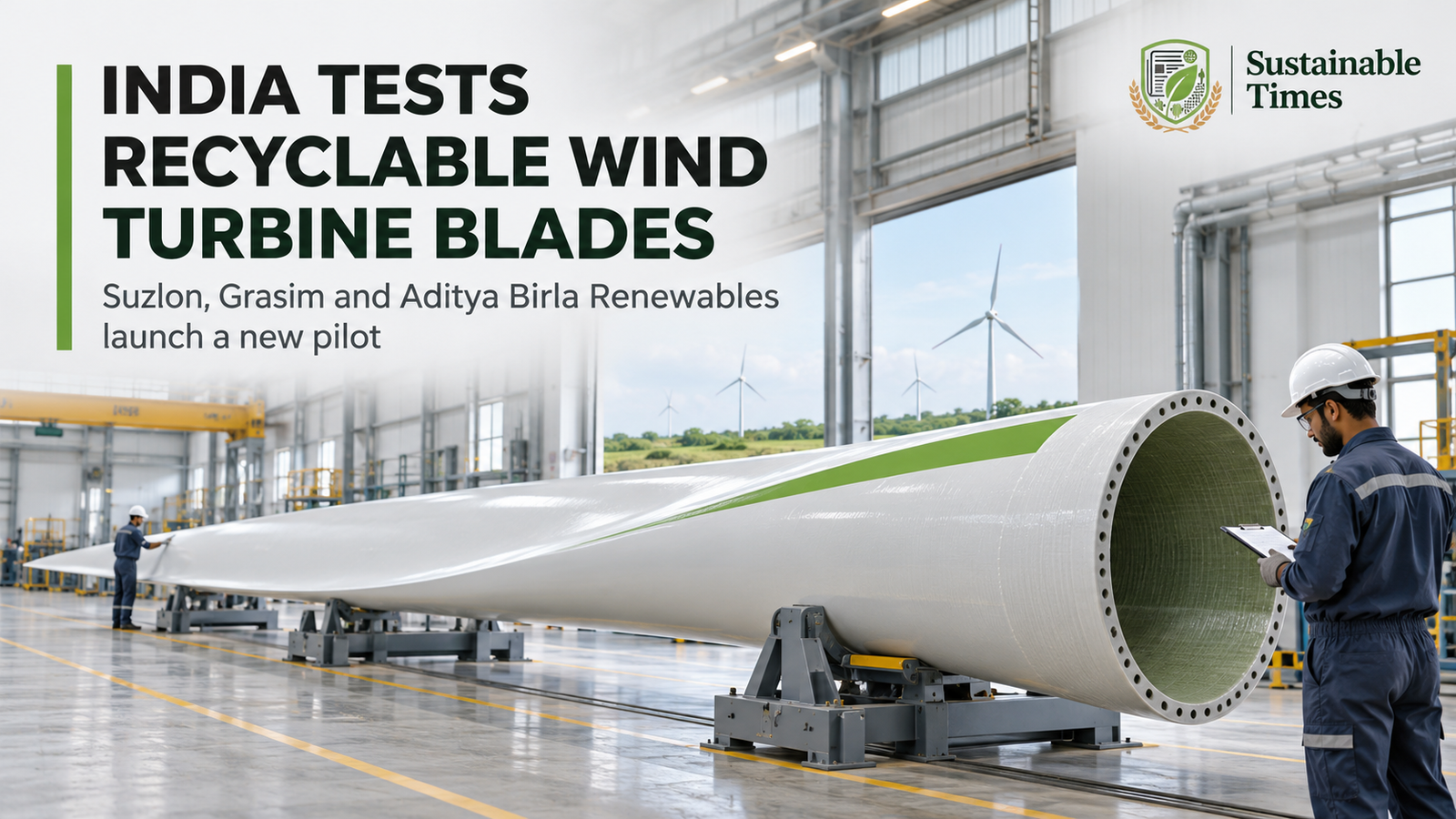
On 4 November 2026, Grasim Industries, Aditya Birla Renewables and Suzlon Energy announced a partnership to develop and test recyclable wind turbine blades using an advanced epoxy technology known as Recyclamine.
The companies plan to manufacture a turbine equipped with recyclable blades and deploy it at an operational wind-energy project.
If the pilot succeeds, it could help India address a growing waste-management challenge before large numbers of today’s wind turbines reach retirement.
The Clean Energy Industry Has a Recycling Problem
Wind power generates electricity without burning fossil fuels during operation, making it an important part of efforts to reduce greenhouse-gas emissions.
However, constructing wind turbines requires substantial quantities of steel, concrete, copper and composite materials.
Most of those materials already have established recycling pathways.
Turbine blades are different.
Manufacturers typically combine glass or carbon fibres with thermosetting resins to create structures that are lightweight, strong and resistant to fatigue.
The resulting composites perform remarkably well during operation. They allow blades to withstand repeated mechanical loads while maintaining the aerodynamic shape needed to generate electricity.
But the same durability that makes these materials useful also makes them difficult to recycle.
Traditional thermosetting resins form tightly connected molecular networks during manufacturing. Once cured, they cannot simply be melted and remoulded like many conventional plastics.
Separating the reinforcing fibres from the surrounding resin can require specialised processing, substantial energy or harsh treatment conditions.
As a result, retired blades may be cut into pieces for alternative uses, processed through selected industrial recovery routes or sent to landfill where regulations permit.
The challenge is expected to grow as global wind capacity expands and older installations reach the end of their operating lives.
Three Indian Companies Are Testing a Different Approach
The new partnership brings together businesses with complementary expertise.
Grasim Industries, part of the Aditya Birla Group, will supply its Recyclamine epoxy technology through its Advanced Materials Division.
Suzlon Energy, one of India’s established wind turbine manufacturers, will work on incorporating the material into turbine blades.
Aditya Birla Renewables will provide a project site where the companies can test a turbine fitted with those blades under actual operating conditions.
The agreement was signed during the Bharat Renewable Energy Summit & Expo 2026.
Rather than focusing exclusively on developing recyclable material in a laboratory, the partnership aims to demonstrate whether the technology can function inside a commercial wind turbine.
That distinction matters.
A material that performs well in small test samples must still prove that it can withstand the enormous stresses experienced by full-size turbine blades.
How Recyclamine Could Make Blades Easier to Recover
The central innovation lies in the resin.
Conventional epoxy composites are difficult to break apart after curing because their molecular structures resist separation.
Recyclamine technology uses a specially designed epoxy system that allows the cured composite to undergo chemical recycling.
According to Grasim, the process can help recover valuable constituents of the blade material for reuse in new applications.
This changes how manufacturers can think about a blade’s eventual retirement.
Instead of treating the reinforced composite as a permanently bonded material that is difficult to recover, engineers can design the blade with a future separation process in mind.
The goal is to retain the structural performance required during operation while creating a practical route for material recovery afterward.
However, chemical recyclability does not automatically mean every component can return to a new wind turbine blade.
Recovered materials must still meet quality requirements, and the recycling process itself needs to be commercially and environmentally viable.
Those questions will become important as the project moves toward testing.
Why the Pilot Matters More Than the Announcement
The partnership is still at an early stage.
The companies have signed a memorandum of understanding, but they have not yet demonstrated widespread commercial deployment of the recyclable-blade technology.
Their immediate objective is to integrate the material into blade manufacturing and test its performance at a selected wind-energy project.
That trial will need to answer several important questions.
Can the new resin perform reliably under repeated mechanical stress? Will it withstand changing temperatures, humidity and environmental conditions? Can manufacturers produce the blades at competitive costs?
The companies will also need to determine whether the material-recovery process can operate efficiently when a blade eventually reaches retirement.
This is particularly important because wind turbine blades are long-life infrastructure.
A technology that appears promising during manufacturing must continue performing safely for many years.
Suzlon co-founder Girish Tanti has indicated that the company aims to make future wind turbines recyclable within the next three to four years.
That ambition provides a direction for the partnership, although achieving it will depend on successful testing, engineering development and commercial adoption.
The Wind Industry Cannot Ignore Its Future Waste
The wider industry is already facing increasing pressure to develop better end-of-life solutions.
A 2026 review published in Resources, Conservation and Recycling examined the recycling challenges associated with decommissioned wind turbine blades.
The researchers highlighted the difficulties of recovering high-value materials from conventional composites and noted that existing mechanical, thermal and chemical recycling methods have not yet reached widespread commercial scale.
The review also discussed projections suggesting that annual wind-blade waste could rise substantially by 2030.
These estimates underline the importance of acting early.
Wind turbines installed today may continue operating for decades. By the time their blades require replacement, the industry will need reliable systems for collection, transportation and material recovery.
Designing recyclable blades now could make that future transition easier.
However, manufacturers must also build the infrastructure needed to process the materials.
A recyclable product has limited practical value if suitable recycling facilities do not exist when it reaches the end of its life.
India Could Build a New Circular Manufacturing Opportunity
India is expanding renewable-energy infrastructure as it works to meet growing electricity demand and reduce the carbon intensity of its energy system.
Wind power remains an important part of that transition.
As installations increase, the country will eventually need to manage larger volumes of retired turbine equipment.
Developing recyclable blades domestically could create opportunities beyond waste reduction.
Composite-material manufacturers, recycling companies and engineering businesses may find new markets in recovering and processing materials from renewable-energy infrastructure.
That could support a more circular domestic supply chain.
Instead of treating retired blades only as disposal challenges, companies could recover useful materials and direct them toward other industrial applications.
But the economic case remains crucial.
Recycling must compete with conventional disposal options, particularly where transporting large composite structures over long distances creates additional costs.
The success of circular wind manufacturing will therefore depend on more than the chemistry of a new resin.
It will require coordinated investment in manufacturing, collection and recycling infrastructure.
The Bigger Question: How Sustainable Is Clean Energy Equipment?
Renewable electricity plays an essential role in reducing emissions.
But the technologies that generate it still depend on physical materials and industrial processes.
Solar panels eventually require replacement.
Batteries contain materials that need responsible recovery.
Wind turbines include components that may be difficult to recycle.
These challenges do not undermine the environmental benefits of renewable energy.
They demonstrate why clean-energy infrastructure should be designed with its entire life cycle in mind.
The most sustainable solutions should ideally minimise unnecessary material consumption, operate efficiently for many years and provide practical recovery pathways after retirement.
That is where the Indian partnership becomes interesting.
The companies are not simply attempting to improve how turbine blades are discarded.
They are exploring whether manufacturing decisions made today can prevent future waste problems.
Looking Ahead
Grasim, Suzlon and Aditya Birla Renewables have taken an important first step, but the project still needs to prove its value in real-world conditions.
The companies must demonstrate that recyclable blades can deliver the reliability expected from conventional designs without creating unacceptable production costs or new environmental burdens.
They will also need to establish how effectively recovered materials can return to industrial use.
If the pilot succeeds, it could support wider adoption of recyclable composite technologies in India’s wind-energy sector.
The implications could extend beyond wind turbines.
Similar composite materials appear in vehicles, aircraft, industrial equipment and other products where strength and durability matter.
Improving their recyclability could create opportunities across multiple industries.
For now, the announcement points toward an important change in the clean-energy conversation.
Building renewable infrastructure is no longer the only challenge.
The industry must also consider what happens to that infrastructure after it has finished generating electricity.
The next generation of wind turbines should not only produce cleaner energy. It should also leave behind less difficult-to-manage waste when its working life ends.
About The Author