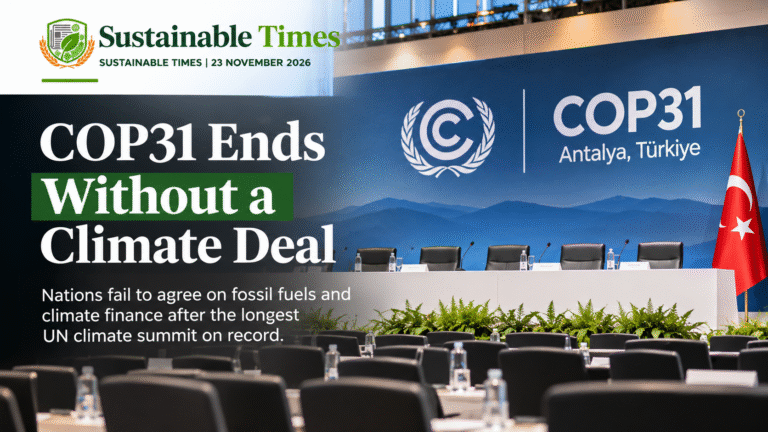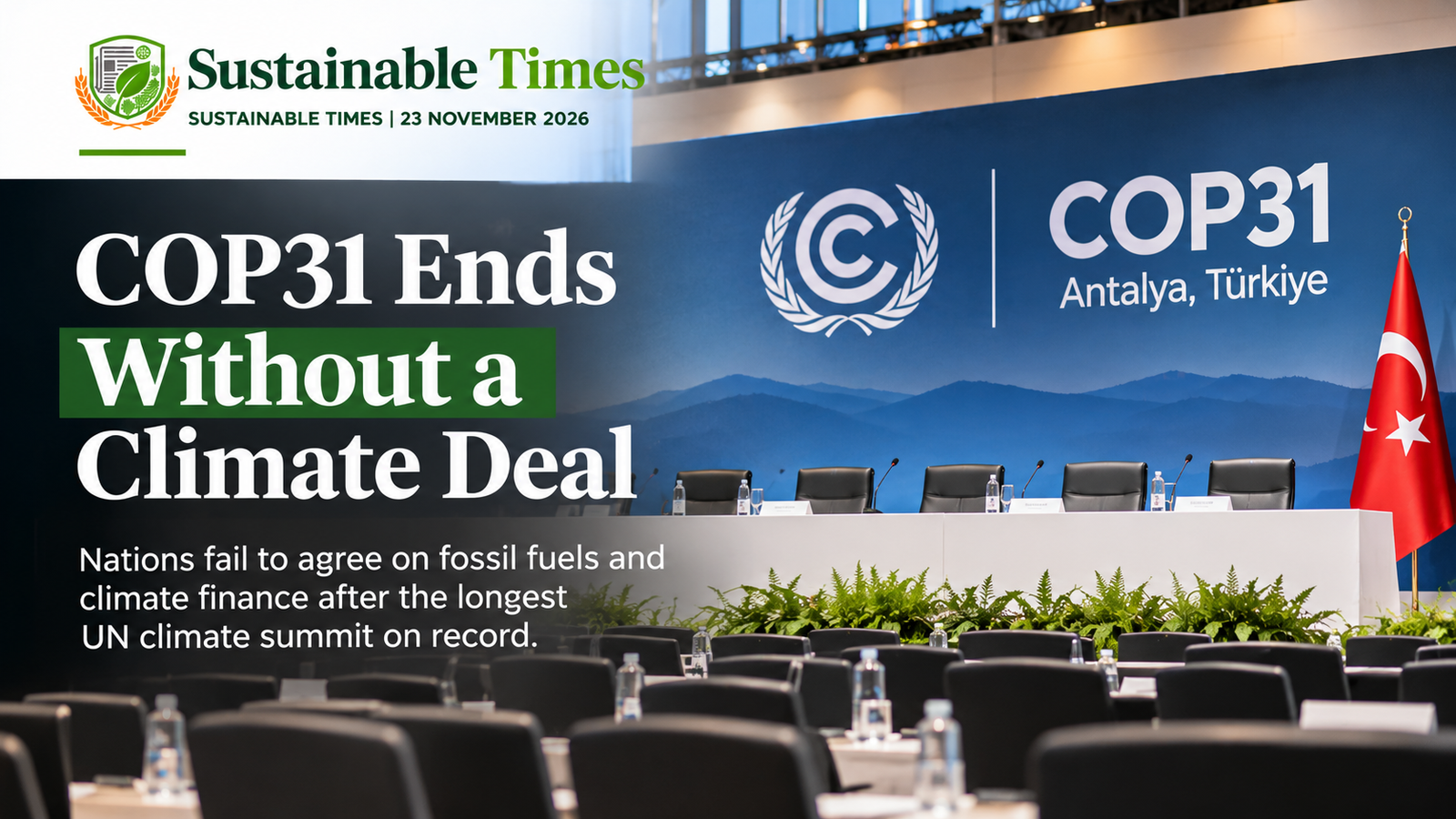
After more than two weeks of negotiations, countless meetings and two extra days of talks, world leaders left the COP31 climate summit in Antalya, Türkiye, without agreeing on its most important political declaration.
It was an extraordinary ending to a conference that was supposed to demonstrate how countries would accelerate climate action.
Nearly 200 nations had gathered to discuss reducing greenhouse-gas emissions, moving away from fossil fuels and securing more money for countries already experiencing the consequences of global warming.
Instead, disagreements over oil, gas, coal and climate finance brought negotiations to a standstill.
On 22 November 2026, COP31 President Murat Kurum acknowledged that countries could not reach consensus on the proposed agreement. The conference closed without adopting its overarching political decision, making it the most significant breakdown of this kind since the Copenhagen climate summit in 2009.
The failure does not erase the Paris Agreement or earlier climate commitments. Several technical and negotiating decisions were also adopted.
But the outcome exposes a difficult truth about international climate policy.
Countries increasingly understand what needs to change. They remain deeply divided over who should change first, how quickly the transition should happen and who should pay for it.
Two Extra Days Could Not Save the Agreement
COP31 began on 9 November and was scheduled to conclude on 20 November.
As the deadline approached, negotiators struggled to agree on several politically sensitive issues.
The Turkish and Australian presidencies worked to develop a compromise that could satisfy countries with very different energy systems and economic interests.
Some nations wanted stronger commitments to reduce fossil-fuel dependence.
Others opposed language that could restrict oil, gas or coal production, arguing that energy security and economic development must remain priorities.
Developing countries also demanded clearer commitments from wealthier nations to finance adaptation and support the transition.
Negotiations continued through the weekend, eventually making COP31 the longest UN climate summit on record.
But the additional time did not resolve the central disagreements.
When the final proposal reached delegates on Sunday, several countries refused to support it.
The summit ended without the agreement that organisers had spent more than two weeks trying to negotiate.
The Missing Words That Divided the World
The central controversy involved something surprisingly straightforward.
The final draft did not explicitly mention fossil fuels.
That omission became unacceptable to the European Union, the United Kingdom and several climate-vulnerable countries.
Their concern was that a global climate agreement should clearly address the primary source of human-caused greenhouse-gas emissions.
Coal, oil and natural gas remain central to the world’s energy system. Burning these fuels releases carbon dioxide, while fossil-fuel operations can also produce methane emissions.
At COP28 in Dubai in 2023, countries had agreed to transition away from fossil fuels in energy systems.
That language was considered a breakthrough because international climate agreements had historically avoided directly addressing the fuels responsible for much of global warming.
Three years later, negotiators could not agree on how to carry that commitment forward.
The European Union argued that accepting a new agreement without meaningful fossil-fuel language would weaken the credibility of international climate cooperation.
Other countries viewed the proposed text differently.
Some argued that reaching a compromise, even an imperfect one, would have been preferable to ending the summit without an overarching outcome.
For fossil-fuel-producing economies, the disagreement also involved concerns about employment, export revenues, energy affordability and future investment.
Those competing priorities ultimately proved impossible to reconcile.
Climate Finance Became Another Breaking Point
Fossil fuels were not the only obstacle.
Developing countries also questioned whether the proposed agreement offered sufficient support for responding to climate change.
Many vulnerable nations already face costly adaptation challenges involving extreme weather, coastal flooding, drought and damage to infrastructure.
They need financing to strengthen water systems, protect communities, improve agricultural resilience and prepare for future disasters.
Yet climate finance remains one of the most contested issues in international negotiations.
The proposed COP31 agreement included language about increasing adaptation finance, including an ambition to triple it.
However, negotiators criticised the absence of a clearly defined baseline against which that increase would be measured.
Without a clear starting figure, governments could interpret the target differently.
For countries seeking predictable financial assistance, that uncertainty matters.
A political commitment to increase funding is valuable only when countries understand how much money it represents, where it will come from and how they can access it.
The failure to agree on the final declaration left those questions without a new overarching political resolution.
Why Some Countries Preferred No Deal to a Weak One
At first glance, rejecting a climate agreement may seem counterproductive.
Climate change is accelerating, and international cooperation remains essential.
But several countries believed that accepting the proposed text could create a different problem.
They feared that a weak agreement would signal reduced ambition at precisely the moment stronger action was needed.
Small island nations were especially concerned.
For countries threatened by rising sea levels and increasingly severe climate impacts, delays in reducing emissions can have lasting consequences.
The Marshall Islands, Vanuatu and other vulnerable countries supported stronger language addressing fossil fuels and limiting future warming.
Some developing nations nevertheless argued that keeping the negotiating process moving was important, even if the final text remained imperfect.
The disagreement reflected different assessments of political risk.
One group believed that accepting a weak deal could undermine earlier commitments.
Another believed that failing to reach any overarching agreement could damage international cooperation.
Neither position eliminated the underlying climate challenge.
Not Everything at COP31 Failed
The collapse of the main declaration does not mean the entire summit achieved nothing.
UN Climate Change confirmed that negotiators adopted decisions on several individual issues, including the Just Transition Work Programme.
That work focuses on helping countries and communities manage the social and economic consequences of moving toward lower-emission development.
The summit also adopted a separate decision concerning the Adaptation Fund.
Outside the formal negotiating process, governments, companies and other organisations announced additional initiatives involving electrification, infrastructure and climate technology.
These activities may continue independently of the failed political declaration.
However, there is an important distinction between announcements and results.
A funding pledge is not the same as completed investment.
A transition initiative is not the same as a measurable reduction in emissions.
And voluntary cooperation does not replace the need for governments to establish credible national policies.
COP31 produced areas of progress, but its central political disagreement remained unresolved.
The 35% Electrification Proposal Did Not Become a Global Agreement
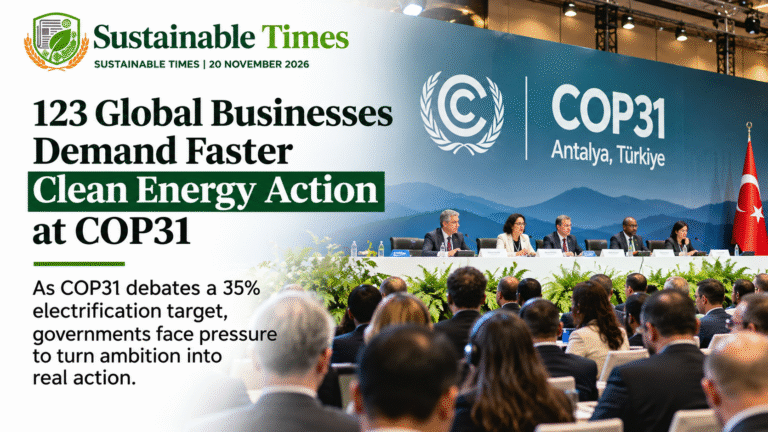
One notable casualty of the failed negotiations was a proposal to increase electricity’s share of global final energy use to approximately 35% by 2035.
The proposal had attracted attention because electrification can help reduce fossil-fuel use in transport, buildings and certain industrial processes.
Electric vehicles, heat pumps and efficient electric machinery can offer important advantages when supported by increasingly clean electricity.
But the target appeared in the proposed overarching agreement that countries ultimately failed to adopt.
That means it did not become a new consensus commitment through the COP31 cover decision.
Separate voluntary initiatives and national electrification policies can still proceed.
However, governments have not collectively adopted the proposed 35% target through the failed declaration.
This distinction matters for businesses and investors interpreting the summit’s outcome.
The transition toward electrification continues, but the political framework supporting it remains uneven.
What the Collapse Means for India
India entered COP31 emphasising equity, climate finance and the principle that countries should pursue energy transitions according to their national circumstances.
Its position reflects the challenges facing a rapidly developing economy.
India needs more electricity to support industry, infrastructure and a growing population.
It is expanding renewable-energy capacity, but coal and other conventional sources remain important to its energy system.
The government has argued that international climate commitments must recognise differences in development needs and historical responsibility for emissions.
It has also called for financial support that does not place excessive debt burdens on developing countries.
The failure of the COP31 cover decision means negotiations did not produce a new overarching agreement addressing those concerns.
However, India’s existing climate commitments and domestic energy policies remain in place.
For Indian businesses, the practical implications are also important.
Companies investing in renewable electricity, energy efficiency and cleaner manufacturing will still face evolving regulations, international market expectations and long-term energy risks.
The failure of one climate summit does not stop those economic forces.
It does, however, underline the uncertainty surrounding international policy coordination.
The Bigger Problem Is Political Confidence
Global climate cooperation depends on trust.
Developing countries need confidence that wealthy nations will provide promised financial and technological support.
Fossil-fuel-producing economies need credible strategies for economic diversification.
Businesses need predictable rules before investing in infrastructure that may operate for decades.
And vulnerable communities need evidence that governments will act quickly enough to reduce future risks.
COP31 struggled to reconcile these expectations.
The disagreement also exposed limitations in the consensus-based UN climate process.
Because almost every participating country must accept major decisions, a relatively small number of determined objections can prevent agreement.
Supporters of consensus argue that it protects national sovereignty and ensures that climate decisions have broad legitimacy.
Critics believe the process can allow political disagreements to delay urgent action.
The failure in Antalya has renewed debate about whether international climate negotiations need reform.
But changing the process will not automatically resolve disagreements over finance, energy security and responsibility.
Those political questions will remain difficult under any negotiating system.
Climate Action Will Continue Outside the Negotiating Hall
Despite the diplomatic breakdown, the world’s energy transition is not entirely dependent on annual climate summits.
Renewable-energy investment continues across many markets.
Companies are developing cleaner industrial technologies.
Governments are expanding electricity infrastructure and introducing policies to reduce emissions.
Cities are investing in adaptation, while businesses increasingly recognise the financial risks associated with climate change.
These developments create momentum that can continue even when international negotiations stall.
However, progress remains uneven.
Countries with access to affordable financing and established infrastructure can often move faster than those facing high borrowing costs and limited technical capacity.
That makes international cooperation particularly important.
Without it, the global transition risks becoming fragmented, with some economies advancing quickly while others struggle to participate.
COP32 Now Inherits an Unfinished Agenda
The next UN climate summit, COP32, is scheduled to take place in Addis Ababa, Ethiopia, in 2027.
Its organisers will inherit several issues that COP31 could not resolve.
Governments must continue debating how to accelerate the transition away from fossil fuels, strengthen adaptation finance and support vulnerable countries.
They will also face pressure to demonstrate that earlier commitments are translating into measurable progress.
For the international climate process, rebuilding confidence may become as important as negotiating new targets.
Countries need to show that disagreements can be resolved without continuously weakening environmental ambition.
They also need to demonstrate that financial promises can become accessible resources and that transition commitments can influence real economic decisions.
The failure in Antalya makes that task more urgent.
The World Cannot Afford Another Year of Deadlock
COP31’s outcome is disappointing, but it does not mean climate action has stopped.
Earlier agreements remain in force.
National policies continue.
Businesses and communities are still investing in cleaner technologies and adaptation.
What failed was the attempt to create a new shared political direction at a moment when the world needed one.
That failure matters because climate change does not pause while diplomats negotiate.
Greenhouse gases continue accumulating in the atmosphere.
Extreme weather continues affecting communities.
And infrastructure decisions made today can shape emissions and energy systems for decades.
The challenge for COP32 will not simply be producing another carefully negotiated declaration.
It will be restoring confidence that international cooperation can deliver progress despite profound economic and political differences.
The longest climate summit in history ended without its most important agreement. The real question now is whether governments will treat that failure as a warning—or allow another year to pass without resolving the decisions that matter most.
About The Author