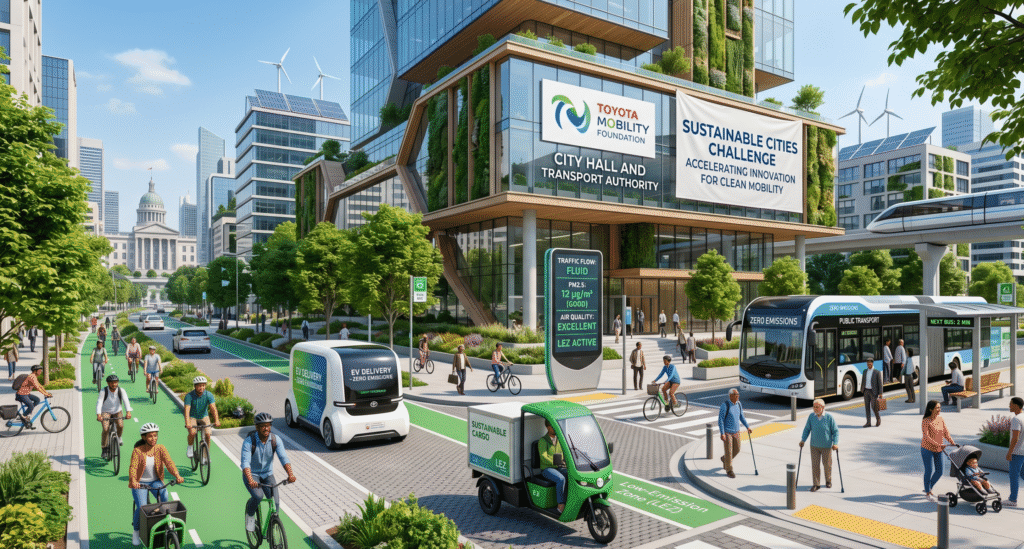
The Toyota Mobility Foundation has announced new progress under its Sustainable Cities Challenge, a global program focused on building cleaner, safer, and more inclusive urban transport systems. The initiative brings together city leaders and innovators to rethink how mobility works in fast-growing urban areas.
A global effort to redesign mobility
The Sustainable Cities Challenge is a multi-year program supported by the Toyota Mobility Foundation in collaboration with Challenge Works and the World Resources Institute.
Importantly, the program connects city governments with startups, researchers, and technology providers. As a result, these stakeholders can co-create solutions that directly address modern transport challenges.
In addition, the initiative focuses on reducing carbon emissions, improving accessibility for underserved communities, and strengthening data-driven transport systems. Therefore, cities can build more resilient and efficient mobility networks.
Funding to accelerate real-world solutions
The program offers up to 9 million US dollars in funding over three years. This funding supports selected cities and their partners as they test and scale new mobility models.
Moreover, municipal governments, transport authorities, and public agencies across the world can apply. Through this approach, the challenge encourages cities to adopt innovative transport systems that can handle rapid urban growth while lowering environmental impact.
India’s role in sustainable urban transport
India plays a significant role in this initiative, as several cities have been shortlisted. This highlights the urgent need to solve issues such as congestion, poor last-mile connectivity, and rising air pollution.
For example, Varanasi is exploring locally developed mobility solutions. These include low-carbon vehicles, shared mobility platforms, and digital planning tools. As a result, cities can improve accessibility and efficiency in everyday transport.
Detroit showcases clean freight innovation
In April 2026, Detroit emerged as one of the winning cities for its clean freight solutions. The selected projects include electric semi-trikes, hydrogen-powered delivery fleets, and fast-charging battery systems.
Furthermore, these innovations focus on improving last-mile logistics in urban areas. This demonstrates a broader shift in mobility thinking.
Instead of focusing only on vehicle technology, the challenge emphasizes city-led innovation. Consequently, cities can build transport systems that are safer, more inclusive, and aligned with global climate goals.
About The Author