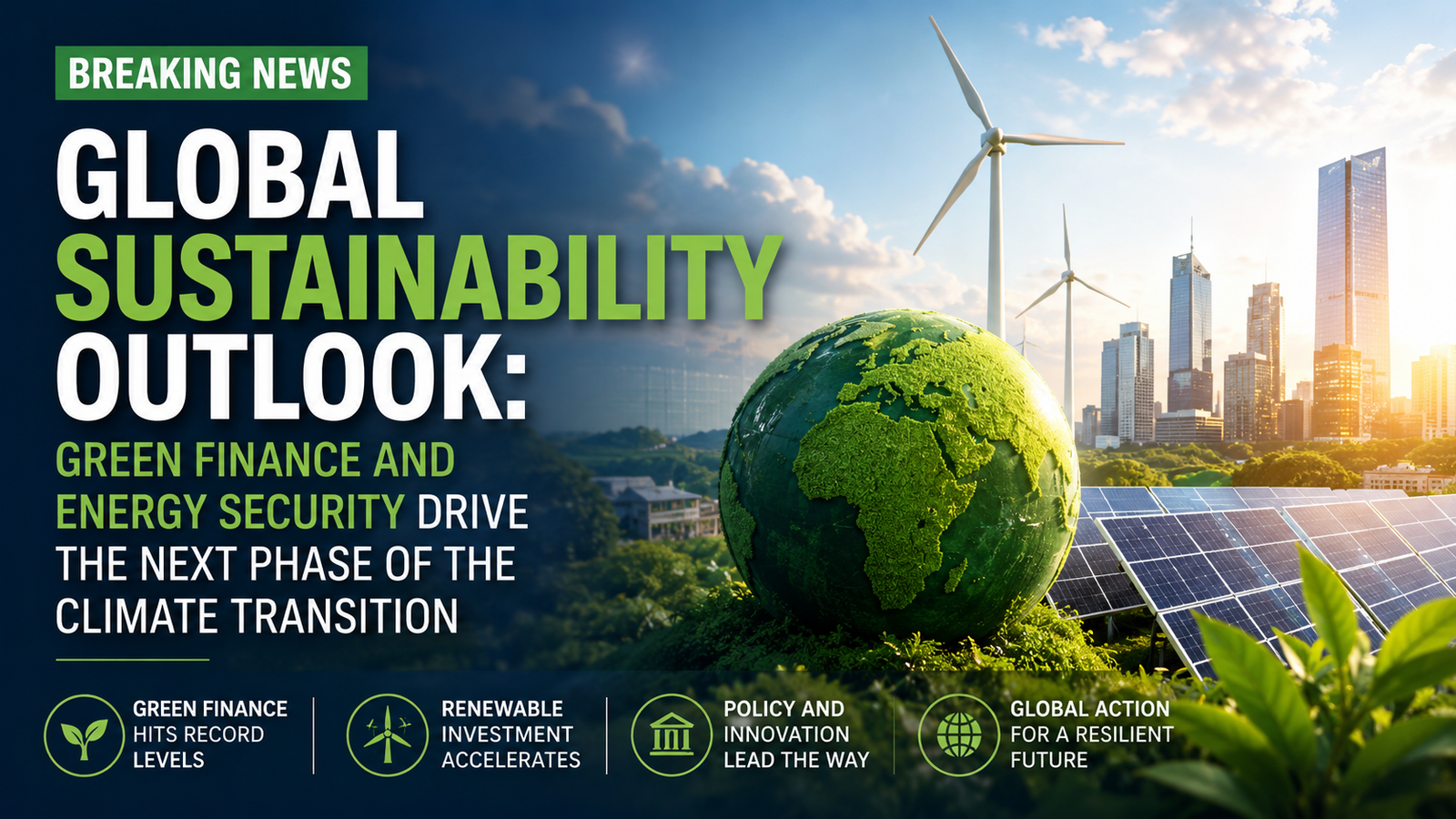
The global sustainability landscape is entering a new phase where environmental priorities are increasingly being shaped by economic resilience, energy security, and long-term investment strategies.
Recent developments across Europe and other major economies indicate that sustainability is no longer viewed solely as a climate initiative. Instead, governments, financial institutions, and corporations are integrating environmental goals into broader economic and industrial policies.
Europe Leads the Green Finance Revival
Europe has emerged as the global leader in sustainable finance during the first half of 2026. Green bond issuance has reached record levels, accounting for nearly two-thirds of the global market. Utility companies, infrastructure developers, and public institutions are increasingly using green financing to expand renewable energy projects, strengthen electricity grids, and modernize clean infrastructure.
The renewed momentum reflects investor confidence in Europe’s long-term climate policies and demonstrates how financial markets continue to support the energy transition despite global economic uncertainty.
Energy Security Accelerates Renewable Investment
Recent geopolitical tensions have highlighted the importance of energy independence.
Countries that previously relied heavily on imported fossil fuels are accelerating investments in solar power, wind energy, battery storage, and hydrogen technologies. Rather than treating renewable energy solely as an environmental objective, governments now recognize it as a strategic asset capable of improving national resilience and reducing exposure to volatile fuel markets.
This shift is expected to drive further investment in clean technologies throughout the remainder of the decade.
Sustainability Moves Beyond Corporate Reporting
Corporate sustainability is also evolving.
Businesses are increasingly shifting their focus from publishing ESG reports to embedding sustainability directly into operational decision-making. Companies are investing in cleaner supply chains, energy-efficient manufacturing, circular economy practices, and data-driven environmental management.
Digital technologies, particularly artificial intelligence, are helping organizations automate emissions reporting, monitor supply chains, and identify opportunities for carbon reduction with greater accuracy and speed.
The Growing Importance of Policy
Experts continue to emphasize that market forces alone will not be sufficient to achieve global climate objectives.
Large-scale decarbonization of industries such as steel, cement, chemicals, and aviation requires coordinated public policy, long-term regulatory certainty, and continued investment in innovation. Carbon pricing, government incentives, and international cooperation remain essential for accelerating industrial transformation while maintaining economic competitiveness.
Looking Ahead
The sustainability transition is entering a more mature stage.
Rather than focusing exclusively on climate commitments, governments and businesses are increasingly aligning sustainability with economic growth, energy security, technological innovation, and industrial competitiveness.
The coming years are likely to see greater collaboration between policymakers, investors, technology companies, and industries as the global economy continues its transition toward a lower-carbon future.
Key Takeaway
Sustainability is no longer a standalone environmental agenda—it has become a central pillar of global economic strategy. From record green finance activity to accelerated renewable energy deployment, the latest developments demonstrate that the future of sustainability will be driven by innovation, investment, and international collaboration.
About The Author