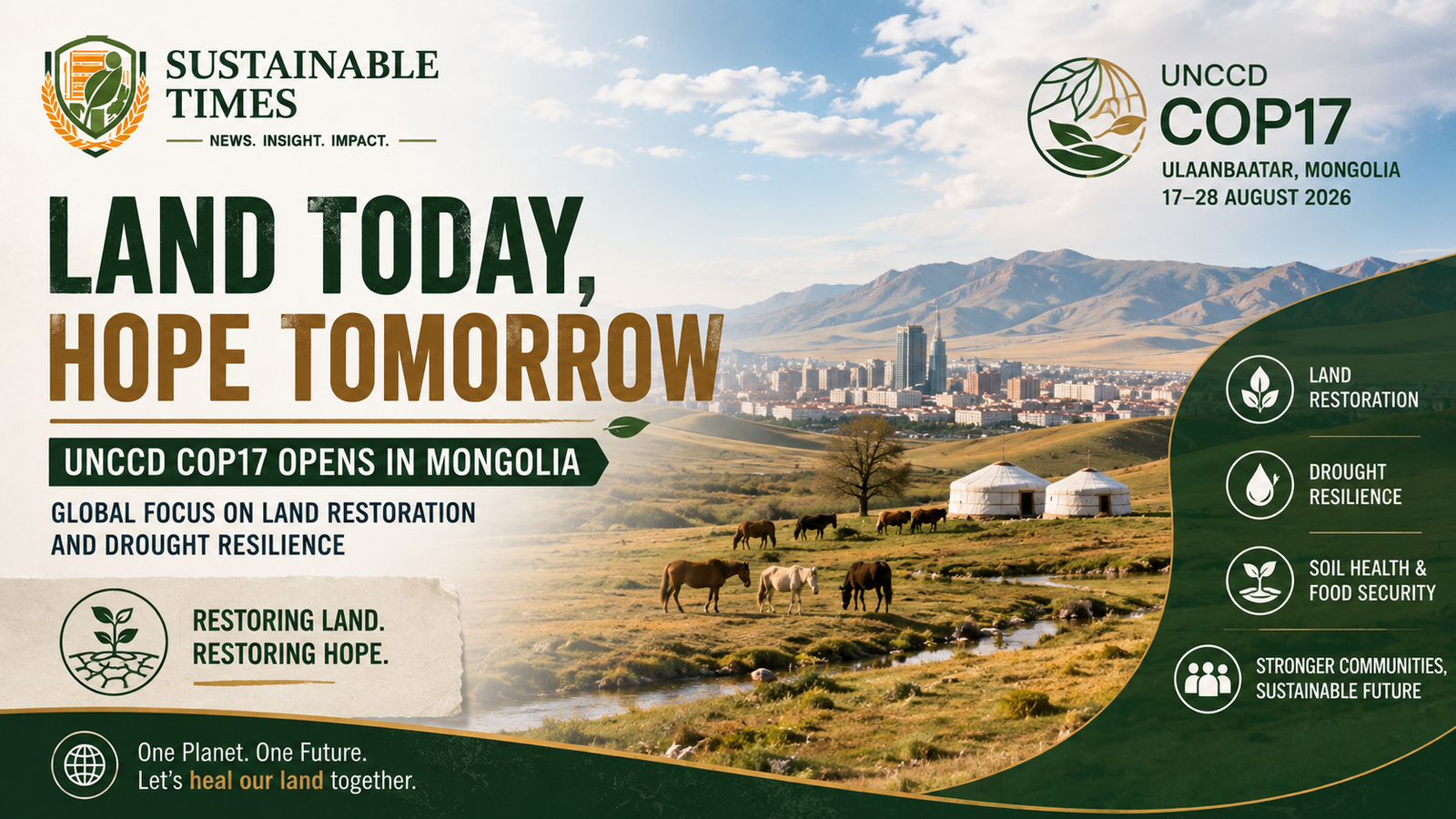
UNCCD COP17 begins in Mongolia with global focus on land restoration, drought resilience, food security, soil health and sustainable land management.
A major global sustainability meeting opens today in Ulaanbaatar, Mongolia, as the 17th session of the UN Convention to Combat Desertification (UNCCD COP17) begins. Running from 17 to 28 August, the conference brings governments, scientists, businesses, civil society and local communities together to address a problem that often receives less attention than climate change: the deterioration of the land we depend on.
Under the theme “Restoring Land. Restoring Hope.”, COP17 will focus on desertification, land degradation and drought—and on turning land restoration into practical action.
Why Land Has Become a Global Sustainability Issue
Land degradation is not simply an environmental problem. It can affect food production, water availability, livelihoods and economic stability.
The UNCCD estimates that up to 40% of the world’s land is degraded. That makes land restoration closely connected to food security, biodiversity and climate resilience.
When productive land loses its ability to support crops, livestock or natural ecosystems, communities can face declining incomes and greater pressure on already limited resources.
That is why COP17 is putting land at the center of a much wider sustainability conversation.
Drought Resilience Takes Center Stage
Drought will be one of the major issues discussed during the conference.
The COP17 programme includes discussions on drought policy, water management, land restoration and ways to strengthen resilience. The conference will also examine how land degradation can contribute to migration and instability in vulnerable regions.
This matters as countries increasingly face more complicated climate risks. Preparing for drought is no longer only about emergency response. It also involves improving soil health, managing water more efficiently, protecting ecosystems and making agricultural systems more resilient.
Food Systems and Soil Health
Agriculture sits at the heart of the land conversation.
COP17 will include a dedicated focus on food systems and soil health, alongside discussions on rangelands and pastoral communities. These areas connect environmental restoration directly with the livelihoods of farmers, pastoralists and rural communities.
Healthy soils can support agricultural productivity while also improving water retention and ecosystem health. Restoring degraded land therefore offers an opportunity to address several challenges at once rather than treating food security, biodiversity and climate resilience as separate issues.
Why Mongolia Matters
Mongolia provides a particularly relevant setting for the conference.
The country has vast rangelands and pastoral communities whose livelihoods depend heavily on healthy land. UNCCD says nearly 77% of Mongolia’s land is affected by degradation, placing land resilience high on the country’s development agenda.
Hosting COP17 gives Mongolia an opportunity to bring greater international attention to dryland ecosystems, pastoral livelihoods and the challenges facing communities that depend directly on land.
From Commitments to Investment
One of the biggest questions facing COP17 is not simply what countries agree to do, but how they will finance and implement those commitments.
The conference programme includes discussions on financial mechanisms, private-sector involvement, drought resilience and investment in land restoration. It also features a Business4Land programme designed to explore how companies and financial institutions can increase investment in restoring degraded land.
That could become an important part of the sustainability discussion. Land restoration requires long-term investment, local participation and practical projects that can continue beyond international conferences.
Looking Ahead
COP17 opens at a time when environmental challenges are becoming increasingly interconnected.
A degraded landscape can affect food production. Water shortages can affect communities and businesses. Drought can put pressure on livelihoods and increase migration risks. Biodiversity loss can weaken ecosystems that provide essential services.
Restoring land cannot solve all of these problems on its own, but it can strengthen the natural systems that societies depend on.
Over the next two weeks, the focus in Ulaanbaatar will therefore be on turning the idea of land restoration into policies, financing and action that can work on the ground.
Key Takeaway
UNCCD COP17 puts land restoration and drought resilience at the center of the global sustainability agenda. The discussions in Mongolia could influence how governments, businesses and communities approach one of the most fundamental sustainability challenges: keeping the land that supports people, food and ecosystems healthy for the future.
About The Author