For years, the global conversation around land degradation has focused on what the world is losing: fertile soil, biodiversity, water security and livelihoods.
Now, governments and investors are putting a much larger number behind the solution.
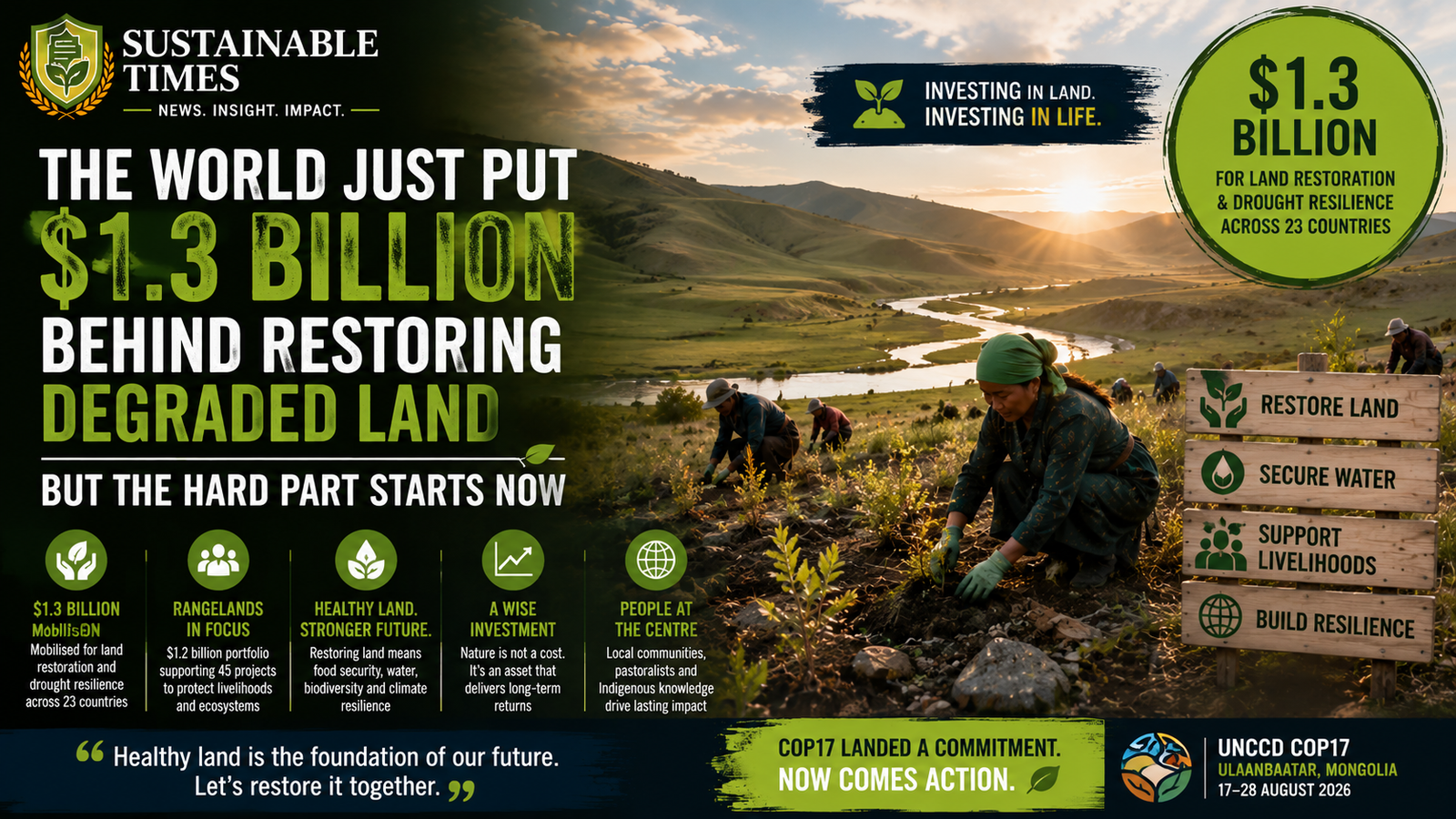
The UN Convention to Combat Desertification (UNCCD) concluded its COP17 meeting in Ulaanbaatar, Mongolia, on 28 August with governments, development banks, funds and businesses announcing a US$1.3 billion portfolio of finance for land restoration and drought resilience across 23 countries. The package includes a major new focus on rangelands, which cover roughly 54% of the world’s land surface and support the livelihoods of around two billion people.
The announcement is significant because land restoration has often struggled to attract the same financial attention as renewable energy or climate infrastructure.
COP17 tried to change that.
Rangelands Move Into the Spotlight
Rangelands rarely receive the same attention as forests, wetlands or oceans, yet they cover more than half of the planet’s land.
They support livestock, wildlife, pastoral communities and a wide range of ecosystem services. When drought, overgrazing, poor land management and climate change weaken these landscapes, the consequences can spread through food systems and rural economies.
At COP17, the new Rangelands Flagship Initiative brought together a US$1.2 billion portfolio covering 45 projects aimed at conserving, sustainably managing and restoring rangelands.
That puts pastoral landscapes much closer to the centre of the global sustainable-finance conversation.
This Is More Than a Climate Story
Healthy land does much more than absorb carbon.
It produces food, supports biodiversity, stores water, reduces erosion and provides livelihoods.
That makes land restoration one of the rare sustainability investments that can connect several global challenges at once.
A restored landscape can become more productive for farmers and pastoralists while improving ecosystem resilience. Better water retention can help communities withstand drought. Healthier soils can support agricultural productivity while reducing pressure to convert additional land.
The UNCCD says the projects announced at COP17 span 23 countries across five continents, linking restoration and drought resilience with practical investment opportunities.
But There Was No Full Drought Deal
The headline funding number comes with an important caveat.
Countries did not reach agreement on a global drought framework at COP17. Negotiations will continue at the next UNCCD COP. The World Resources Institute described the outcome as progress on finance but a shortfall on broader global drought action.
That matters because drought is becoming a more immediate economic and humanitarian risk in many regions.
Communities do not experience drought as an abstract environmental indicator. They experience it through empty reservoirs, failed harvests, livestock losses, food-price pressures and disrupted livelihoods.
Finance can help build resilience, but governments still need effective policies, early-warning systems and long-term land-management strategies to make that investment work.
A New Investment Argument for Nature
One of the more interesting developments around COP17 was the attempt to present land restoration not simply as an environmental expense, but as an investment opportunity.
A report launched during the summit, Rangelands Rising, argued that the world’s rangelands generate enormous economic and ecological value while remaining significantly underfunded. The report was produced by the International Livestock Research Institute, GIZ, the Economics of Land Degradation Initiative, UNCCD and IUCN.
That argument could become increasingly important.
Investors are becoming more interested in natural capital, climate resilience and biodiversity, but they still need projects that demonstrate credible financial and environmental returns.
Land restoration presents a difficult investment case because benefits can take years to materialize and may not always appear directly on a company’s balance sheet.
The challenge now is to build financial structures that can capture those long-term benefits.
The Missing Link: Local Communities
There is another reason the COP17 outcome deserves attention.
Land restoration cannot succeed if the people who actually manage the land remain outside the investment process.
Pastoralists, farmers, Indigenous communities and local governments often understand local ecosystems better than anyone. They also face the consequences when restoration projects fail.
UNCCD’s COP17 agenda placed greater emphasis on people who manage rangelands and on strengthening participation by local and regional actors. The summit also brought together mayors, governors and other local leaders to discuss how land resilience can become part of local development planning.
That shift could determine whether restoration remains a collection of large international projects or becomes something communities can maintain over decades.
Why Businesses Should Pay Attention
The land-restoration story also reaches into corporate sustainability.
Food companies depend on healthy agricultural landscapes. Apparel companies depend on natural fibres and agricultural commodities. Livestock businesses depend directly on rangelands. Banks and insurers increasingly face financial exposure to climate and nature-related risks.
As a result, degraded land can eventually become a supply-chain problem.
Restoring landscapes where key commodities are produced could therefore become part of corporate resilience strategies—not simply corporate philanthropy.
That creates an interesting bridge between nature finance, sustainable agriculture and supply-chain resilience.
The Bigger Question
The $1.3 billion announced at COP17 is significant, but it remains small compared with the scale of the global land problem.
The real test will come after the headlines disappear.
Will the announced financing actually reach projects? Will restoration improve livelihoods as well as ecosystems? Will investors continue supporting landscapes after the first funding cycle? And can countries build systems that prevent restored land from degrading again?
Those questions will matter more than the size of the announcement itself.
Looking Ahead
COP17 has made one thing increasingly difficult to ignore: land is becoming an investment issue, not just an environmental issue.
The world’s food supply, biodiversity, water systems and rural economies all depend on functioning landscapes. Climate change is putting additional pressure on those systems, making restoration and resilience increasingly urgent.
The $1.3 billion package gives the global land agenda a financial push.
Now governments, investors and local communities have to prove that the money can turn degraded landscapes into productive, resilient ones.
The next chapter of the land-restoration movement will not be written in conference halls. It will be written on farms, rangelands and landscapes where restoration actually happens.
Key Takeaway
UNCCD COP17 has mobilised US$1.3 billion in new and pipeline finance for land restoration and drought resilience across 23 countries, including a US$1.2 billion rangelands portfolio. The outcome shows growing interest in treating healthy land as an economic asset—but the lack of agreement on a global drought framework shows that major policy gaps remain.
About The Author