The next big technology race may not happen in a laboratory or a data centre.
It may happen on farms.
As climate change makes agriculture more vulnerable to heat, drought, water stress and shifting growing conditions, some of the world’s largest emerging economies are trying to reshape how farming knowledge, technology and genetic resources move across borders.
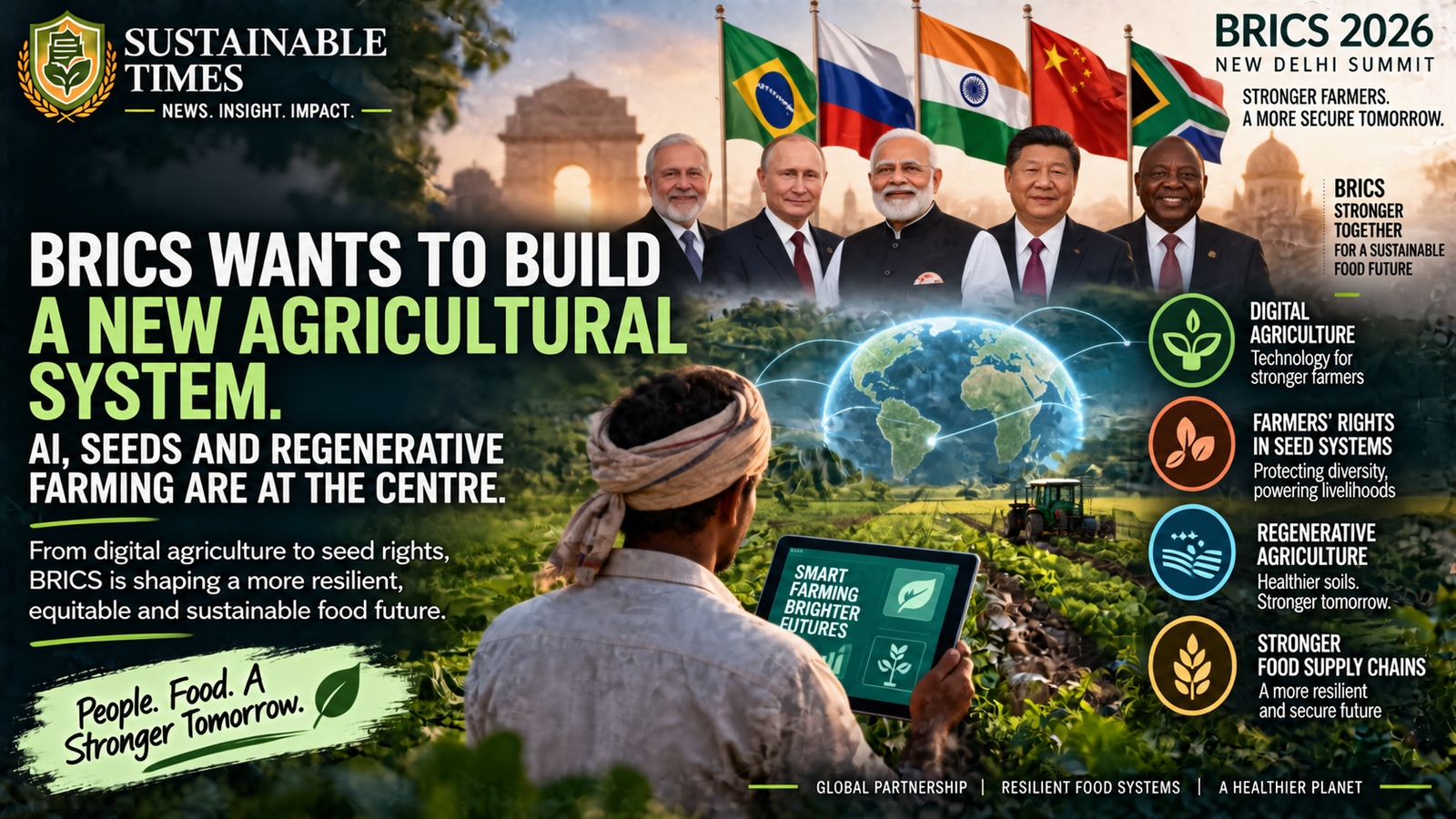
At the BRICS Summit in New Delhi, leaders backed a new set of initiatives designed to deepen cooperation on agriculture, including a digital agriculture network, a platform for agroecology and regenerative farming, a new framework for agricultural inputs and genetic resources, and a global forum focused on farmers’ rights in seed systems.
The proposals build on work carried out under India’s 2026 BRICS presidency and the agriculture ministers’ meeting held earlier this year in Indore.
Together, they point toward something bigger than another agricultural cooperation agreement.
They suggest that BRICS wants to treat food security, climate resilience and agricultural technology as interconnected challenges.
And that could become increasingly important as the countries responsible for a huge share of the world’s agricultural production face a more uncertain climate.
Farming is entering a very different era
For generations, agricultural productivity depended heavily on land, water, seeds, weather and farmers’ accumulated knowledge.
Technology has changed that equation.
Satellite imagery can identify crop stress. Sensors can measure soil conditions. Artificial intelligence can analyse weather and crop data. Digital platforms can help farmers make decisions about irrigation, fertiliser and planting.
But access to those technologies remains uneven.
A farmer may have access to a smartphone but lack reliable agronomic data. Another may have productive land but limited access to improved seed varieties or climate information. A third may face worsening drought while lacking the financing needed to change farming practices.
The BRICS countries are now trying to address some of those gaps through cooperation.
The newly backed BRICS Network on Digital Agriculture is intended to deepen collaboration around AI-driven decision-support systems, geospatial intelligence, Internet of Things monitoring and advanced agricultural data analytics. The network will also cover areas including agroforestry, fisheries and aquaculture.
That could give digital agriculture a much broader role than simply precision farming.
The goal is to build systems that can help countries share knowledge and technologies while adapting them to local farming conditions.
The AI farmer is not the point
There is a tendency to describe agricultural AI as if the future farmer will simply hand decisions over to an algorithm.
That is not what makes this development interesting.
The more important possibility is that farmers could gain access to better information at the moment they need it.
Imagine a system combining satellite imagery, weather forecasts, soil information and local crop data. Instead of giving a farmer a generic recommendation, it could help identify where water stress is emerging, whether a crop is likely to face heat damage or when irrigation could be most effective.
The technology does not replace the farmer’s knowledge.
It adds another layer of information to it.
That distinction will matter enormously in countries where millions of smallholders operate under highly variable local conditions.
The BRICS digital agriculture network is therefore potentially significant not because AI is new, but because cooperation could help make agricultural intelligence more widely accessible.
The other side of the technology story is much older: seeds
While AI represents the future of agriculture, another BRICS initiative is focused on something farmers have relied on for thousands of years.
Seeds.
The New Delhi Declaration welcomed the creation of a Global Forum on Farmers’ Rights in Seed Systems. The forum is intended to address shared challenges, support policy development and encourage the documentation and exchange of traditional agricultural knowledge and practices.
That brings a complicated issue into the centre of the agricultural debate.
Modern agriculture relies heavily on improved and commercially developed varieties, but farmers and communities have also spent generations selecting, saving and adapting seeds to local environments.
Those traditional varieties can carry valuable genetic characteristics, including tolerance to drought, heat, pests or poor soils.
As climate conditions change, that genetic diversity could become increasingly important.
A crop variety that performed well under yesterday’s climate may not necessarily perform as well under tomorrow’s.
The forum will therefore have to navigate a difficult balance between farmers’ rights, plant breeders’ rights, innovation and the protection of traditional knowledge.
The BRICS agriculture declaration specifically calls for an approach that recognises both farmers’ and breeders’ rights while encouraging fair and equitable benefit-sharing.
Regenerative agriculture is moving into the mainstream conversation
The third major piece of the agricultural agenda is perhaps the most directly connected to sustainability.
BRICS countries have backed a Network of Centres of Excellence on Agroecology and Regenerative Agriculture for Climate Resilience and Productivity.
The idea is to create stronger cooperation around research, knowledge-sharing and capacity-building for farming systems that can improve resilience while reducing pressure on natural resources.
India has already been expanding several practices associated with this transition, including natural farming, agroforestry, micro-irrigation, integrated farming systems and scientific soil management. Government data released in August said natural-farming clusters covered 8.8 lakh hectares and included 18.19 lakh farmers as of March 2026.
But regenerative agriculture is not simply about eliminating one input or adopting one technique.
It is about treating the farm as an ecosystem.
Healthy soils can hold more water.
Greater biodiversity can support ecosystem functions.
Agroforestry can combine agricultural production with trees.
Better water management can reduce pressure on scarce resources.
The challenge is proving which practices work best in which environments and helping farmers adopt them without creating new economic risks.
That is where international research cooperation could become useful.
BRICS is also trying to solve a supply-chain problem
Agricultural sustainability is not only about what happens on farms.
It is also about what happens between the farm and the consumer.
Fertiliser, seeds, machinery, logistics, finance and agricultural inputs all depend on supply chains that can be disrupted by wars, trade restrictions, extreme weather and geopolitical tensions.
The New Delhi Declaration calls for stronger cooperation on resilient and non-discriminatory agricultural and food supply chains, while also recognising the importance of smallholders, family farmers, pastoralists, fishers, Indigenous peoples, women and youth in food systems.
That is particularly relevant after several years in which global food markets have been repeatedly disrupted.
A drought in one region can affect prices elsewhere.
A conflict can disrupt fertiliser supplies.
A shipping disruption can change the cost of agricultural inputs.
A climate shock can reduce production while increasing demand for imports.
Food security is therefore becoming inseparable from supply-chain resilience.
A grain exchange could add another layer
The BRICS summit also backed a proposal for a BRICS grain trading platform, with the initiative linked to efforts to make agricultural trade more efficient and resilient.
The proposal is particularly interesting because it shows that the BRICS agricultural agenda is moving beyond farm-level technology.
It is trying to address the market itself.
If implemented effectively, a more coordinated trading mechanism could potentially improve transparency and reduce some transaction costs between participating countries.
But trade platforms alone cannot guarantee food security.
Food security ultimately depends on whether farmers can produce enough food, whether consumers can afford it, whether infrastructure can move it and whether countries can withstand climatic and geopolitical shocks.
The grain platform is therefore one part of a much larger system.
Why this matters beyond BRICS
The importance of these initiatives extends beyond the 11-member grouping.
BRICS countries include some of the world’s largest agricultural producers, consumers and commodity traders.
They also contain enormous differences in farming systems, climates and economic conditions.
Brazil is a major agricultural exporter.
India has hundreds of millions of people dependent directly or indirectly on agriculture.
China is a major agricultural producer and consumer.
Russia plays a significant role in global grain markets.
Other BRICS members add major agricultural, fisheries and commodity-producing regions.
If these countries begin sharing agricultural technologies, climate-resilient practices, genetic resources and research more systematically, the consequences could extend into global food markets.
The potential is particularly significant for the Global South.
For decades, much agricultural innovation has flowed through established centres of research and multinational supply chains.
A stronger South-South agricultural innovation network could create a different pathway, in which countries facing similar climate, water and food-security challenges exchange solutions directly.
The biggest question is whether cooperation reaches the farm
There is a reason agricultural announcements often sound more impressive on paper than they look in fields.
Creating a network is easy.
Making it useful to farmers is much harder.
An AI system must work with imperfect data.
A digital platform must reach farmers with limited connectivity.
A new seed variety must perform under real local conditions.
A regenerative farming technique must make economic sense.
A supply-chain initiative must survive political and commercial pressures.
And any new system has to work for the farmer who ultimately carries the risk.
That is why the farmer-centric language in the BRICS commitments matters.
The initiatives are being presented not simply as technology projects, but as tools intended to improve productivity, resilience and livelihoods.
Whether that promise becomes reality will depend on implementation.
Agriculture may become one of the biggest climate technologies
There is a larger lesson hidden inside the BRICS agricultural agenda.
When people talk about climate technology, they often think about batteries, solar panels, wind turbines, electric vehicles or carbon removal.
But one of humanity’s most important climate technologies may be the way we grow food.
Agriculture occupies enormous areas of land and depends directly on water, soils, biodiversity and weather.
Making those systems more resilient could reduce environmental pressure while protecting food supplies.
Digital agriculture can help farmers make better decisions.
Regenerative systems can strengthen soils and ecosystems.
Genetic diversity can provide options as climate conditions change.
Better supply chains can reduce vulnerability to shocks.
None of these solutions works alone.
Together, however, they could begin to change the way agricultural systems respond to a warming and increasingly uncertain world.
The BRICS initiatives are still at the beginning.
Networks need to be built. Research needs to be shared. Farmers need to be involved. Technologies need to prove themselves outside conference rooms and pilot projects.
But the direction is significant.
The future of sustainable agriculture may not be decided by one breakthrough seed, one AI model or one new farming machine.
It may emerge from something less dramatic but potentially more powerful: countries sharing what works before climate pressure forces them to learn the same lessons separately.
And that could make the farm of the future not just more productive, but considerably more resilient.
About The Author