For decades, the global economy has largely followed a simple pattern: take resources, make products, use them and throw them away.
That model is becoming increasingly difficult to sustain.
The world is consuming materials at a pace that puts pressure on forests, minerals, water and energy, while businesses are simultaneously facing higher resource costs and more complicated supply chains. The question is no longer simply how much waste we can recycle.
It is becoming a much bigger question:
Can we redesign the economy so that waste is no longer the end of a product’s life, but the beginning of its next one?
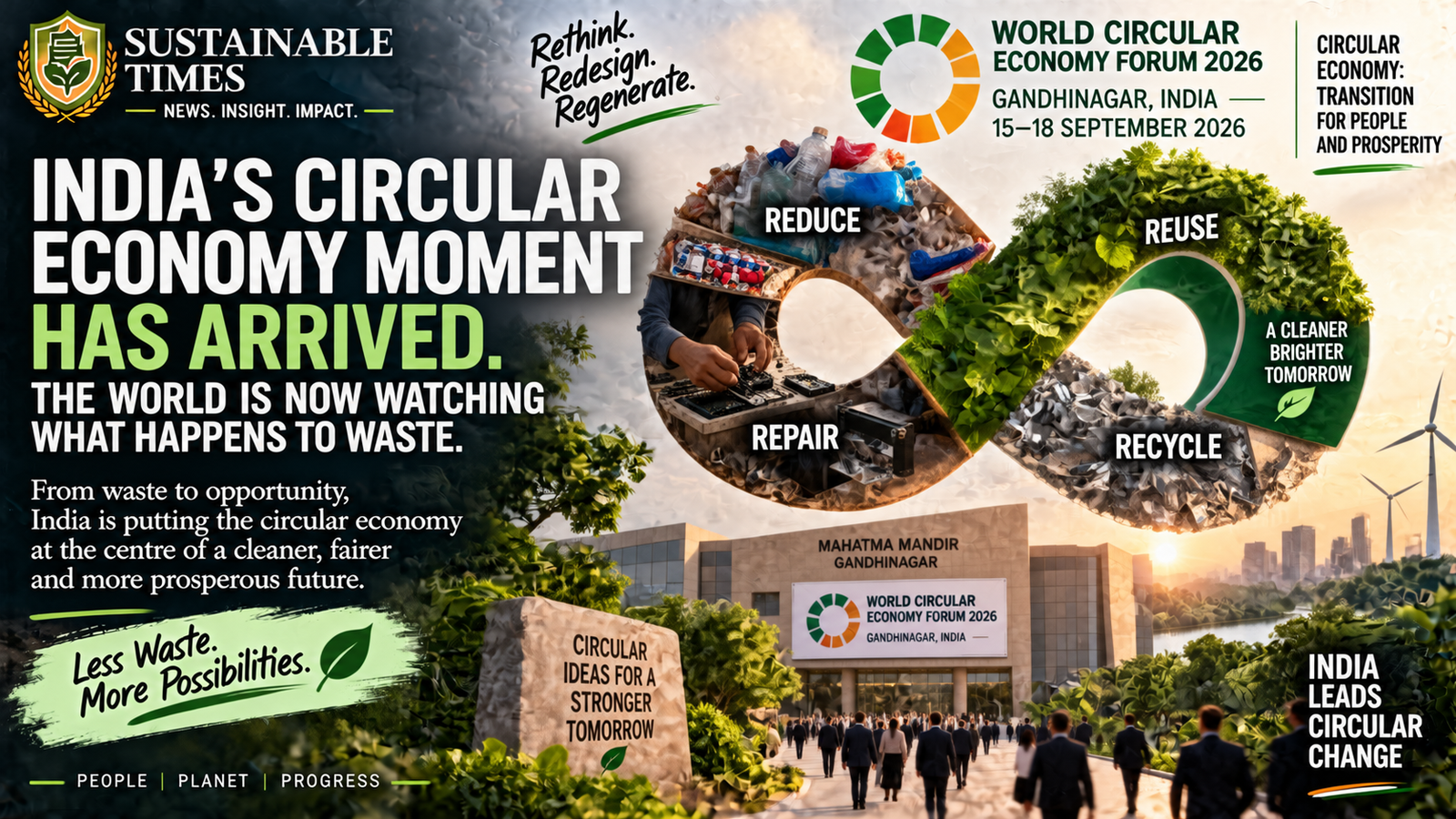
That question is at the centre of the World Circular Economy Forum 2026, which is taking place in Gandhinagar, Gujarat, from September 15 to 18. The tenth edition of the forum is the first to be held in South Asia, bringing policymakers, businesses, investors, researchers and innovators together around the theme “Circular Economy: Transition for People and Prosperity.”
And this time, the conversation is moving well beyond recycling bins.
The world is beginning to look at waste differently
India’s Environment Minister Bhupender Yadav used the opening of the forum to make a simple point: a circular economy should not be judged only by how much waste gets recycled.
The bigger objective is to preserve the value of materials for as long as possible.
That means repairing a product instead of immediately replacing it. Reusing materials instead of sending them to disposal. Designing products so that they last longer and can eventually be dismantled, repaired or recycled.
The Indian government’s message at the forum was summed up through the principle “Repair before Replace, Reuse before Discard, Recover before Waste.”
That shift sounds subtle, but it changes where the circular economy begins.
It begins before a product becomes waste.
India’s scale makes this more than a conference story
India is already dealing with the enormous practical challenge of managing materials from a rapidly growing economy.
According to the Ministry of Environment, Forest and Climate Change, more than 83,000 producers and 4,802 recyclers had registered under India’s various Extended Producer Responsibility frameworks by August 2026. The regulated waste streams covered by those systems had resulted in approximately 482.24 lakh metric tonnes of waste being processed.
Those numbers show the scale of the system being built.
But they also reveal why recycling alone cannot be the final answer.
If companies continue producing goods that are difficult to repair, difficult to dismantle and difficult to recycle, the recycling industry will always be trying to catch up with the design of the products themselves.
That is why ecodesign has become one of the important discussions at WCEF 2026.
The next circular economy battle could be won at the design stage
A product’s environmental footprint is often shaped long before consumers buy it.
The materials selected by a manufacturer, the way components are assembled, whether individual parts can be replaced and whether the product can eventually be dismantled all influence what happens at the end of its life.
A smartphone with a replaceable battery is different from one that requires specialised equipment to replace it.
A vehicle designed with recoverable materials is different from one whose components are difficult to separate.
A piece of furniture designed for repair can remain useful for decades rather than becoming waste after one damaged component fails.
The WCEF programme is putting this issue directly on the agenda through a session on ecodesign for sustainable products and a circular economy, bringing together perspectives from India, the European Union and other regions. The discussion focuses on durability, repairability, resource efficiency and recyclability, as well as the practical problems of compliance, testing, finance and access to technology.
This is where circular economy policy starts becoming a business issue.
Companies that design products for longer life may eventually have to compete with companies still following the old disposable model.
AI is entering the circular economy
One of the most interesting aspects of this year’s forum is the growing role of artificial intelligence.
AI is often discussed in the context of data centres, productivity and automation. But it could also become an important tool for tracking materials through complex supply chains.
A product can pass through manufacturers, distributors, retailers, consumers, repair businesses, recyclers and processors before its materials enter another production cycle.
Keeping track of that journey is difficult.
Digital product records, sensors, automated sorting systems and AI-powered data analysis could make it easier to identify where materials are located and what they can become next.
The WCEF programme specifically includes sessions examining the application of AI and digitalisation to circularity. The Indian government has also highlighted digital systems as part of its broader circular-economy approach.
The real opportunity is not simply using AI to recycle faster.
It is using digital information to prevent valuable materials from disappearing from the economic system in the first place.
Cars are becoming a test case
The automotive industry illustrates the challenge particularly well.
A modern vehicle contains steel, aluminium, copper, plastics, glass, electronics, batteries and dozens of other materials. Recovering those materials efficiently at the end of a vehicle’s life requires systems that can identify components, dismantle vehicles and separate materials at sufficient quality.
At WCEF, industry discussions are already focusing on how data from end-of-life vehicles can be fed back into product design.
That creates an interesting possibility.
Instead of treating the end of a car’s life as an isolated waste-management problem, manufacturers could use information from dismantling and recycling to design the next generation of vehicles for easier recovery.
The product’s end could influence the design of its successor.
That is circularity in its more ambitious form.
The Global South has a different opportunity
There is another reason this year’s forum matters.
The circular economy is often discussed through the lens of wealthy consumer markets, but some of the biggest opportunities may exist in the Global South.
Countries across Africa, Asia and Latin America hold large supplies of minerals and other resources that the global energy and technology transition increasingly needs.
The WCEF organisers argue that these countries have an opportunity to capture much more value by moving beyond simply exporting raw materials and developing circular industries around them.
That could mean recovering valuable metals from discarded electronics.
It could mean developing local repair and refurbishment industries.
It could mean turning agricultural residues into new products.
It could mean building recycling and remanufacturing businesses around materials that previously left the country as waste.
The economic argument is therefore becoming just as important as the environmental one.
A circular economy can reduce resource pressure, but it can also create businesses, jobs and new industrial capabilities.
The hard part is making recycled materials competitive
There is, however, a problem that cannot be solved with policy slogans.
Recycled materials must compete.
A manufacturer will not automatically choose recycled aluminium, plastic or other materials simply because they have a lower environmental footprint. The material must meet quality requirements, arrive reliably and make commercial sense.
That is why circular supply chains need investment.
Recycling infrastructure needs capital.
Collection networks need scale.
Processing facilities need reliable feedstock.
Manufacturers need confidence in the quality of recovered materials.
And businesses need markets willing to purchase circular products.
Without those connections, materials can remain trapped between waste collection and industrial production.
India is trying to turn circularity into an economic strategy
This is perhaps the most important message emerging from Gandhinagar.
India is increasingly presenting circular economy policy not as a narrow waste-management programme but as part of a broader strategy for resource efficiency, industrial resilience and economic growth.
That approach could become increasingly important as global competition for critical minerals intensifies.
A country that can recover materials from products already in circulation becomes less dependent on continuously extracting new resources.
The value of a tonne of material can therefore extend beyond its first use.
One batch of aluminium can move from mining to manufacturing, from a vehicle into recycling, and then back into another industrial product.
The same principle can apply to plastics, electronics, batteries, textiles and construction materials.
The objective is not to eliminate resource use.
It is to extract more value from the resources already available.
Circularity is moving from environmental policy to competitive strategy
Businesses are beginning to face a different reality.
Resource shortages can disrupt production.
Commodity prices can swing sharply.
Supply chains can become vulnerable to geopolitical shocks.
Consumers increasingly question how products are made and what happens to them after use.
Governments are introducing producer-responsibility rules and sustainability requirements.
Under these conditions, circularity is becoming less about corporate image and more about resilience.
A company that can recover its own materials, reduce dependence on volatile raw-material markets and design products for longer use may gain an economic advantage.
That is why WCEF 2026 is bringing together governments, investors, entrepreneurs and businesses rather than treating circularity as an environmental issue alone. The forum’s official programme places market transformation, finance, innovation, sustainable resources and business models at the centre of the discussion.
The real test begins after the forum ends
Thousands of people can gather in Gandhinagar and agree that the linear economy needs to change.
That is the easy part.
The difficult part begins when companies return to factories, governments return to ministries and investors return to financial models.
Will manufacturers redesign products?
Will consumers repair rather than replace?
Will recycled materials become commercially competitive?
Will cities build better collection systems?
Will investors finance circular businesses at scale?
Will digital technologies actually improve material tracking rather than simply generate another layer of data?
Those questions will determine whether the circular economy becomes a genuine economic transformation or remains a collection of promising pilot projects.
India has given the global circular economy movement an important platform this week.
Now the challenge is to turn the conversations in Gandhinagar into systems that work outside the conference hall.
Because the most successful circular economy will not be the one that recycles the most waste.
It will be the one that creates the least waste in the first place, keeps products useful for longer and makes every tonne of material work harder before it is finally lost.
About The Author