For a few minutes on a Saturday afternoon, Australia offered a glimpse of what a very different electricity system could look like.
The sun was shining.
Wind farms were producing strongly.
Millions of rooftop solar panels were sending electricity into the grid.
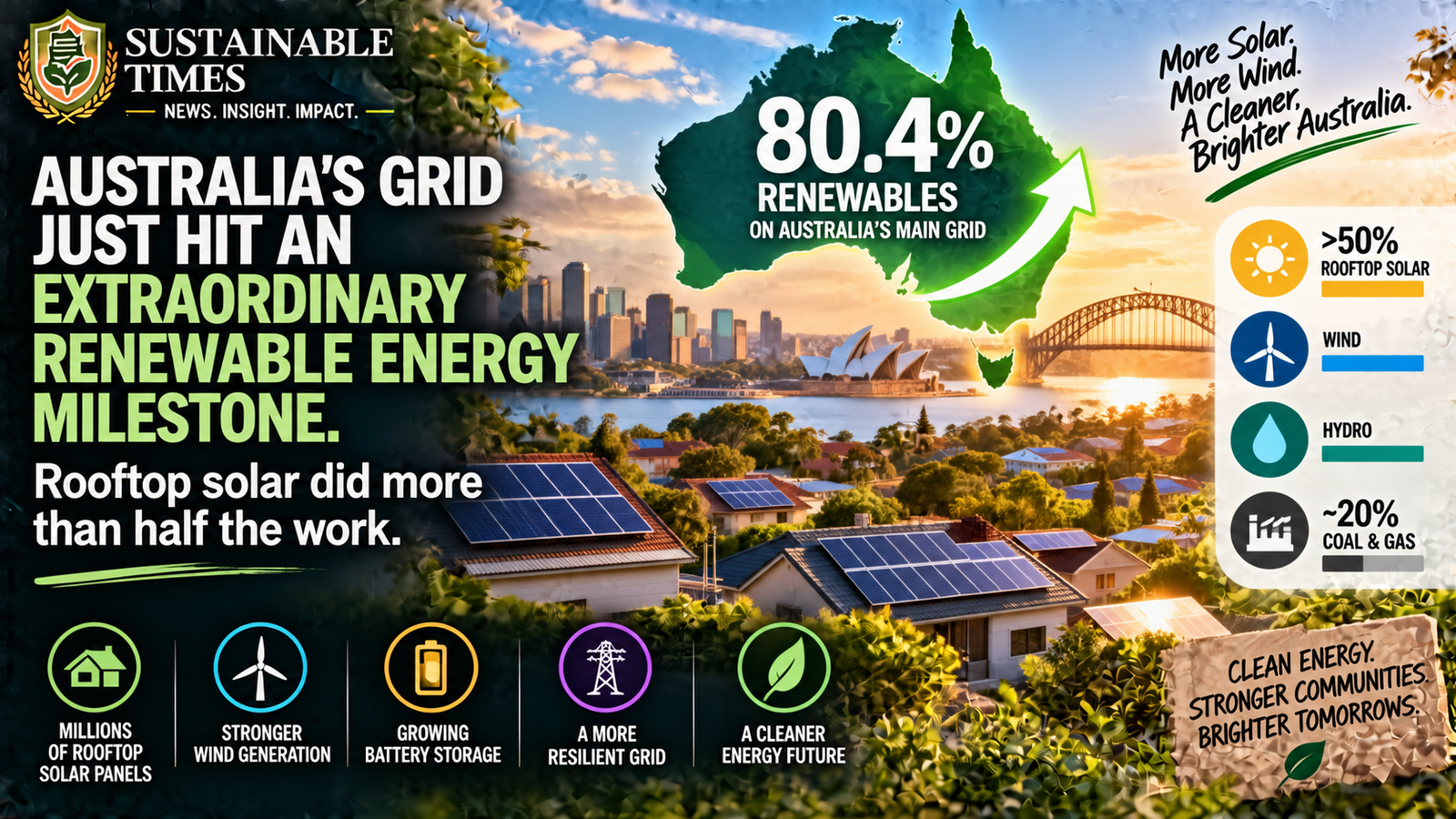
And together, renewable sources supplied 80.4% of electricity demand on Australia’s main National Electricity Market.
It was the first time the country’s main grid had crossed the 80% mark. During the peak 30-minute period around lunchtime on 19 September, rooftop solar alone supplied more than half of the electricity being consumed.
That number is impressive.
But the more interesting story is what happened underneath it.
Australia is discovering that once enough solar, wind, batteries and flexible demand enter a power system, the challenge changes.
The question is no longer simply:
Can renewable energy generate enough electricity?
It becomes:
Can the grid manage all of it when the sun is shining and the wind is blowing at the same time?
And that is a much more interesting problem.
A record built from millions of small solar panels
Australia’s renewable-energy transition is unusual because households themselves have become a major part of the electricity system.
More than 4.3 million Australian homes now have rooftop solar.
That means the country’s clean-energy infrastructure is not concentrated entirely in enormous solar farms and wind projects.
It is sitting on rooftops across suburbs and towns.
On 19 September, that distributed solar fleet became the largest contributor to the record.
For a short period around lunchtime, rooftop solar supplied more than 50% of electricity demand across the National Electricity Market, which covers Australia’s eastern states, South Australia and the Australian Capital Territory.
Utility-scale solar and wind supplied much of the remaining renewable electricity, with hydro contributing a smaller share.
Coal and gas together supplied roughly 20% during the record period.
It is a remarkable reversal for a country that has historically depended heavily on coal-fired electricity.
But there is an important detail.
This was a short-term peak, not Australia’s normal electricity mix.
And that distinction matters.
Eighty percent does not mean Australia is already an 80% renewable grid
The headline number can easily create the wrong impression.
Australia did not suddenly become an 80% renewable electricity country.
The 80.4% figure represents a particular period when renewable generation was exceptionally high and electricity demand was relatively low.
For the year to June, renewable sources supplied around 44% of electricity generation in the National Electricity Market.
That gap tells us something important.
Australia has already demonstrated that its grid can reach extremely high renewable penetration for short periods.
The harder challenge is maintaining a reliable, affordable and increasingly renewable system through the entire day, every season and every type of weather.
That is where batteries, transmission, flexible demand and other forms of firming capacity become crucial.
The grid is starting to experience a completely different problem
Traditional electricity systems were built around large power stations that could increase or decrease their output according to demand.
Solar does not work that way.
At midday, solar generation can surge.
In the evening, it can fall rapidly just as households return home and electricity demand rises.
That creates a phenomenon sometimes called the duck curve, where electricity demand that must be supplied by conventional or dispatchable sources drops during sunny hours and then rises sharply later.
Australia is now experiencing the next stage of that transition.
There can be so much renewable electricity available that the grid cannot always use all of it.
Some electricity gets stored.
Some gets exported between regions.
And some gets curtailed.
The recent renewable record again exposed those constraints, with batteries and pumped-hydro facilities absorbing some excess generation while network limitations and system-security requirements forced other renewable output to be reduced.
That may sound like a problem.
In reality, it is also a sign of how far the system has moved.
The grid is beginning to deal with too much cheap renewable electricity at certain times, rather than simply struggling to produce enough power.
Batteries are becoming part of the answer
Solar panels generate electricity when the sun is available.
People do not necessarily consume the most electricity at that exact moment.
That makes storage increasingly valuable.
A battery can absorb electricity when solar generation is abundant and release it later when demand rises.
Pumped hydro can perform a similar role by using excess electricity to move water uphill and then releasing it through turbines when electricity is needed.
Australia’s energy market operator has already reported that batteries are playing a growing role in reshaping the country’s electricity market.
In the first quarter of 2026, renewable sources supplied a record 46.5% of generation in the National Electricity Market, while battery participation continued to increase.
The latest 80.4% event demonstrates why that storage capacity matters.
The more renewable electricity a grid adds, the more valuable the ability to shift electricity from one time of day to another becomes.
Australia’s next renewable challenge may be invisible
People tend to notice solar panels and wind turbines.
They do not see transmission lines in the same way.
Yet transmission infrastructure could determine how quickly Australia can continue its renewable expansion.
A solar farm in one region may produce enormous amounts of electricity while another region needs power several hundred kilometres away.
Without enough transmission capacity, the electricity cannot move where it is needed.
The same problem appears when many renewable projects connect to the same part of the network.
Australia’s 2026 Integrated System Plan from the Australian Energy Market Operator identifies major transmission and system-development requirements as the country transitions toward a more renewable electricity system.
So the renewable transition is no longer simply about building generation.
It is about building an entire electricity system around generation that behaves differently from coal and gas.
There is another challenge hiding in Australia’s success
Australia’s renewable record is good news for climate policy.
But it also exposes a new economic problem.
When enormous amounts of solar power enter the grid at the same time, wholesale electricity prices can fall sharply.
That benefits consumers in the short term.
It can also make it harder for developers to recover the cost of building new renewable projects.
Recent Australian wholesale electricity prices have fallen significantly in several states, partly because more renewable generation and battery storage are changing the shape of electricity demand.
This creates an unusual paradox.
The country needs more renewable generation to meet its long-term targets.
But successful renewable deployment can sometimes reduce the prices that renewable projects depend on to earn returns.
The solution will not simply be to build more solar panels.
The system needs better storage, stronger transmission, flexible consumption and investment mechanisms that can support infrastructure over decades.
What happens when solar becomes almost too successful?
This may be the most fascinating part of Australia’s story.
For decades, the biggest criticism of renewable energy was intermittency.
What happens when the sun goes down?
What happens when the wind stops?
Those questions still matter.
But Australia’s latest milestone highlights a different question:
What happens when renewable electricity becomes abundant?
If solar production continues growing, midday electricity could become extremely cheap or occasionally even produce negative wholesale prices.
That could encourage new forms of electricity consumption.
Factories could shift energy-intensive processes toward sunny hours.
Electric vehicles could charge when solar power is abundant.
Batteries could absorb surplus electricity.
Water systems could move pumping operations into low-cost periods.
Green hydrogen production could eventually use abundant renewable electricity.
Large industrial facilities could increasingly schedule electricity-intensive operations around renewable availability.
The grid could begin behaving less like a system that simply supplies demand and more like a system where demand itself becomes flexible.
Australia’s rooftops are becoming a giant distributed power station
The scale of rooftop solar changes the traditional relationship between consumers and utilities.
A household with solar is not simply an electricity customer.
At certain times, it is also a generator.
Add millions of such homes together and the result becomes enormous.
That creates opportunities.
But it also creates technical challenges.
Grid operators need visibility into distributed generation.
Voltage levels need management.
Inverters need to interact properly with the electricity network.
Batteries need safe and reliable connection standards.
Electric vehicles could add another major source of flexible demand.
Australia’s government endorsed a national technical framework this month for consumer energy resources, covering technologies such as rooftop solar, batteries and electric-vehicle charging equipment. The framework aims to create common technical rules so these resources can connect reliably to the grid.
That may sound like technical housekeeping.
It is actually part of the foundation of Australia’s next energy system.
The 80% moment also happened because of ordinary weather
There is another lesson hidden in the record.
The milestone was helped by clear skies and relatively low electricity demand.
That means Australia cannot simply use the record as evidence that the grid is ready for 80% renewables every day.
Weather matters.
Seasonal demand matters.
Industrial electricity consumption matters.
Cloud cover matters.
Wind conditions matter.
The timing of renewable generation matters.
That is why one spectacular record does not replace long-term planning.
It does, however, demonstrate that the physical grid can already operate with an extraordinarily high share of renewable electricity under favourable conditions.
That is an important milestone in itself.
Coal’s role is changing, even if it has not disappeared
Australia remains a major coal-producing country.
Coal also remains part of its electricity system.
But the latest renewable records are changing the role that coal-fired generators play.
During the September record, fossil fuels supplied only around one-fifth of demand for the short period when renewables reached 80.4%.
Coal generation in Queensland also reached a record low during the renewable surge.
That does not mean coal is disappearing immediately.
Large thermal power stations cannot simply be switched off permanently because one afternoon produced a renewable record.
The bigger change is that their position within the electricity system is gradually being challenged by solar, wind, batteries and other flexible resources.
Australia’s energy transition will ultimately be judged not by one impressive afternoon, but by what happens to coal generation over years.
The 2030 target is still difficult
It would be easy to read this story as a victory lap.
Australia should resist that temptation.
The country has set a target of 82% renewable electricity by 2030.
Researchers and energy analysts continue to warn that reaching that target will require much more investment in renewable generation, storage and transmission.
The 80.4% moment therefore represents both progress and pressure.
Progress because the grid has demonstrated an extraordinary level of renewable penetration.
Pressure because the country still needs to transform that short-term achievement into a stable annual system.
The hardest part of an energy transition is rarely proving that something can work once.
It is making it work reliably at scale.
And this is where the story becomes global
Australia is not the only country facing this challenge.
Solar and wind capacity continues to expand around the world.
Renewable energy groups warned this week that global renewable deployment needs to accelerate dramatically if countries are to meet 2030 climate goals. A new report says annual deployment would need to more than double from current levels.
Countries are therefore entering a new phase of the energy transition.
The early question was:
Can renewable energy compete with fossil fuels?
Increasingly, the question is:
How do we build an electricity system that can handle very large amounts of renewable energy?
That requires a different toolbox.
Storage.
Transmission.
Smart grids.
Flexible demand.
Better forecasting.
Modern inverters.
Digital control systems.
And consumers who can participate in the energy system rather than simply consume electricity from it.
Australia’s latest record provides a real-world glimpse of that future.
The most important number may not be 80.4%
The headline figure is impressive.
But perhaps the more revealing statistic is this:
More than half of Australia’s electricity demand was briefly supplied by rooftop solar alone.
That tells us something profound about how quickly the electricity system can change.
A technology that once existed mainly on experimental rooftops has become a major component of a national power system.
Millions of ordinary households are now part of the energy transition.
And the next stage may make them even more important.
Their batteries could store electricity.
Their electric vehicles could become flexible loads.
Their smart appliances could respond to grid conditions.
Their homes could become miniature energy hubs.
The power station of the future may not always look like a power station.
Sometimes it may look like a suburban street covered in solar panels.
Australia just showed the world what the next grid problem looks like
The significance of the 80.4% record is not that Australia has solved renewable energy.
It has not.
The country still needs more generation, more storage, more transmission and better system integration.
But Australia has crossed an important psychological and technical threshold.
For a brief period, four out of every five units of electricity demanded across its main grid came from renewable sources.
The next challenge is making that kind of performance less unusual.
And then making it possible on cloudy days.
During winter evenings.
During periods of extreme heat.
During industrial demand peaks.
Eventually, the goal is not to celebrate an 80% renewable afternoon.
It is to build an electricity system where clean energy is so deeply integrated that the extraordinary becomes ordinary.
Australia’s record may therefore be less a finish line than a preview.
The question is no longer whether renewable electricity can dominate the grid for a moment.
The real question is how quickly the rest of the electricity system can catch up.
About The Author