For years, consumers have been surrounded by products described as green, eco-friendly, climate neutral, sustainable and environmentally responsible.
The problem has never been the words themselves.
It has been figuring out which ones actually mean something.
That is about to become much harder for companies to ignore.
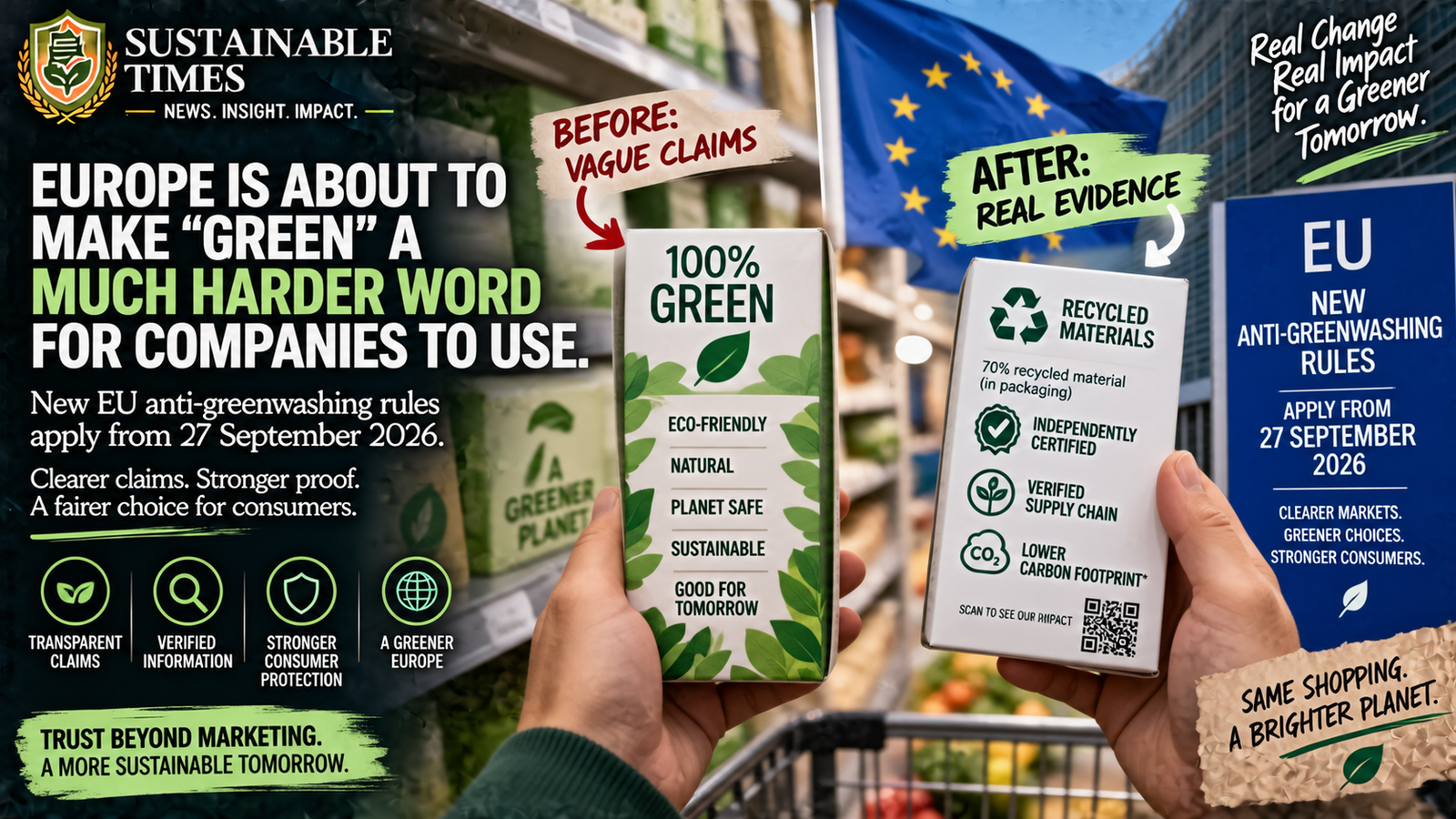
From 27 September 2026, new European Union rules designed to protect consumers from misleading environmental claims will begin applying across the bloc. The rules are part of the EU’s Empowering Consumers for the Green Transition Directive, and they will change how businesses communicate environmental benefits to consumers.
For companies that have built marketing around sustainability, this is more than another compliance deadline.
It could change the language of green marketing itself.
A company will increasingly need to answer a simple question before putting an environmental message in front of a customer:
Can you prove it?
The sustainability label era is entering a new phase
Walk into a supermarket, clothing store or online marketplace and it is easy to find environmental messages.
A package might say it is environmentally friendly.
A fashion product might describe itself as sustainable.
A company might promote a product as climate neutral.
A label might suggest that an item is better for the planet.
The European Commission has long warned that consumers struggle to distinguish reliable environmental information from misleading claims.
Its own assessment says 53% of green claims provide vague, misleading or unfounded information, while 40% have no supporting evidence. The Commission also says there are around 230 sustainability labels and 100 green-energy labels operating in the EU with widely varying levels of transparency.
That creates a strange situation.
Sustainability has become increasingly important to consumers, but the amount of sustainability information available to them can actually make decision-making harder.
More labels do not necessarily mean more transparency.
Sometimes they create more confusion.
The EU is now targeting the confusion itself
The new rules amend existing EU consumer-protection legislation.
One of the most important changes concerns vague environmental claims.
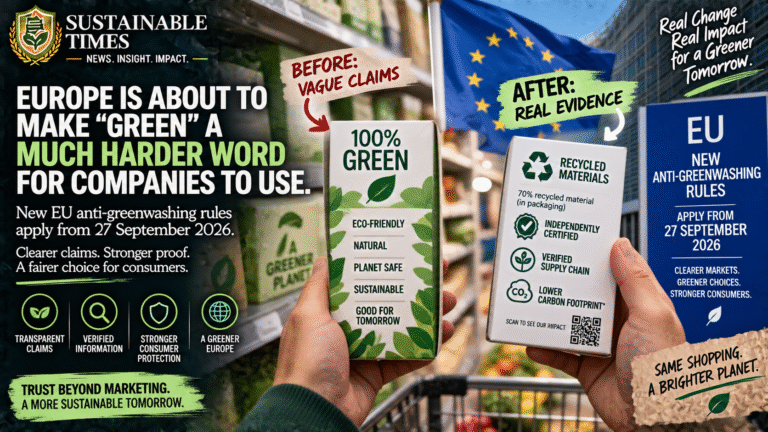
A business cannot simply tell consumers that a product is “green” or “environmentally friendly” without being able to substantiate the claim.
The rules also restrict sustainability labels that are not based on an appropriate certification scheme or established by public authorities.
That matters because sustainability labels have become a powerful marketing tool.
A small symbol on packaging can influence how consumers perceive an entire product.
The new rules effectively ask:
Who created the label?
What does it actually measure?
Who verifies it?
What evidence supports the claim?
Those questions are about to become much more important.
“Made with recycled material” can also become a problem
One of the more interesting aspects of the legislation is that a company cannot use a limited environmental improvement to create a misleading impression about the whole product or business.
Imagine a product whose packaging contains recycled material.
The company might be tempted to market the entire product as environmentally friendly.
The EU rules specifically address situations where an environmental claim about one part of a product creates the impression that the whole product has that environmental characteristic.
That principle could affect thousands of marketing messages.
A company might genuinely have a sustainability improvement.
But that does not automatically mean the company can present its entire product as sustainable.
The difference is subtle.
And commercially important.
The words “climate neutral” are facing a particularly important test
Perhaps the most significant change for sustainability marketing involves carbon offsetting.
The legislation prohibits certain claims that present a product as having a neutral, reduced or positive environmental impact when the claim relies on greenhouse-gas offsetting outside the product’s value chain.
The EU’s legal text specifically identifies claims such as “climate neutral”, “CO2 neutral certified”, “carbon positive” and “net zero” among the types of claims affected when they rely on such offsetting.
This does not mean companies can no longer talk about carbon-credit projects.
They can still communicate about environmental investments when the information is accurate and not misleading.
But there is an important distinction.
A company investing in a forest or carbon project does not automatically make the product itself climate neutral.
That distinction is going to become much more visible.
The fashion industry should pay close attention
Few industries have embraced sustainability language as aggressively as fashion.
Clothing brands routinely talk about recycled fibres, responsible materials, sustainable collections, lower-impact production and circularity.
Some claims are backed by strong evidence.
Others can be much harder for consumers to evaluate.
That makes the new rules particularly relevant to fashion brands selling into Europe.
A shirt made partly from recycled polyester may have a legitimate environmental attribute.
But that does not necessarily make the entire garment sustainable.
A collection using certified organic cotton may have a verifiable material claim.
But the claim needs to accurately describe what the certification covers.
A company that has reduced emissions at one facility cannot necessarily imply that its entire supply chain has become low-carbon.
The new regulatory environment rewards specificity.
Broad statements are becoming increasingly risky.
Food companies will face the same problem
Food packaging is another major area where environmental language can influence purchasing decisions.
Consumers increasingly encounter terms related to sustainable agriculture, responsible sourcing, recyclable packaging, lower emissions and environmental stewardship.
But food supply chains are complicated.
A product may have sustainable packaging while its agricultural ingredients come from conventional production.
A company may source one ingredient responsibly while sourcing others differently.
A particular farm programme may cover only a fraction of total production.
The new rules create pressure to communicate those distinctions clearly.
Instead of saying:
“Our product is better for the planet.”
Companies may increasingly need to explain:
“This specific ingredient is certified under this specific standard, covering this specific part of our supply chain.”
That may sound less glamorous.
It is also much more useful to consumers.
Certification bodies could become more important
This is where the story becomes particularly relevant to the sustainability-certification industry.
The new rules increase the importance of credible evidence behind environmental claims.
The EU’s broader Green Claims proposal has focused on science-based substantiation, verification and reliable environmental information. Although that separate Green Claims Directive remains a pending proposal, the consumer-protection rules entering application this week already establish important restrictions on misleading sustainability labels and claims.
That could create stronger demand for credible certification and verification.
A brand making an environmental claim may increasingly need evidence that a consumer, regulator or business partner can actually examine.
This is one reason certification systems, traceability platforms and independent verification may become more commercially important.
The sustainability market is gradually moving from:
“Tell us that you are sustainable.”
to:
“Show us how you know.”
Companies have been given time. Now the deadline is arriving.
The EU adopted the directive in 2024.
Member states had until 27 March 2026 to transpose it into national law.
The rules begin applying on 27 September 2026.
That means the transition period is effectively ending this week.
The European Commission has also published updated questions and answers to help businesses and national authorities interpret the rules.
In June, EU consumer-protection authorities agreed on a common approach to products already manufactured or placed on shelves before the new rules apply. They described these as “old stock” situations and said authorities can take a phased approach where genuine transitional difficulties exist.
So companies are not simply switching everything overnight.
But the direction is clear.
Businesses are expected to adapt.
Sustainability teams now have a new problem
For years, many sustainability departments have concentrated on collecting better data.
Emissions.
Energy.
Water.
Waste.
Supply chains.
Materials.
Now another challenge is becoming just as important:
How does that data appear in marketing?
A company may possess excellent sustainability data and still create a misleading impression if its advertising oversimplifies the findings.
That means sustainability teams and marketing departments may need to work much more closely together.
The person preparing an ESG report may need to understand how the marketing department describes the same environmental performance.
The marketing team may need to understand the limitations of the underlying data.
Legal teams may increasingly sit in the middle.
This could fundamentally change how sustainability claims are approved internally.
The new rules could actually help honest companies
At first glance, regulation sounds like bad news for business.
There will be additional compliance work.
Marketing claims may need review.
Packaging may need changes.
Some labels may have to disappear.
Some campaigns may need to be rewritten.
But there is another side to the story.
Companies that have invested heavily in genuine environmental improvements may benefit from a market where unsupported claims become harder to make.
Imagine two brands selling similar products.
One has spent years improving sourcing, reducing emissions and independently verifying its environmental performance.
The other relies mostly on attractive green language.
If consumers can increasingly distinguish evidence from marketing, the first company has more opportunity to turn sustainability investment into competitive advantage.
That is the market the EU says it wants to create.
A level playing field where companies competing on environmental performance can prove what they are doing.
But there is a risk of companies becoming afraid to talk about sustainability
There is also a less obvious danger.
If environmental claims become complicated enough, some companies may simply stop talking about sustainability.
This is sometimes called greenhushing.
A company may genuinely improve its environmental performance but avoid communicating it because it fears making a claim that could later be challenged.
That would create a strange outcome.
The EU wants more transparency.
But excessive uncertainty could potentially produce less communication.
The challenge for regulators will therefore be finding the balance between stopping deception and allowing companies to communicate genuine progress.
Clear evidence should make that balance easier.
The consumer may ultimately become the biggest winner
The most important change may not happen inside corporate sustainability departments.
It may happen in consumers’ heads.
People are increasingly asking whether a product is genuinely sustainable.
But most consumers do not have time to investigate supply chains, calculate lifecycle emissions or analyse certification methodologies before buying a pair of shoes or a packet of food.
They rely on the information placed in front of them.
If that information becomes more specific, verifiable and comparable, consumers can make better decisions.
The EU’s stated objective is precisely that: to protect consumers from greenwashing while making environmental claims more reliable and useful.
That could gradually change consumer expectations.
A green label may no longer be enough.
People may start looking for the standard behind it.
The certification behind the standard.
And the evidence behind the certification.
Europe could influence companies far beyond Europe
There is another reason this matters internationally.
Global companies rarely create completely separate products and marketing systems for every market.
A fashion company selling clothing in Europe may use similar packaging and claims in other countries.
A multinational food company may use common branding across continents.
A cosmetics company may operate one global sustainability programme.
That means European consumer rules can influence corporate practices beyond European borders.
A company that changes its global marketing system to comply with EU requirements may decide that it is simpler to use the same evidence-based approach everywhere.
In that sense, European regulation can become a global market signal.
The sustainability industry itself is changing
For years, the sustainability economy grew around commitments.
Net-zero targets.
Sustainability pledges.
Green labels.
Responsible sourcing statements.
Climate promises.
Now the market is moving toward something harder.
Verification.
Can the claim be demonstrated?
Can the data be traced?
Can another organisation independently check it?
Does the claim cover the entire product or only one component?
Does the certification actually mean what consumers think it means?
That shift could favour companies and organisations that build strong systems for traceability, certification and evidence.
It could also expose weak claims that previously survived largely because consumers had no practical way to challenge them.
“Green” is becoming a claim that needs a story behind it
There was a time when putting a green leaf on a package was enough to suggest environmental responsibility.
That era is fading.
A modern sustainability claim increasingly needs a chain of evidence behind it.
A material came from somewhere.
That source needs verification.
The production process created a particular environmental impact.
That impact needs measurement.
A reduction was achieved.
The baseline needs to be credible.
A certification was issued.
Someone needs to explain who verified it and what exactly was verified.
The word sustainable is therefore becoming less valuable on its own.
Evidence is becoming the valuable part.
The biggest change may be cultural, not legal
The EU’s new rules are ultimately about advertising and consumer protection.
But their effect could reach much further.
They could push businesses toward more precise sustainability communication.
They could encourage stronger certification.
They could increase demand for traceability.
They could make environmental data more commercially important.
And they could slowly change what consumers expect from companies.
The question may no longer be:
“Is this product sustainable?”
It may become:
“What exactly makes it sustainable, and where is the evidence?”
That is a much harder question for companies.
It is also a much better one for the planet.
Because sustainability should never depend on how convincingly something is marketed.
It should depend on what actually happens in the field, the factory, the supply chain and the environment.
From 27 September, Europe is taking another step toward making that distinction impossible to ignore.
About The Author