For generations, farmers have been paid for what they grow.
Rice. Wheat. Cotton. Maize. Vegetables. Milk.
Now, something that has always been beneath their feet is beginning to acquire economic value.
The soil itself.
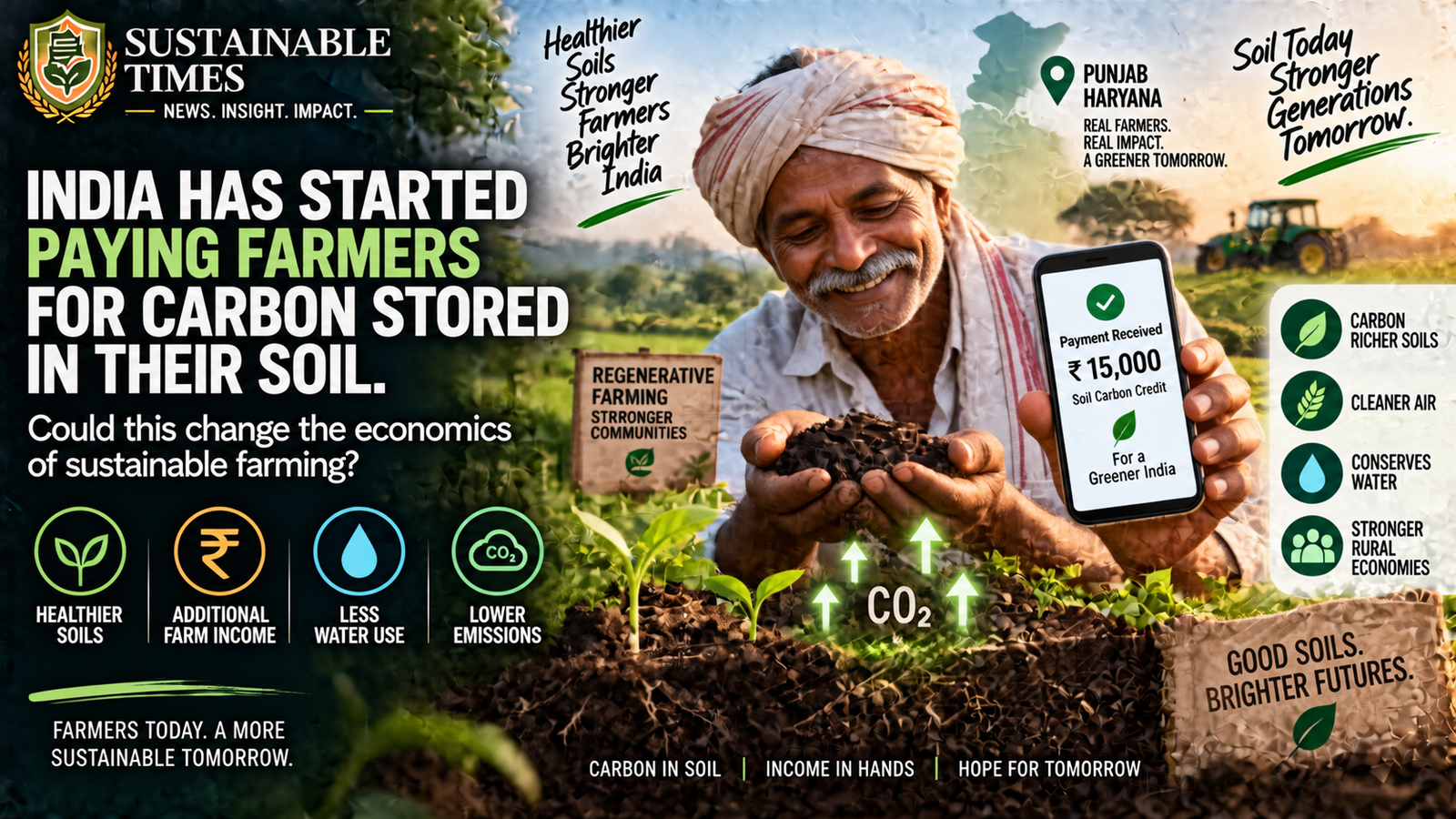
India has taken a significant step in that direction. More than 2,500 farmers in Punjab and Haryana are receiving over ₹2.9 crore in digital payments linked to verified soil-carbon credits, in what the Ministry of Agriculture describes as the country’s first farm-level soil-carbon payment initiative. The first payments were transferred at Punjab Agricultural University in Ludhiana.
The development may sound like another carbon-credit story.
It is more interesting than that.
For the first time, climate-friendly farming practices are being connected directly with additional income for farmers at scale.
And that could change the conversation around regenerative agriculture.
Instead of asking farmers only to adopt sustainable practices because they are good for the environment, the emerging carbon market is asking a different question:
What if farmers could actually earn from the environmental benefits they create?
The money is coming from changes farmers were already making
The participating farmers did not simply plant trees and wait for carbon credits.
Many adopted agricultural practices including Direct Seeded Rice, reduced tillage and improved crop-residue management between 2019 and 2022.
Those changes can influence both emissions and soil carbon.
Direct-seeded rice, for example, can reduce irrigation requirements compared with conventional transplanting.
Reduced soil disturbance can help protect soil structure and organic matter.
Better residue management can reduce the need to burn crop waste.
The resulting greenhouse-gas reductions and changes in soil carbon were measured and independently verified before credits were issued.
That verification is crucial.
A farmer cannot simply claim that a field stored carbon and receive money.
The environmental outcome has to be measured according to an approved methodology.
The programme used the Verra VM0042 methodology for its agricultural carbon credits.
That is what turns a farming practice into a potential carbon-market product.
The first payments are smaller than a crop cheque, but the idea is bigger
The initial issuance covered around 30,000 acres and more than 50,000 carbon credits.
Individual participating farmers received approximately ₹3,000 to ₹15,000, depending on their share of the credits generated from their fields.
For a farmer, that amount is not enough to replace agricultural income.
And it should not be presented that way.
But an additional payment of several thousand rupees can still matter, particularly when it rewards practices that farmers need to maintain year after year.
More importantly, the first payments demonstrate that a mechanism which has largely existed in policy discussions and pilot projects can actually reach the farm.
That is the part worth watching.
There is an unusual financial model behind the payments
The programme has also tried to address one of the biggest problems with agricultural carbon markets:
Farmers often have to wait a long time before carbon credits generate money.
Measuring changes in soil carbon is not like weighing a harvested crop.
It can take years of monitoring, verification and certification.
In this programme, Grow Indigo released the payments digitally from its own funds before the credits had been fully sold.
Farmers could choose between an assured upfront payment or 75% of the net carbon revenue after the credits were sold.
That arrangement is important because farmers generally cannot operate on the same financial timeline as carbon markets.
They have seeds to buy.
They have labour to pay.
They have equipment costs.
They need cash during the farming cycle, not years later when an environmental credit eventually reaches the market.
If carbon farming is going to scale among smallholders, payment structures will matter almost as much as the carbon science.
The environmental benefits go beyond carbon
The most interesting aspect of the programme is that carbon is only one part of the story.
According to India’s Ministry of Agriculture, the enrolled fields from 2019 to 2022 are estimated to have saved around 45 billion litres of water.
More than 200,000 tonnes of crop residue were also kept out of fires, with an estimated avoidance of about 1,000 tonnes of PM2.5 emissions.
That creates a much broader picture of sustainable agriculture.
A farming practice can potentially:
reduce greenhouse-gas emissions,
use less irrigation water,
improve soil management,
reduce crop-residue burning,
lower local air pollution,
and generate an additional source of farmer income.
That is considerably more compelling than treating carbon credits as a standalone financial product.
Punjab’s stubble-burning problem makes this especially relevant
Every year, northern India’s crop-residue burning becomes a major environmental issue.
After the paddy harvest, farmers have a narrow window to prepare fields for the next crop.
Burning residue is quick and inexpensive, but it contributes to severe air pollution.
The new carbon-payment model creates another possible incentive.
If farmers can earn from managing residue rather than burning it, sustainability becomes connected with economics.
India’s government says Punjab recorded 5,114 farm-fire incidents during the 2025 paddy harvesting season, its lowest figure since monitoring under the current framework began. That represented a 93% reduction compared with 2021 and a 90% reduction compared with 2022.
Carbon payments are not responsible for all of that reduction, and it would be misleading to suggest otherwise.
Government programmes, machinery access, enforcement, changing farming practices and local initiatives have all played roles.
But the development points toward an interesting possibility.
What if environmental behaviour could become financially attractive instead of simply being regulated?
One village has already shown what long-term change can look like
The government has highlighted the example of Ransinh Kalan in Moga, where the village maintained a residue-burning-free status across around 1,310 acres for six consecutive years.
That is important because sustainable agriculture rarely succeeds through one-season campaigns.
Farmers need systems that remain practical after the initial enthusiasm disappears.
A village that keeps managing residue properly year after year demonstrates something different from a short-term demonstration project.
It shows that behaviour can change when infrastructure, knowledge, community participation and incentives begin working together.
Carbon payments could become another piece of that system.
India is building something much larger than this first payment
The initial 2,550 farmers are only a small part of the wider programme.
The government says the Aadi programme covers more than two million acres and over 100,000 farmers across seven states.
That changes the scale of the story.
If carbon markets can eventually provide meaningful additional income to hundreds of thousands or millions of farmers, regenerative agriculture could become much easier to explain.
Farmers would not have to view practices such as reduced tillage, residue retention or efficient irrigation only as environmental responsibilities.
They could become part of a diversified farm-income model.
The important word here is could.
The market still needs to prove that carbon payments can remain reliable, transparent and economically worthwhile as participation expands.
But carbon farming has a problem nobody should ignore
The excitement around agricultural carbon markets comes with a serious challenge.
Measuring soil carbon is difficult.
Soil varies enormously from one field to another.
Carbon levels can change because of weather, crop choices, soil management and natural processes.
A credit must represent a real environmental improvement rather than something that would have happened anyway.
That is why measurement and verification are so important.
The Indian programme involved soil sampling, greenhouse-gas accounting, crop modelling, field-team training, satellite and remote-sensing approaches, and independent verification. ICAR institutions contributed scientific expertise to the process.
Without that scientific backbone, agricultural carbon markets could quickly lose credibility.
Farmers also need to understand exactly how payments are calculated.
Companies buying credits need confidence that the credits represent genuine climate benefits.
And regulators need to ensure that the market does not reward exaggerated claims.
The farmer must remain at the centre
This is where the Indian experiment could become particularly important.
Carbon markets are often discussed using the language of tonnes, credits, verification and corporate buyers.
Farmers can easily disappear from that conversation.
But the farmer is the person actually changing the land-management practice.
If a carbon market earns significant revenue while the farmer receives only a tiny fraction, the model will struggle to remain attractive.
If farmers have transparent contracts, understandable payment formulas and reliable income from verified environmental outcomes, the model could become much more powerful.
The first payments therefore matter not just because money changed hands.
They establish a precedent.
A farmer can now be compensated for an environmental service generated on agricultural land.
That is a significant shift.
This could change how we think about agricultural productivity
Traditional agricultural productivity asks:
How much did the farm produce?
The emerging regenerative model asks several additional questions.
How much water did it use?
How much carbon did the soil retain?
How much residue was burned?
How much soil was disturbed?
How much greenhouse gas did the farming system emit?
And now:
What economic value can those environmental outcomes create?
That is a much more complicated definition of productivity.
It also opens the door to new forms of rural income.
Crop sales could remain the main source.
Livestock and allied activities could provide another.
Carbon payments could become an additional stream.
Potential ecosystem-service payments could eventually add another.
The farm begins to look less like a single-output business and more like a multi-value environmental enterprise.
The biggest test will be scaling beyond Punjab and Haryana
The practices that work in Punjab and Haryana will not automatically work everywhere.
India contains radically different farming systems.
Rainfed farms in Maharashtra face different constraints from irrigated farms in Punjab.
Smallholders in Rajasthan manage water differently from rice farmers in West Bengal.
Farmers in the Northeast face another set of conditions.
Carbon accounting must therefore reflect local realities.
The government’s announcement itself points toward wider adoption of residue retention, minimum soil disturbance, direct-seeded rice, diversified cropping, improved soil biology and efficient water use.
The challenge will be finding combinations that work economically and environmentally in each region.
A national carbon market cannot mean one farming formula for everyone.
It needs a framework that recognises local conditions.
India’s experiment is also attracting international attention
There is a wider geopolitical dimension to this development.
India hosted the 16th BRICS Agriculture Ministers’ Meeting in Indore in June 2026, where members agreed to establish a BRICS Network of Centres of Excellence focused on agroecology and regenerative agriculture for climate resilience and productivity.
The BRICS New Delhi Declaration later welcomed stronger cooperation through that network.
That means India’s agricultural transition is no longer only a domestic issue.
If India can develop credible systems for measuring and rewarding sustainable farming, other large agricultural economies could study the model.
The same question exists across much of the developing world:
How do you persuade millions of small farmers to adopt climate-smart practices without making sustainability another financial burden for them?
Paying for verified environmental outcomes could be part of the answer.
The real breakthrough is not the ₹2.9 crore
The headline number is attractive.
More than ₹2.9 crore going to 2,550 farmers sounds impressive.
But the real significance lies elsewhere.
For decades, sustainable agriculture has struggled with a basic economic problem.
Farmers often bear the cost of changing their practices, while society receives many of the benefits.
Cleaner air benefits cities.
Lower emissions benefit the climate.
Better soil benefits future production.
Reduced water consumption benefits entire regions.
Yet the farmer does not always receive direct compensation for creating those benefits.
India’s first soil-carbon payments attempt to change that equation.
It says that if society values healthier soils, lower emissions and better resource management, the farmer who creates those outcomes should have a chance to earn from them.
That could prove far more important than the first payment itself.
A new market is forming beneath India’s food system
The next few years will reveal whether this model can scale.
Can carbon measurements remain credible?
Can farmers understand and trust the contracts?
Can carbon buyers pay enough to make sustainable practices worthwhile?
Can payments arrive consistently?
Can environmental benefits survive beyond the period used to generate the credit?
And perhaps most importantly:
Can the carbon market improve farm economics without turning farmers into unpaid suppliers for another complicated financial system?
Those questions deserve serious attention.
Because if the answers are positive, India may be witnessing the beginning of something much bigger than a carbon-credit programme.
It could be the emergence of a new agricultural economy in which farmers are rewarded not only for the food they produce, but also for the soil they protect, the water they conserve and the emissions they prevent.
For the first time, the market is beginning to put a price on something farmers have been managing for generations.
The soil beneath their feet.
About The Author