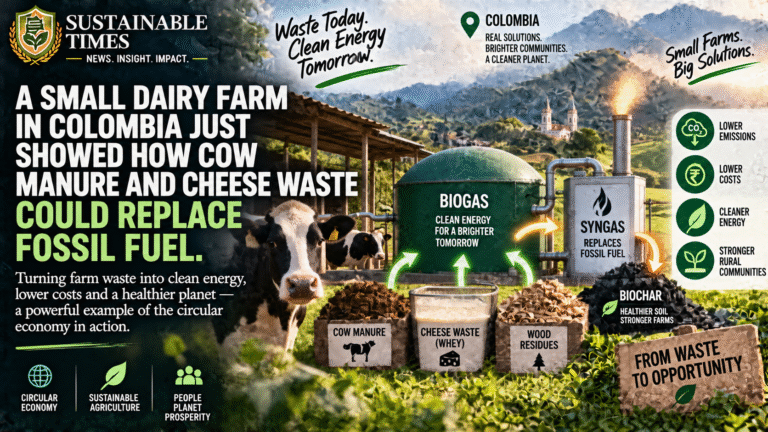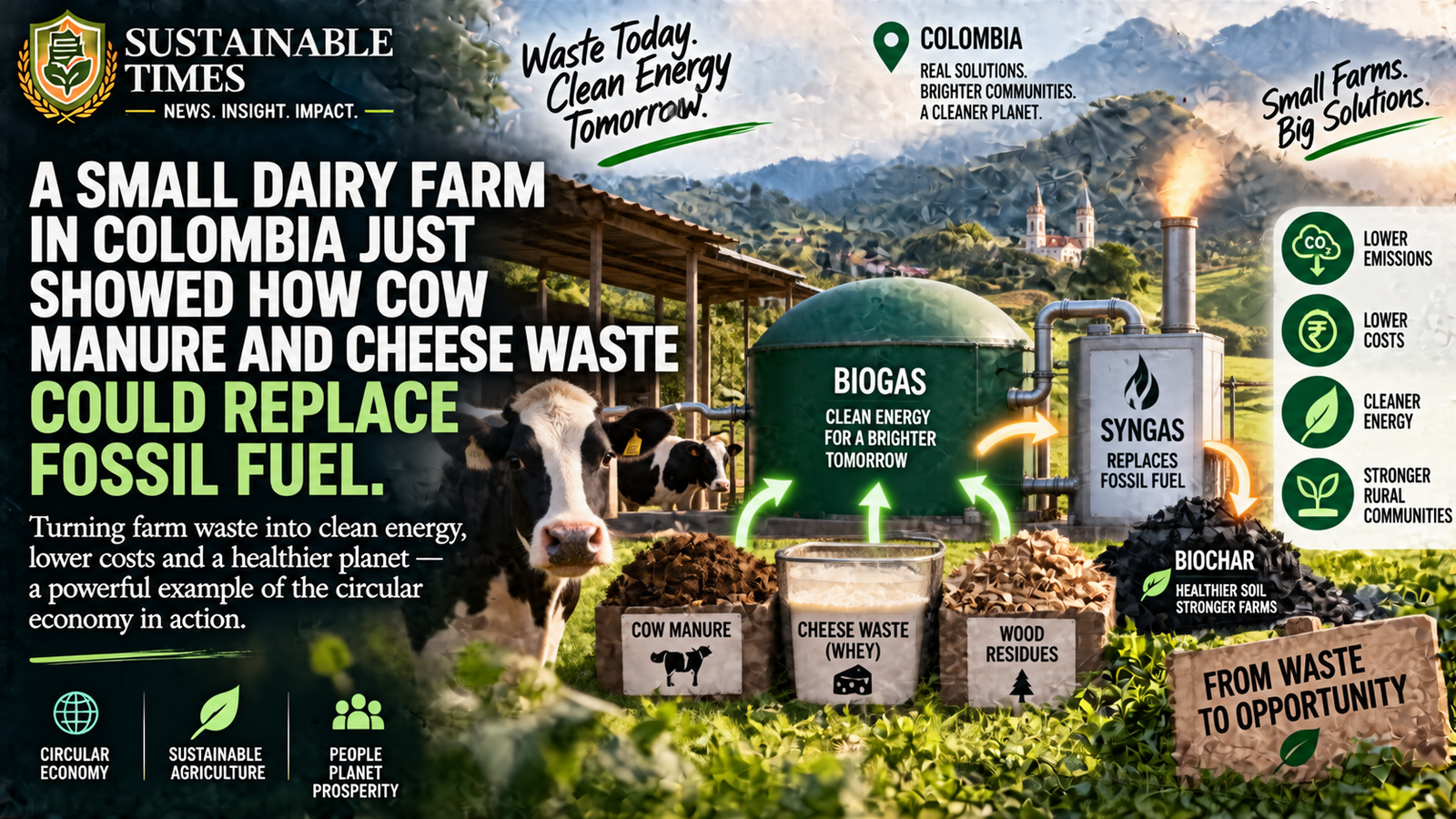
A small dairy farm in the Colombian Andes has become an unlikely case study in what a circular economy can look like when it is built around the realities of a rural farm rather than a large industrial facility.
The system uses cow manure, cheese whey and discarded wood residues to produce biogas, syngas and biochar. Researchers have now measured what happens when these technologies work together, and the results are striking: the integrated system reduced several environmental impacts while cutting the farm’s estimated production costs by more than half.
The research, published on 20 September 2026 in the Journal of Cleaner Production, examined a small dairy and cheese-producing farm in Colombia. It looked at three situations: conventional waste and energy management, a low-tech anaerobic digester, and a system combining the digester with gasification.
The most interesting finding was not simply that waste could produce energy.
It was that two relatively simple technologies could work together to change the economics of a small farm.
The farm had a problem that many rural businesses will recognise
The farm produces milk and turns part of it into cheese.
That sounds straightforward until you look at what comes out of the process.
There is cow manure.
There is cheese whey.
There are agricultural and wood residues.
And there is a continuing need for energy.
Traditionally, these streams are treated separately. Manure can sit in storage. Whey can become a waste-disposal problem. Cooking and cheese processing can depend on LPG or other fossil fuels. Farmers may also continue buying synthetic fertilisers even though nutrients are leaving the farm in its waste streams.
The Colombian researchers asked a different question.
What if the waste streams were treated as resources instead?
First came the digester
The farm already had a low-tech anaerobic digester.
Anaerobic digestion uses microorganisms to break down organic material in an oxygen-free environment.
In this case, the digester processed a mixture of cattle manure and cheese whey.
The process produced biogas, which could replace part of the farm’s LPG consumption.
It also produced digestate, which could be used in agriculture.
The approach is relatively simple compared with the highly engineered biogas facilities found at large industrial farms.
That simplicity matters.
A technology that works only with expensive equipment and specialist operators may have limited value for a small rural producer.
A system that can operate at farm scale is a different proposition.
Then the researchers added something unexpected: wood waste
The second stage involved gasification.
The farm had wood residues that were previously used as animal bedding.
Researchers used some of this material in a small gasifier.
Gasification converts biomass at high temperatures into a combustible gas known as syngas. The process also produces biochar.
The biochar was not treated as another waste product.
It was fed back into the anaerobic digestion process.
That created a link between the two technologies.
The gasifier produced syngas that could replace LPG.
Its biochar went into the digester.
The digester produced more biogas.
Instead of building two independent waste-management systems, the farm created a small network in which one process supplied material to another.
That is where the circular-economy idea becomes much more tangible.
The results were surprisingly strong
The researchers compared the integrated system with the conventional baseline.
The system combining the digester and gasifier reduced environmental impacts associated with climate change and eutrophication by up to about 15% compared with the baseline. It also reduced fossil-resource scarcity by around 17%.
But the economic result may be even more interesting.
The study estimated that combining the technologies could reduce total cheese-production costs by 56% compared with the conventional system.
The main reason was energy.
The integrated system could replace fossil LPG with biogas and syngas.
That meant the farm could reduce its dependence on purchased fuel.
For a large corporation, energy savings can be significant.
For a small rural business, they can determine whether a production system remains financially viable.
The biochar played a bigger role than simply storing carbon
Biochar has attracted considerable attention as a potential climate tool.
But in this project, researchers were interested in another function.
Adding biochar to the digester helped improve methane production.
According to the study, the system produced more biogas after biochar was incorporated, while the gasifier generated syngas that could be used directly in place of LPG.
That creates an interesting chain.
Wood residue becomes biochar.
Biochar helps the digester.
The digester produces biogas.
The gasifier produces syngas.
Biogas and syngas replace fossil fuel.
The farm therefore extracts more than one useful product from materials that previously had limited economic value.
The whey problem becomes an energy opportunity
Cheese production creates another major side stream: whey.
Whey contains organic matter and nutrients, which means releasing it untreated can create environmental problems.
In the Colombian system, whey became feedstock for anaerobic digestion rather than simply a disposal problem.
This is an important principle for circular agriculture.
Waste streams rarely exist in isolation.
One business’s waste can become another process’s feedstock.
But the most efficient systems may be even more integrated, with several waste streams from the same farm or food-processing operation feeding into one another.
That can reduce transport requirements and make resource recovery more practical.
It was a tiny farm, and that is exactly why the study matters
The farm studied had only 13 cattle, produced around 221 kilograms of manure per day and processed milk into cheese.
This is not an enormous industrial dairy.
There is no giant biogas plant here.
There is no huge solar farm.
There is no sophisticated industrial waste-treatment complex.
That makes the results interesting for a different reason.
A large company can often afford expensive sustainability infrastructure.
Small farmers cannot.
If circular systems are going to become widespread across rural economies in developing countries, they will need technologies that work at smaller scales.
The researchers specifically describe the approach as having potential for decentralised, low-tech bioenergy systems on small farms in low- and middle-income countries.
But the study does not say every farm should copy it tomorrow
There is an important qualification.
The researchers used life-cycle assessment and life-cycle costing to compare the systems. That means the study looked beyond the energy produced and considered the environmental and economic consequences of the infrastructure and inputs required.
That matters because a technology can appear sustainable at one point in the system while creating impacts somewhere else.
For example, building equipment requires materials.
Transport requires energy.
Maintenance has a footprint.
Digestate may not completely replace synthetic fertiliser.
And local conditions can change the economics dramatically.
The study itself is therefore better understood as evidence of potential, rather than proof that one universal system will work everywhere.
Fertiliser is still a difficult piece of the puzzle
One of the less impressive findings concerns digestate.
Although the digester produces a nutrient-containing residue that can be returned to farmland, the study found that its ability to replace synthetic fertiliser was limited.
The researchers found that the digestate’s relatively low nutrient concentration restricted the amount of synthetic fertiliser it could displace.
That is a useful reminder.
Circular agriculture does not become sustainable simply because every waste product is technically reused.
The replacement has to be meaningful.
If a by-product replaces only a tiny amount of the material that would otherwise have been purchased, its environmental benefit may remain limited.
The strongest systems will therefore be those that maximise both resource recovery and useful substitution.
The model could be particularly relevant to rural economies
There is a larger development story here.
Small dairy farms in many parts of Latin America, Asia and Africa face the same combination of challenges:
They generate organic waste.
They need affordable energy.
They often depend on purchased fertiliser.
They may have limited access to sophisticated infrastructure.
And their margins can be thin.
A decentralised system that converts local waste into energy could address several problems simultaneously.
It could reduce waste.
It could lower fuel purchases.
It could provide renewable energy.
It could create useful soil amendments.
And it could reduce exposure to volatile fossil-fuel prices.
That does not mean every farm needs its own gasifier.
In some regions, a cooperative or community-scale facility may make more sense.
Several nearby farms could supply manure and agricultural residues to one shared system while sharing the resulting energy and products.
That could eventually create a new model of rural infrastructure.
The bigger idea is not biogas. It is integration.
Biogas itself is hardly new.
Neither is gasification.
Neither is composting.
Neither is biochar.
What is interesting here is the way researchers connected them.
The future of circular agriculture may depend less on finding one magical technology and more on connecting technologies that already exist.
A farm can produce food.
Its residues can feed a digester.
The digester can produce energy.
A gasifier can process another waste stream.
Biochar can return to the biological process.
Digestate can return to the soil.
Energy can return to production.
The system begins to behave less like a straight line and more like a loop.
That is the real promise of the circular bioeconomy.
There is a lesson here for India too
India has millions of small and marginal farms, dairy producers and village-level food-processing businesses.
Many already generate cattle manure, crop residues and food-processing by-products.
The challenge is rarely a complete absence of resources.
It is often the lack of economically viable systems that connect them.
A village dairy cooperative, for example, could potentially aggregate manure and processing waste.
A local digester could produce biogas.
A nearby food-processing unit could potentially use the gas.
Agricultural residues could supply other processes.
The resulting digestate could return nutrients to farms.
The exact model would depend heavily on local conditions, but the principle is worth watching.
The next stage of sustainable agriculture may not come from producing more inputs. It may come from wasting fewer of the inputs and by-products that farms already have.
Small technology can sometimes create big changes
There is a tendency to associate climate technology with enormous infrastructure.
Gigawatt-scale solar parks.
Massive battery factories.
Industrial carbon-removal plants.
Hydrogen hubs.
But sustainability also has a quieter side.
A small digester on a farm.
A gasifier using local wood residues.
A simple system for capturing energy from waste.
A technology that saves a farmer money every month.
These solutions may not dominate headlines, but their cumulative effect could become significant if they spread across thousands of rural businesses.
The Colombian study offers an unusually practical example of that possibility.
It does not promise a perfect circular farm.
It shows something more useful.
With the right combination of technologies, waste from one part of a small dairy operation can become energy for another part, while reducing both environmental pressure and production costs.
That is a much more interesting definition of sustainability than simply producing less waste.
It is about designing farms where less of what enters the system ever needs to leave it as waste in the first place.
About The Author