For years, scientists have warned that tiny plastic particles are finding their way into almost every corner of the environment, from ocean sediments and drinking water to food and human tissues.
But one important question has remained difficult to answer: What makes these microscopic particles potentially harmful once they enter living organisms?
A new study published on 14 October 2026 in the journal Nature may provide part of the answer.
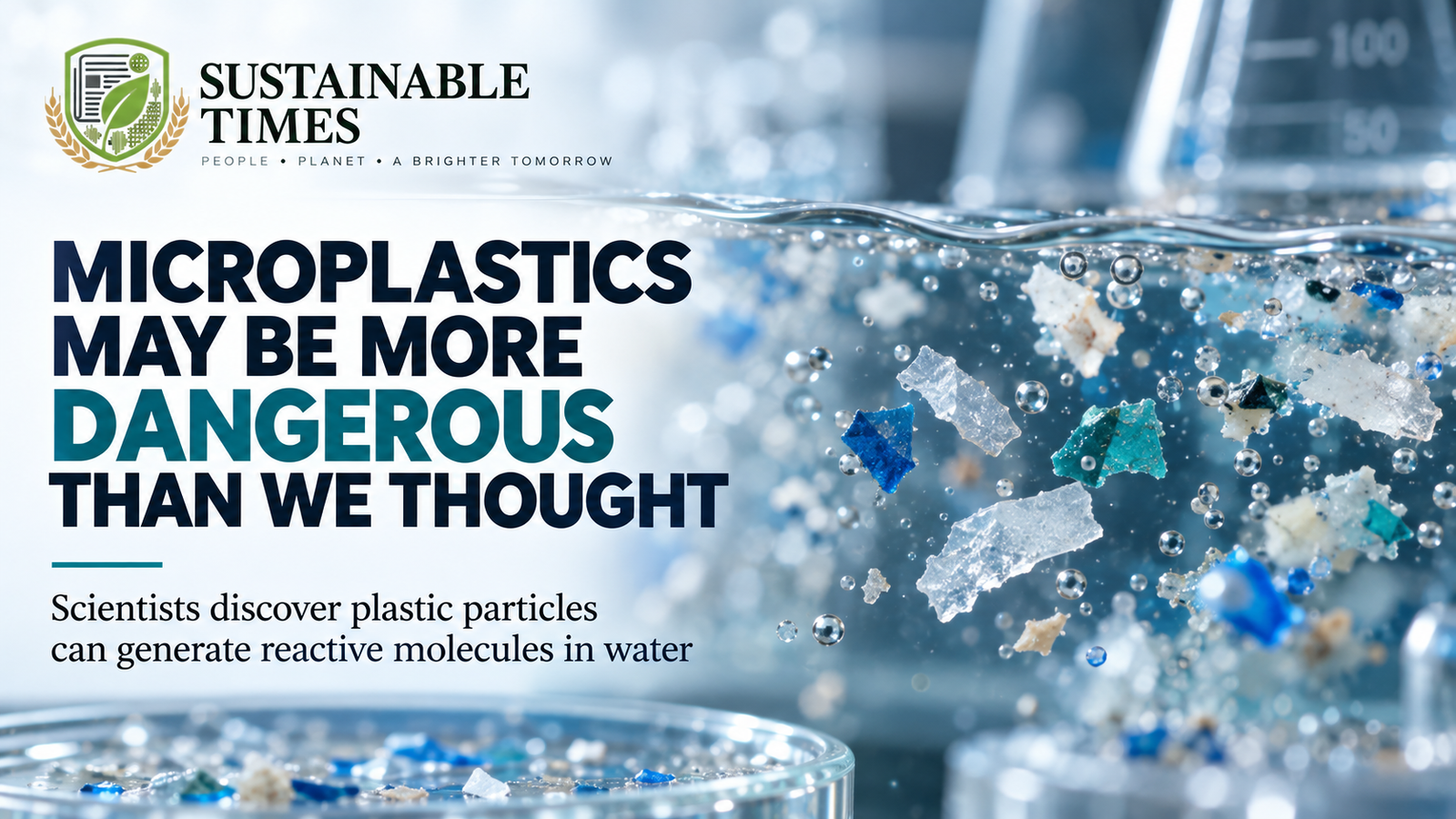
Researchers from Columbia University and the University of California, Berkeley, have discovered that microplastics can generate highly reactive molecules simply by interacting with water.
The finding challenges the long-standing assumption that many common plastics remain largely chemically inactive under ordinary conditions.
More importantly, it reveals a potential mechanism through which plastic particles could interact with biological tissues and contribute to environmental and health risks.
The discovery does not prove that every microplastic particle causes disease. However, it gives scientists a new way to investigate why plastic pollution may be more harmful than previously understood.
The Smaller Plastic Gets, the More Complicated the Problem Becomes
Plastic pollution rarely remains in its original form.
A discarded bottle, food container or synthetic fabric can gradually break into smaller fragments through sunlight, mechanical wear and other environmental processes.
These fragments eventually become microplastics, typically defined as plastic particles smaller than five millimetres.
Some break down further into nanoplastics, which are so small that researchers need specialised instruments to detect them.
As plastic particles become smaller, their total surface area increases dramatically relative to their volume.
That change is central to the new discovery.
A large piece of plastic exposes relatively little surface area to the surrounding environment. But when it breaks into thousands of microscopic fragments, much more of the material comes into direct contact with water.
The researchers found that these exposed surfaces can create conditions for unexpected chemical reactions.
In other words, breaking plastic into smaller pieces does not simply make it harder to collect.
It may also change how the material behaves chemically.
Scientists Found an Unexpected Reaction With Water
The research team investigated what happens when common plastic materials interact with water at the molecular level.
They discovered that certain plastic surfaces can promote the spontaneous formation of reactive oxygen species, including hydroxyl radicals.
These molecules are highly reactive and can interact with other chemical compounds.
In biological systems, excessive reactive oxygen species can contribute to oxidative stress, potentially damaging proteins, lipids and other cellular components.
The researchers found that the reaction was strongly linked to how the plastic surface interacts with water.
Many common plastics are hydrophobic, meaning they repel water.
However, the interface between a water-repelling surface and surrounding water can create unusual chemical conditions.
According to the study, these conditions can facilitate electron transfer and the formation of reactive radicals.
The team combined laboratory experiments with molecular simulations to understand the process.
Researchers at Columbia University conducted the experimental work, while collaborators at UC Berkeley investigated the underlying molecular interactions.
The results suggest that water is not merely a passive environment surrounding microplastics.
It can actively participate in chemical reactions occurring at their surfaces.
Why This Discovery Matters for Human Health
Microplastics have already been detected in multiple human tissues and biological samples.
Previous studies have reported associations between microplastic exposure and several health concerns.
However, researchers have struggled to establish exactly how these particles might contribute to biological harm.
The new findings offer one possible explanation.
If microplastics generate reactive molecules when surrounded by water, similar processes could potentially occur in water-rich biological environments.
Human cells contain substantial amounts of water, making the interaction particularly relevant for future health research.
Wei Min, a professor of chemistry and biomedical engineering at Columbia University, explained that smaller plastic fragments expose more reactive surface area and may change the chemistry of the water around them.
His team believes this process could help explain some of the biological effects observed in previous studies.
However, an important distinction remains.
The research demonstrates a chemical mechanism under experimental conditions. It does not establish that everyday exposure to microplastics inevitably causes specific diseases.
Scientists still need to determine how these reactions behave inside living organisms and whether they occur at levels capable of causing meaningful health damage.
The Environmental Implications Go Beyond Drinking Water
The discovery also raises questions about the behaviour of microplastics in natural ecosystems.
Plastic fragments enter rivers, lakes and oceans through several pathways, including wastewater discharges, synthetic textile fibres, industrial activities and the breakdown of larger plastic products.
Once these particles enter aquatic environments, they can remain suspended in water, settle into sediments or interact with organisms.
Until now, much of the environmental discussion has focused on the physical presence of microplastics and the chemicals associated with them.
The latest research introduces another consideration: the particles themselves may influence chemical reactions in surrounding water.
That could make their environmental behaviour more complicated than previously assumed.
Scientists will now need to investigate whether these surface reactions occur under different natural conditions, including varying temperatures, water chemistry and concentrations of organic matter.
Understanding those factors could improve future assessments of microplastic pollution.
A New Challenge for Plastic Manufacturers
The findings may also influence how manufacturers approach material design.
Plastics remain essential to modern industries because they are lightweight, versatile, durable and often inexpensive.
Packaging, electronics, healthcare equipment, transportation and construction all rely heavily on plastic materials.
However, durability creates a difficult environmental trade-off.
Materials designed to resist degradation can persist in the environment for long periods.
When they eventually fragment, their smaller particles may behave differently from the original material.
The new research suggests that surface chemistry could become an important consideration when developing safer plastics.
Teresa Head-Gordon, a professor at UC Berkeley who contributed to the study, believes understanding these reactions could eventually help researchers redesign common plastics to reduce their potential environmental and biological impacts.
That does not mean manufacturers already have a proven solution.
But the discovery gives material scientists another property to investigate when evaluating plastic safety.
Recycling Alone Cannot Solve the Microplastics Problem
The findings also highlight a limitation of conventional plastic waste management.
Recycling helps recover valuable materials and can reduce demand for virgin plastic production.
Yet not all plastic waste reaches recycling facilities.
Some escapes into the environment during manufacturing, transportation, use or disposal.
Synthetic clothing can release microscopic fibres during washing. Tyres shed particles through road wear. Larger plastic products can gradually fragment after entering natural environments.
These pollution sources require more than better waste collection.
They also require improved product design, stronger pollution controls and technologies capable of preventing small particles from entering waterways.
Researchers at Columbia University are already investigating engineering approaches to reduce microplastic emissions from washing machines and laundry dryers.
Such interventions could become increasingly important as scientists learn more about the behaviour of plastic particles after they escape into the environment.
The Discovery Could Change How We Measure Plastic Pollution
For years, researchers have worked to answer a relatively straightforward question:
How much microplastic pollution is present in a particular environment?
That remains important.
But the new findings suggest that counting particles may not provide a complete picture of environmental risk.
Two environments containing similar quantities of microplastics may not necessarily experience identical chemical effects.
Particle size, surface properties and interactions with surrounding water could influence how the materials behave.
This may eventually encourage scientists to examine not only the quantity of plastic particles but also their chemical activity.
Such measurements could provide a more detailed understanding of environmental exposure.
However, developing reliable testing methods will require additional research and scientific validation.
What Happens Next?
The study provides a valuable starting point, but several questions remain unanswered.
Scientists still need to determine how different plastics behave in complex natural environments and living tissues.
They also need to establish whether the reactive molecules identified in laboratory experiments contribute directly to biological damage under realistic exposure conditions.
Researchers are continuing to investigate how microplastics move through human tissues and whether their chemical interactions can affect cells.
Future studies could help connect the new molecular findings with broader environmental and public-health research.
For policymakers and manufacturers, the discovery reinforces the importance of reducing unnecessary plastic pollution while improving scientific understanding of existing materials.
It also demonstrates how much researchers still have to learn about substances that have been part of everyday life for decades.
A Small Particle With a Much Bigger Environmental Story
The world’s plastic problem has traditionally been presented as a waste-management challenge.
Plastic accumulates in oceans, damages habitats and persists long after products reach the end of their useful lives.
But the latest research suggests that the problem may extend beyond where plastic particles travel or how long they remain in the environment.
Their microscopic surfaces may also trigger chemical reactions that scientists are only beginning to understand.
That creates a new dimension for environmental research, product safety and sustainable material innovation.
Reducing plastic pollution will still require better waste systems, responsible consumption and improved product design.
Now, scientists have another reason to examine the materials themselves.
The next breakthrough in tackling plastic pollution may not simply involve removing microscopic particles from the environment. It may begin with understanding what those particles do once they get there.
About The Author