For years, governments have agreed that developing countries need far more money to respond to climate change. Yet raising that money has remained one of the biggest obstacles in international climate negotiations.
Now, the world’s largest multilateral climate investment fund is attempting to change how the system works.
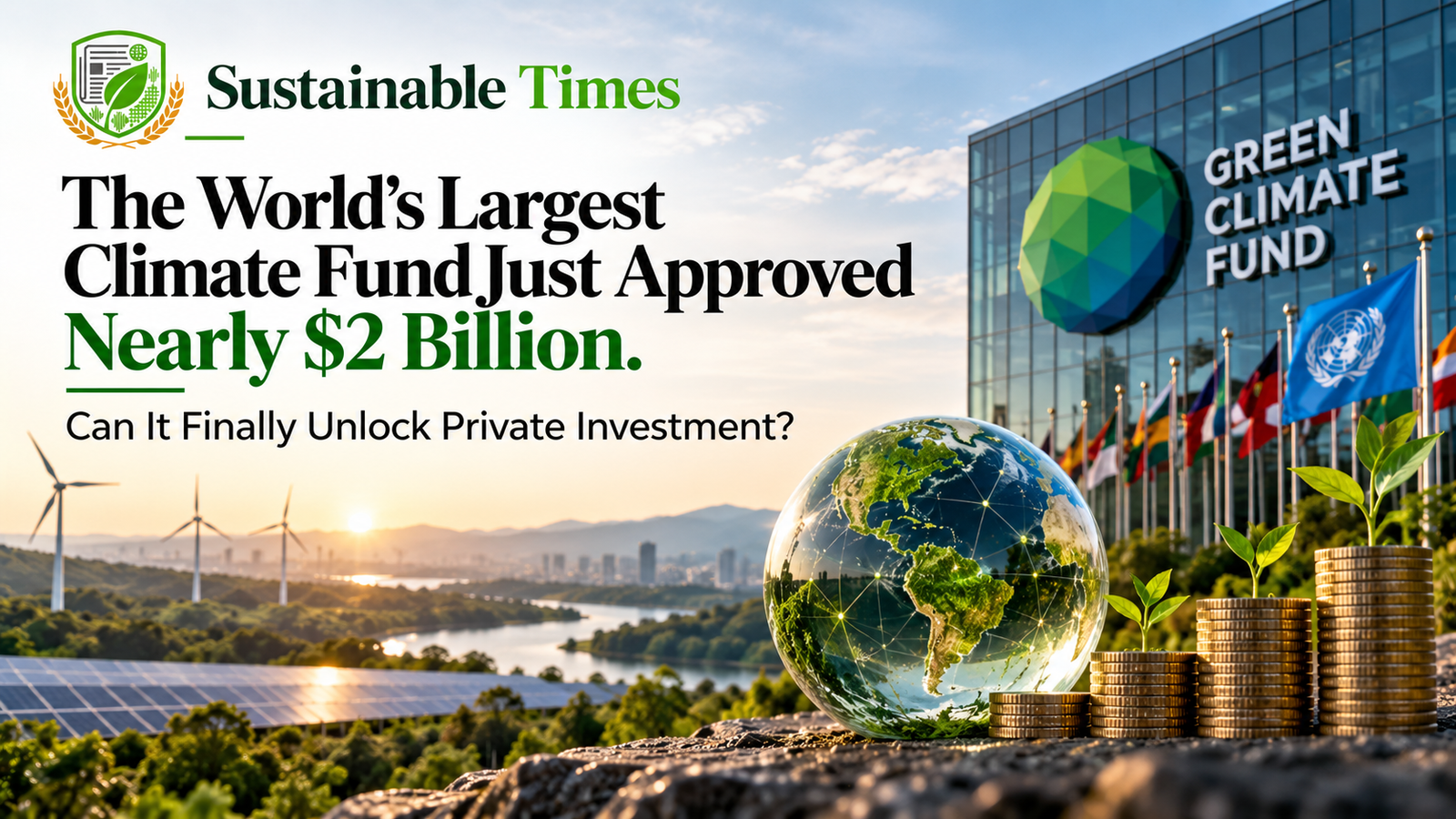
The Green Climate Fund (GCF) has approved a record $1.97 billion in climate financing for 21 projects and programmes, marking the largest funding package approved at a single meeting of its governing board.
The decision came during the fund’s 46th board meeting, held from 26 to 29 October in Songdo, South Korea.
The approvals bring the fund’s total financing decisions in 2026 to approximately $3.3 billion, setting a new annual record.
But the bigger development is not simply the amount approved.
The Green Climate Fund wants to use its resources to attract significantly more private investment into climate projects, particularly in developing economies where commercial financing often remains difficult to obtain.
That could become one of the most important changes in how global climate action receives funding.
Why Climate Finance Remains a Difficult Problem
Developing countries face a complicated financial challenge.
They need to expand clean energy, improve infrastructure, protect communities from extreme weather and develop more sustainable agricultural systems.
Many also need to strengthen water supplies, modernise electricity networks and prepare for climate impacts that are already affecting their economies.
These investments can require substantial upfront capital.
Yet financing often costs more in developing markets than in wealthier economies.
Commercial lenders may demand higher interest rates because of currency volatility, political uncertainty, limited infrastructure or concerns about project profitability.
That creates an uncomfortable situation.
A renewable-energy project may offer strong long-term environmental benefits but struggle to secure affordable financing.
A flood-protection programme may prevent enormous future losses without generating the direct revenue investors normally expect.
Climate finance institutions exist partly to address these gaps.
The Green Climate Fund uses public resources to support projects that might otherwise struggle to attract sufficient investment.
Its latest record approvals show that demand for this kind of financing remains substantial.
The Fund Is Moving Beyond Traditional Climate Grants
Climate finance has traditionally relied heavily on government contributions and development assistance.
Those resources remain essential, particularly for vulnerable countries that cannot afford to borrow heavily.
However, public finance alone cannot meet every climate investment requirement.
The Green Climate Fund is therefore expanding its efforts to attract private-sector capital.
Of the $1.97 billion approved at the latest board meeting, approximately $682 million will support six private-sector initiatives.
These initiatives are intended to mobilise additional investment in activities that can reduce emissions, improve resilience or support sustainable development.
The fund’s executive director, Mafalda Duarte, has emphasised that public climate finance must become more effective at bringing commercial investors into projects.
That changes the role of institutions such as the GCF.
Instead of acting only as providers of funding, they increasingly seek to become partners that help make climate projects financially viable.
One Public Dollar Could Attract Several More
The central idea is financial leverage.
When a climate fund provides money to a project, that contribution may reduce the risks faced by other investors.
For example, public capital can absorb part of the potential losses or support early project-development costs.
That can make a project more attractive to commercial banks, infrastructure funds and institutional investors.
According to the GCF, its investments have historically mobilised approximately three dollars of additional resources for every dollar it invests.
For private-sector initiatives, the historical average has been around $4.50.
The fund reports that its private-sector leverage ratio increased to approximately nine dollars last year.
Duarte now wants that figure to exceed ten dollars.
The ambition is significant.
If public climate finance consistently attracts larger amounts of private investment, limited government resources could support a much greater volume of climate-related infrastructure and development.
However, financial leverage does not automatically guarantee environmental impact.
Projects must still demonstrate that the additional investment delivers credible emissions reductions, adaptation benefits or other measurable outcomes.
New Climate Projects Will Reach Multiple Regions
The latest approvals support projects across several regions, including Africa, Asia-Pacific, Latin America and the Caribbean.
The fund also approved new partnerships with organisations that can help deliver financing closer to the communities and countries that need it.
Sixteen institutions received accreditation during the meeting, including nine organisations classified as Direct Access Entities.
These entities are particularly important because they allow national and regional institutions to work directly with the GCF.
Instead of relying exclusively on large international development organisations, eligible local institutions can manage climate funding and help shape projects around regional priorities.
That could improve the way climate investment reaches communities.
A country facing severe drought may have different needs from a coastal nation dealing with rising seas.
Local institutions often understand those differences more closely than organisations operating from outside the region.
Industrial Decarbonisation Is Becoming an Investment Opportunity
One notable area receiving support involves industries that are difficult to decarbonise.
Steel, chemicals, fertilisers and other industrial sectors can require substantial amounts of energy and generate significant emissions.
Reducing those emissions often demands new equipment, cleaner production processes and major capital investment.
At the latest meeting, the GCF approved $140 million in catalytic financing for a Southern African industrial decarbonisation initiative associated with Climate Fund Managers.
The programme aims to support projects involving clean industrial technologies, including green hydrogen and related applications.
Such financing could help countries develop new industries while reducing dependence on high-emission production methods.
But these technologies also face economic challenges.
Green hydrogen, for example, remains expensive in many markets, while potential customers may hesitate to commit to long-term purchases.
Public finance can help reduce some of those risks, but successful commercial deployment will depend on market demand, infrastructure and production costs.
Climate Adaptation Must Not Be Forgotten
Investment in clean energy receives considerable attention because many renewable projects can generate revenue through electricity sales.
Climate adaptation is often harder to finance.
Protecting a community from flooding can prevent future losses, but the resulting benefits may not translate into a predictable commercial income stream.
Improving drought resilience can protect food production without producing the financial returns investors usually expect.
That makes public finance particularly important.
The Green Climate Fund has a mandate to support both climate mitigation and adaptation.
Its financing portfolio includes investments intended to help countries manage climate risks while pursuing lower-emission development.
As the fund expands private-sector participation, maintaining support for projects with strong public benefits will remain essential.
Otherwise, investment could concentrate too heavily on commercially attractive technologies while leaving vulnerable communities with insufficient protection.
The challenge is finding a balance between financial returns and genuine climate needs.
The Fund Has Now Built a Much Larger Global Portfolio
With the latest decisions, the Green Climate Fund’s portfolio has reached 379 projects and programmes, supported by approximately $22.3 billion in GCF financing.
When co-financing from other participants is included, the wider portfolio represents approximately $87.3 billion in planned investment.
These figures demonstrate how international climate finance has expanded.
However, they also highlight the difference between approving funding and delivering completed projects.
Climate investments often require years of preparation, construction, implementation and monitoring.
The environmental results may take even longer to emerge.
Governments and financial institutions therefore need to track how quickly approved resources are deployed and whether projects achieve their intended objectives.
A record funding announcement creates momentum.
The real measure of success comes when that funding produces functioning infrastructure, stronger communities and measurable environmental improvements.
A New Funding Model Could Bring More Investors Into Climate Action
The GCF has also adopted a policy allowing contributions from non-government and alternative sources.
Historically, the fund has depended heavily on financial commitments from national governments.
Expanding the range of contributors could help diversify its funding base.
The fund is also developing co-investment platforms designed to bring together sovereign and non-sovereign investors around selected sectors and projects.
These structures could make it easier for investors to participate in climate projects without requiring every organisation to develop an entirely separate financing arrangement.
For emerging economies, the potential benefit is access to a larger pool of capital.
But the structures must remain transparent.
Investors, governments and communities need clear information about financial risks, environmental outcomes and the responsibilities of different participants.
Without that transparency, complex financing arrangements can become difficult to evaluate.
COP31 Will Put Climate Finance Back Under Pressure
The latest approvals arrive shortly before the next United Nations climate summit, COP31, in Türkiye.
Climate finance is expected to remain a major issue as governments debate how wealthy countries, development institutions and private investors should support climate action in developing economies.
The political environment remains difficult.
Governments face competing spending priorities, while international disagreements continue over the scale and distribution of financial commitments.
The Green Climate Fund is preparing for its third replenishment cycle, which will determine how much additional capital it can mobilise for future programmes.
Duarte has said the fund faces demand exceeding $11 billion, considerably more than the resources approved in 2026.
That gap illustrates the wider problem.
Climate financing is expanding, but demand continues to grow faster than the available funding.
The Next Test Is Whether the Money Reaches the Ground
The Green Climate Fund’s record approvals deserve attention.
They show that large-scale climate investment remains possible even during a difficult international political and economic period.
But the announcement also raises a more important question.
Can the fund translate public money into projects that attract additional investment while delivering measurable benefits for developing countries?
The answer will depend on several factors.
Climate projects must secure financing without creating unsustainable debt burdens.
Private investors need confidence in long-term economic performance.
Governments must establish reliable policies and effective oversight.
Local communities need meaningful participation in decisions that affect their livelihoods.
And the resulting investments must produce environmental outcomes that justify the resources committed.
None of these challenges disappears because a funding package reaches a record level.
Looking Ahead
The global climate transition needs investment on a scale that no single institution or government can provide.
The Green Climate Fund is attempting to respond by becoming more effective at mobilising capital rather than relying solely on traditional public funding.
Its latest $1.97 billion approval package marks an important step in that direction.
The next challenge will be demonstrating that the new financing model works consistently across regions, industries and different types of climate projects.
If the fund can attract more private money while maintaining support for vulnerable communities, it could help reshape international climate finance.
If investment concentrates only on commercially attractive projects, the gap between climate ambition and development needs may remain.
The distinction matters because climate finance is ultimately not about the size of a financial portfolio.
It is about what that portfolio makes possible.
The world’s largest climate fund has approved a record amount of money. Now it needs to prove that every public dollar can help deliver more than a financial return—it must create lasting climate progress.
About The Author