Seven months ago, Colombia stood at the centre of an ambitious international effort to move the world away from fossil fuels.
Government representatives from 57 countries gathered in the coastal city of Santa Marta in April to discuss one of the most difficult questions in climate policy: how nations could gradually reduce their dependence on coal, oil and gas without destabilising their economies.
The conference was an important attempt to move beyond promises and begin developing practical national plans.
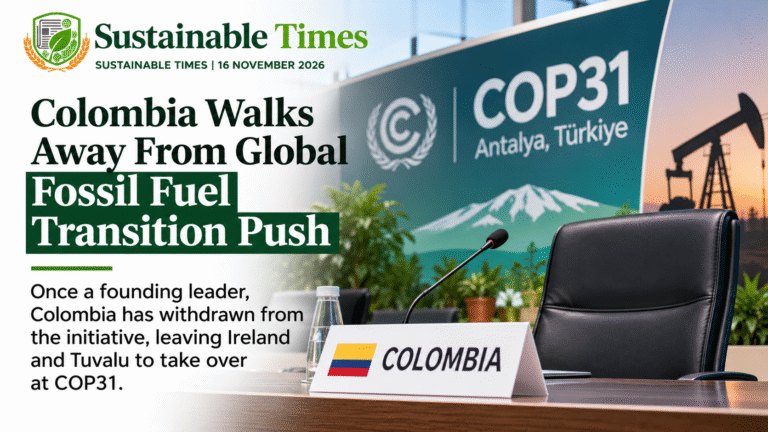
But the country that helped bring those governments together has now withdrawn from the initiative.
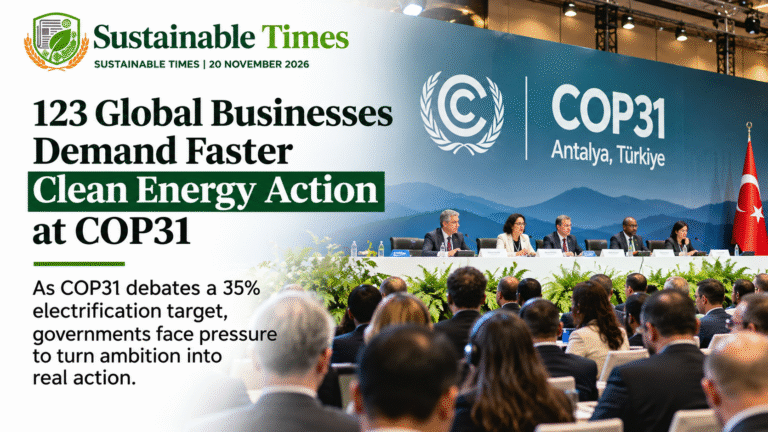
As world leaders enter the second week of the COP31 climate summit in Antalya, Türkiye, Colombia’s departure has exposed how quickly political changes can reshape international climate commitments.
The initiative is not ending. Ireland and the Pacific island nation of Tuvalu are preparing to assume leadership from Colombia and the Netherlands, while organisers plan another international conference for July 2027.
Yet the development raises a question that extends far beyond one country’s decision.
If governments can reverse their climate priorities after an election, how can the world build an energy transition that requires decades of consistent investment and cooperation?
A Climate Initiative That Began With Unusual Ambition
The story began in April 2026, when Colombia and the Netherlands co-hosted the first Conference on Transitioning Away from Fossil Fuels.
The meeting brought together representatives from 57 countries to discuss how governments could turn international climate commitments into national policies.
The timing mattered.
At COP28 in Dubai in 2023, countries had agreed for the first time to transition away from fossil fuels in energy systems in a just, orderly and equitable manner.
That agreement marked an important diplomatic milestone, but it did not establish a binding global timetable for ending fossil-fuel production or consumption.
Countries remained responsible for deciding how to implement the commitment.
The Santa Marta conference attempted to address that gap.
Instead of negotiating another broad declaration, participants explored the economic, financial and political measures needed to reduce dependence on fossil fuels.
They discussed how countries could develop transition plans, manage investment, protect workers and support economies that depend heavily on oil, gas or coal revenues.
The initiative was voluntary and did not impose legally binding phaseout deadlines.
Nevertheless, it created a platform for governments willing to discuss the practical challenges of moving beyond fossil fuels.
Colombia’s Political Direction Has Changed
Colombia’s withdrawal followed a significant change in national leadership.
Former President Gustavo Petro had made the transition away from fossil fuels a central part of his environmental agenda.
His administration stopped awarding new oil and gas exploration contracts and advocated stronger international cooperation to reduce fossil-fuel dependence.
That position helped establish Colombia as an influential voice in climate diplomacy.
But the country’s political direction changed after Abelardo de la Espriella became president in August 2026.
The new administration has placed greater emphasis on expanding domestic oil and gas development, strengthening energy security and encouraging investment in the country’s fossil-fuel sector.
Colombia’s Environment Minister, Fabio Arjona, has argued that restrictions on natural gas development contributed to domestic supply shortages.
The government maintains that increasing gas availability could help certain industries move away from more polluting fuels while supporting economic stability.
That argument reflects a wider debate about the role of natural gas in energy transitions.
Gas combustion generally produces less carbon dioxide than coal combustion for an equivalent amount of energy, but natural gas remains a fossil fuel. Methane leakage across its supply chain can also reduce its potential climate advantages.
The environmental consequences therefore depend on how gas is produced, transported and used.
For Colombia, the disagreement is also economic.
Oil and gas remain important to government revenues, exports and investment. Moving away from those industries requires credible alternatives that can support employment and public finances.
The new administration has chosen a different balance between those priorities.
Why Colombia’s Withdrawal Matters
A government changing its energy policy is not unusual.
Countries regularly revise their priorities after elections, particularly when energy prices, economic conditions or public expectations change.
But Colombia’s decision carries greater symbolic weight because it helped establish the very initiative it has now abandoned.
The Santa Marta conference was designed to demonstrate that countries could cooperate on the difficult task of reducing fossil-fuel dependence.
Colombia’s withdrawal now tests whether that cooperation can continue without one of its original political champions.
The challenge extends beyond international diplomacy.
Energy infrastructure requires long-term investment.
Electricity networks, industrial facilities, transport systems and fuel-production assets often operate for decades.
Investors make decisions based partly on expectations about future regulations, demand and government policy.
When political priorities change sharply, those expectations can become less reliable.
A company considering investment in renewable energy, for example, may need confidence that supporting infrastructure and market rules will remain in place.
Similarly, workers in fossil-fuel industries need credible information about how employment opportunities may change.
A successful transition therefore requires institutions and policies that can survive political disagreements rather than depending entirely on individual leaders.
A Small Island Nation Is Taking on a Major Role
One of the most striking parts of the story is the country preparing to help lead the initiative next.
Tuvalu.
The Pacific island nation contributes only a tiny fraction of global greenhouse-gas emissions, yet it faces serious risks from rising sea levels, coastal flooding and other climate impacts.
Its circumstances are very different from those of major oil, gas and coal producers.
For Tuvalu, reducing global emissions is closely connected to the long-term security of its communities and territory.
That gives the country’s participation particular significance.
Ireland and Tuvalu are preparing to co-host the second Conference on Transitioning Away from Fossil Fuels in 2027.
Ireland confirmed the partnership in April, and both countries are continuing preparations despite Colombia’s withdrawal.
Their leadership illustrates how smaller countries can influence international climate discussions even without the economic power of major fossil-fuel producers.
However, political influence does not automatically translate into implementation.
The next conference will need to demonstrate that participating governments are developing policies capable of producing measurable changes in energy systems.
The World Has Plenty of Climate Promises. It Needs More Detailed Plans.
One of the central weaknesses in international climate policy is the distance between commitments and implementation.
Governments may announce long-term emissions targets without establishing detailed policies for the industries responsible for those emissions.
Reducing dependence on fossil fuels requires more than building additional renewable-energy capacity.
Countries must also consider electricity grids, industrial production, transport infrastructure, public finance and the economic future of fossil-fuel-producing regions.
A credible transition plan should explain how these systems will change over time.
It should also identify the investment needed to support that transformation.
The Santa Marta initiative aims to help governments develop these practical pathways.
According to the International Institute for Sustainable Development, 23 countries have announced national or regional transition road maps or plans to develop them.
However, announcing an intention to prepare a road map is different from publishing and implementing one.
Some countries have made progress, while others remain at an early stage.
This distinction is becoming increasingly important as climate negotiations enter a period when governments face greater pressure to demonstrate results.
COP31 Is Bringing the Fossil-Fuel Debate Back Into Focus
Colombia’s withdrawal comes during a difficult moment for international climate negotiations.
At COP31, governments are debating how to accelerate the transition away from fossil fuels while addressing concerns about economic development, energy security and climate finance.
Brazil’s COP30 presidency published a voluntary fossil-fuel transition road map on 3 November 2026 and formally presented it during the first week of the Antalya summit.
The document outlines possible approaches for countries seeking to reduce dependence on coal, oil and gas according to their economic circumstances.
But the road map is not a binding international agreement.
Its effectiveness will depend on whether governments translate its recommendations into national policies.
Some countries want COP31 to recognise the road map and establish a process for advancing its recommendations.
Others remain cautious about language that could place additional pressure on fossil-fuel-producing economies.
The debate illustrates a familiar problem.
Countries broadly recognise the importance of addressing climate change, but they disagree about how quickly energy systems should change and who should finance that transformation.
Colombia’s withdrawal adds another complication by showing how national political developments can alter the positions countries bring to international negotiations.
The Financial Challenge Is Bigger Than the Political Debate
For many developing countries, the transition away from fossil fuels is not simply a question of choosing cleaner technology.
It is a question of financing an entirely different economic system.
Countries that depend on oil, gas or coal exports may need to develop new industries and sources of government revenue.
Workers may require training, income protection and access to alternative employment.
Electricity systems need investment in generation, transmission, storage and reliable distribution.
Some countries also face high borrowing costs that make clean-energy projects more expensive to finance.
Without affordable capital, governments may struggle to replace fossil-fuel infrastructure even when cleaner alternatives are technically available.
The United Nations has repeatedly emphasised that developing economies need better access to climate finance and investment.
This is particularly important for countries attempting to balance emissions reductions with poverty reduction, industrial development and energy access.
The challenge is not to ignore those economic concerns.
It is to create transition plans that address them directly.
A policy that overlooks employment and energy affordability may face strong political opposition.
A policy that protects existing fossil-fuel industries indefinitely may create long-term climate and economic risks.
Finding a credible pathway between those outcomes is one of the most difficult tasks facing governments.
What This Means for India
India has an important interest in how international fossil-fuel transition policies develop.
The country is expanding renewable-energy capacity while continuing to rely on coal for a substantial share of electricity generation.
Its growing economy also requires reliable energy for manufacturing, transport, households and infrastructure.
That creates a complex transition challenge.
India must strengthen energy security, maintain affordable electricity and support industrial growth while reducing the carbon intensity of its economy.
International transition road maps could provide useful lessons, particularly around financing, industrial planning and worker protection.
However, India’s pathway will differ from those of countries such as Colombia or Tuvalu.
Colombia faces questions about fossil-fuel exports and government revenues.
Tuvalu faces immediate threats from climate change despite contributing very little to global emissions.
India must manage the energy needs of a much larger population and industrial economy.
These differences explain why a single global timetable may not address every country’s circumstances equally.
The value of international cooperation lies partly in helping governments develop realistic national strategies while maintaining shared climate objectives.
Can the Initiative Survive Without Its Founder?
The next few months will test whether the Santa Marta process has developed enough institutional momentum to continue independently of Colombia.
Ireland and Tuvalu have already committed to carrying the initiative forward.
Organisers are preparing additional discussions and a second conference in 2027.
Participating governments are also expected to present progress on national transition planning during COP31.
But several challenges remain.
The initiative must attract sustained political support, encourage countries to publish credible plans and demonstrate that those plans influence real investment decisions.
It also needs broader participation from countries responsible for substantial fossil-fuel production and consumption.
Without engagement from major energy economies, voluntary initiatives may struggle to influence the global pace of change.
At the same time, smaller coalitions can sometimes make progress where universal negotiations move slowly.
Countries willing to experiment with new policies can share lessons, develop financial partnerships and demonstrate approaches that others may eventually adopt.
The important question is whether those activities lead to measurable changes rather than additional declarations.
Climate Policy Needs to Outlast Election Cycles
The larger lesson from Colombia’s withdrawal concerns the relationship between democratic politics and long-term environmental planning.
Governments change.
Economic conditions shift.
Voters reconsider priorities.
Those developments are normal parts of political life.
But climate change operates on a much longer timescale.
The infrastructure countries build today can influence emissions, employment and energy costs for decades.
That means successful climate policy requires more than international agreements signed by current leaders.
It needs credible institutions, stable investment frameworks and public support that can withstand political change.
Governments also need to explain how climate policies will affect ordinary people.
Workers want to know whether their jobs will remain secure.
Households want affordable energy.
Businesses need predictable rules.
Communities dependent on fossil-fuel industries need realistic economic alternatives.
If policymakers fail to address those concerns, ambitious climate commitments may become vulnerable when political leadership changes.
Colombia’s reversal illustrates that risk.
But the continued participation of Ireland, Tuvalu and other countries also suggests that international cooperation does not necessarily collapse when one government withdraws.
The Next Climate Breakthrough May Be Political, Not Technological
The world already possesses many of the technologies needed to reduce fossil-fuel dependence.
Renewable electricity, energy storage, efficient buildings and electrified transport are expanding across global markets.
Technical challenges remain, particularly in energy-intensive industries and sectors that are difficult to electrify.
But political and financial barriers are becoming equally important.
Countries need to agree on credible transition pathways.
Investors need confidence in long-term policies.
Communities need protection from economic disruption.
And governments must find ways to maintain progress even when leadership changes.
The Santa Marta initiative is now confronting those challenges directly.
Its founding country has withdrawn, but its remaining supporters are preparing to continue.
Whether the initiative succeeds will depend less on the number of countries attending its next conference and more on the policies they implement afterward.
For now, Colombia’s departure offers a warning about the fragility of climate commitments.
Ireland and Tuvalu’s decision to continue offers a different possibility: international cooperation can become stronger when it grows beyond the governments that originally created it.
The real test of global climate leadership is not whether a country can make an ambitious promise. It is whether the institutions, investments and partnerships behind that promise can survive when politics changes.
And as COP31 enters its final week, that may be one of the most important questions facing the global energy transition.
About The Author