When people imagine the world’s transition to clean energy, they usually picture solar panels, wind turbines and electric vehicles.
But behind those technologies lies an enormous network of electrical equipment that rarely receives public attention.
And some of that equipment contains one of the most powerful greenhouse gases ever assessed by climate scientists.
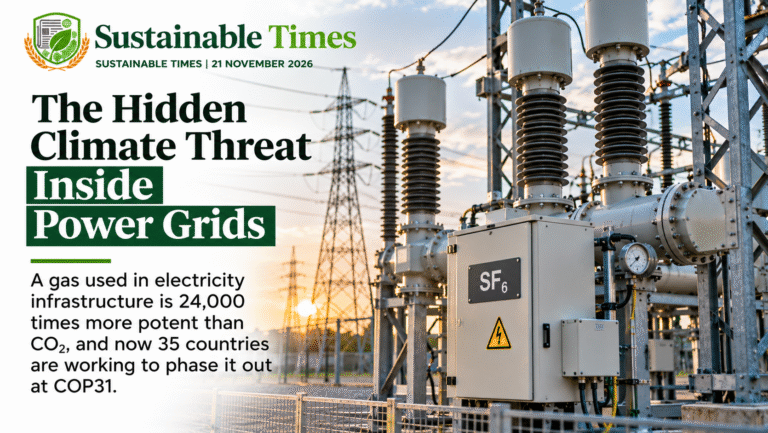
The gas is called sulphur hexafluoride, or SF₆. It has been used for decades in electrical infrastructure because of its remarkable ability to prevent electrical discharges and insulate high-voltage equipment.
Unfortunately, those useful properties come with an extraordinary environmental cost.
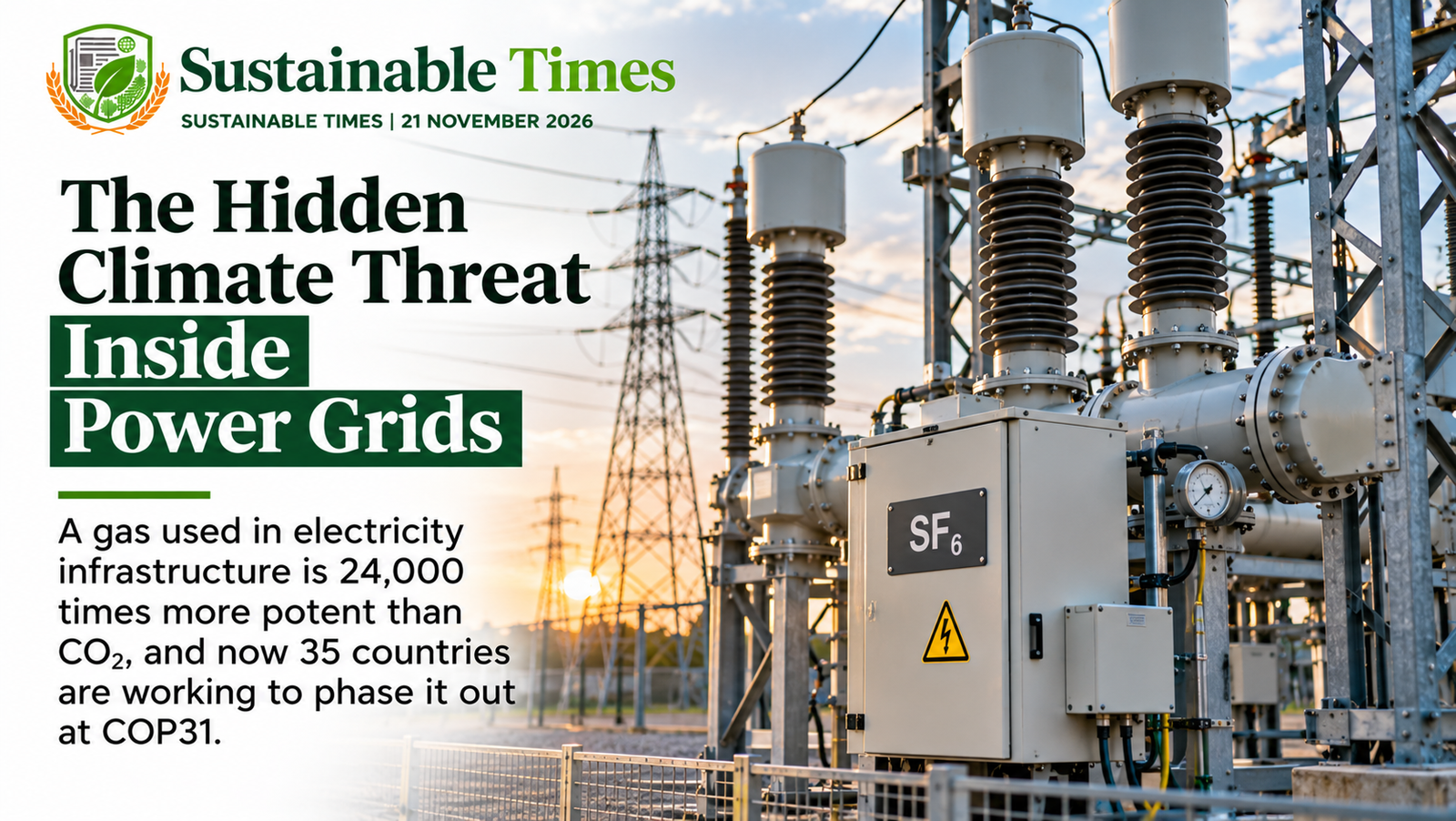
According to the Intergovernmental Panel on Climate Change, SF₆ has a global warming potential approximately 24,000 times greater than carbon dioxide over a 100-year period.
Unlike carbon dioxide, which participates in natural biological and chemical cycles, SF₆ is extremely persistent and can remain in the atmosphere for more than a thousand years.
Now, governments are taking action.
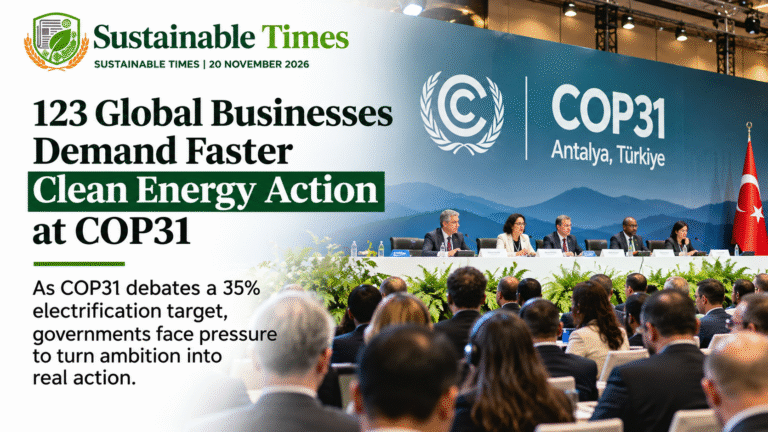
At the COP31 climate summit in Antalya, Türkiye, Germany launched the Global SF₆ Pledge on 19 November 2026, bringing together countries and international organisations to reduce emissions from electricity networks and accelerate the adoption of cleaner technologies.
The European Commission reports that 35 countries, representing approximately one-third of the global economy, have joined the initiative.
The announcement exposes a contradiction at the heart of the energy transition.
The world is building cleaner electricity systems, but some of the equipment used to deliver that electricity still depends on an exceptionally powerful greenhouse gas.
The Invisible Gas Inside Electricity Networks
Electricity does not travel directly from a power station to a household without passing through complex infrastructure.
It moves through transmission lines, substations, transformers and specialised electrical equipment that controls how power flows through the network.
One essential component is switchgear.
Switchgear allows operators to isolate electrical equipment, interrupt faults and manage electricity safely.
In high-voltage systems, these operations can create dangerous electrical arcs.
SF₆ became popular because it provides excellent electrical insulation and helps extinguish those arcs.
Its properties allow engineers to design compact, reliable equipment capable of handling demanding electrical conditions.
That makes it particularly valuable in substations and other parts of the electricity network where space, safety and reliability matter.
For decades, the gas helped utilities build increasingly sophisticated power systems.
However, the environmental consequences became clearer as scientists improved their understanding of fluorinated greenhouse gases.
SF₆ does not need to be released in large quantities to create a substantial climate impact.
Even relatively small emissions can have significant warming effects because each kilogram has an exceptionally high global warming potential.
Why SF₆ Is Such a Serious Climate Problem
Most climate discussions focus on carbon dioxide and methane.
That attention is justified because those gases account for a large share of human-caused warming.
But climate impact depends on more than the quantity of a gas released.
It also depends on how effectively that gas traps heat and how long it remains in the atmosphere.
SF₆ performs unusually strongly on both measures.
Its molecular structure makes it highly effective at absorbing infrared radiation, while its chemical stability allows it to persist for extremely long periods.
To understand the scale, consider a simple comparison.
Releasing one kilogram of SF₆ can have approximately the same 100-year warming impact as releasing 24 tonnes of carbon dioxide.
That does not mean SF₆ contributes more to global warming overall than CO₂. Its emissions are much smaller.
But it does mean that preventing relatively small leaks can deliver meaningful climate benefits.
The challenge becomes particularly important as countries expand electricity networks.
More electrical infrastructure can mean more equipment containing SF₆ unless utilities adopt alternatives.
And equipment installed today may remain operational for decades.
That creates the risk of locking a powerful greenhouse gas into infrastructure intended to support a cleaner energy future.
The Problem Begins With Small Leaks
SF₆ is normally contained inside sealed electrical equipment.
Under proper operating conditions, it is not supposed to escape into the atmosphere.
However, emissions can occur through damaged seals, equipment faults, maintenance activities and improper handling.
Additional losses can happen when equipment is dismantled or reaches the end of its useful life.
These releases may be difficult to detect without appropriate monitoring.
Utilities therefore need reliable information about how much SF₆ their equipment contains and whether losses are occurring.
The new international pledge places considerable emphasis on improving those records.
Participating governments have committed to strengthening monitoring, reporting and verification of SF₆ stocks and emissions.
This is important because some countries do not yet have complete information about the amount of gas contained within their electricity networks.
Without accurate data, policymakers cannot reliably determine where emissions occur or which interventions will deliver the greatest benefits.
Germany Is Leading a New International Effort
The Global SF₆ Pledge was formally launched at COP31 on 19 November.
Germany’s Federal Environment Minister, Carsten Schneider, presented the initiative alongside representatives from supporting countries.
Early supporters included Canada, Cambodia, France, Kenya, Nigeria, Senegal, Spain, Uganda and the United Kingdom, along with the European Union.
The initiative has also received support from organisations including the World Bank and the Climate and Clean Air Coalition.
Its objective is to help countries reduce SF₆ emissions while making cleaner electrical technologies more widely available.
The programme does not require governments to immediately dismantle every existing piece of SF₆-containing equipment.
Instead, it focuses on improving management of existing systems and encouraging SF₆-free alternatives when new infrastructure is installed.
That distinction is important.
Replacing functioning electrical equipment prematurely can create substantial costs and additional material demand.
In many cases, preventing leaks and recovering gas during maintenance may provide a more practical near-term solution.
For new installations, however, the opportunity is different.
Countries can avoid introducing additional SF₆ into their networks by selecting suitable alternative technologies from the beginning.
The Technology to Replace SF₆ Already Exists
One of the most interesting aspects of this development is that engineers do not need to invent an entirely new electricity system.
Alternatives to SF₆ are already available for numerous electrical applications.
Some modern switchgear uses clean air or dry air for insulation.
Other designs combine vacuum circuit breakers with alternative insulating materials.
Vacuum interruption technology can extinguish electrical arcs without relying on SF₆.
These approaches have already reached commercial use in various medium-voltage applications.
Higher-voltage systems can present additional engineering challenges, particularly where equipment must meet demanding performance and space requirements.
Nevertheless, manufacturers have developed SF₆-free solutions for a growing range of high-voltage applications.
The challenge now is accelerating adoption while ensuring reliability, affordability and compatibility with existing networks.
Utilities must consider equipment performance, installation costs, maintenance requirements and the availability of technical expertise.
The environmental advantages are promising, but each alternative still requires appropriate safety and lifecycle assessment.
Europe Has Already Started Restricting the Gas
The European Union has moved beyond voluntary commitments.
Its updated fluorinated greenhouse gas regulation introduces phased restrictions on the use of certain gases in new electrical switchgear.
Restrictions began applying to specified medium-voltage equipment in January 2026.
Additional requirements will take effect in 2028, 2030 and 2032, depending on equipment voltage and technical characteristics.
The regulation also introduces tighter requirements for managing existing SF₆ equipment.
From 2035, servicing electrical switchgear will generally require reclaimed or recycled SF₆, subject to specified exceptions.
The approach is designed to reduce future demand while preventing unnecessary releases from equipment already installed.
It also creates an incentive for manufacturers to develop alternatives.
When governments establish clear regulatory timelines, companies gain greater certainty about which technologies will be required in future markets.
That can encourage investment in research, manufacturing and commercial deployment.
A €15 Million Programme Will Help Countries Make the Transition
Germany is backing the international initiative with €15 million in funding over several years.
The programme will involve Germany’s international development agency GIZ, the World Bank and the UN Climate Technology Centre and Network.
The objective is to help countries improve SF₆ management and adopt alternative electrical technologies.
Support may include technical cooperation, project preparation, knowledge-sharing and assistance with financing.
This matters particularly for developing economies.
Countries expanding electricity access and renewable-energy capacity often face significant infrastructure costs.
Utilities may struggle to justify newer equipment if conventional alternatives appear cheaper upfront.
Technical assistance and suitable financing could help overcome those barriers.
The initiative aims to ensure that countries building new power networks do not automatically repeat the technology choices made by earlier generations of electricity infrastructure.
Kenya Is Already Exploring SF₆-Free Infrastructure
One practical example comes from Kenya.
At COP31, the European Union announced additional support through the UN Climate Technology Centre and Network for climate-technology projects in Kenya, Senegal and the Maldives.
Kenya’s component focuses on developing a national pathway for reducing SF₆ use in electrical infrastructure.
The work includes planning and pilot projects intended to demonstrate cleaner alternatives.
This is relevant because many African countries are expanding electricity networks to improve energy access and support economic development.
Those investments will influence the environmental footprint of their power systems for decades.
Introducing SF₆-free equipment during network expansion could help avoid future emissions while supporting reliable electricity distribution.
However, the technology must remain affordable and suitable for local operating conditions.
The success of pilot projects will depend on whether utilities can maintain and scale the equipment effectively.
Why India Should Pay Attention
India is undertaking one of the world’s largest electricity infrastructure expansions.
Growing industrial demand, urban development, renewable-energy projects and electric mobility are increasing the need for modern transmission and distribution networks.
As more renewable electricity enters the system, utilities must strengthen grid infrastructure and improve reliability.
That creates a significant opportunity to consider the environmental performance of electrical equipment.
SF₆-free switchgear could become increasingly relevant for new installations where suitable technologies are commercially available.
The opportunity is not limited to reducing emissions.
Indian electrical-equipment manufacturers may also find new markets as international regulations encourage utilities to adopt alternative technologies.
However, the transition requires careful planning.
Equipment must meet national safety standards, perform reliably under local conditions and remain economically viable.
India would also need reliable information about existing SF₆ stocks and the emissions associated with maintenance and equipment retirement.
The new global initiative does not establish that India has joined the pledge.
Nevertheless, its objectives are relevant to the country’s expanding electricity sector.
The Real Challenge Is Preventing Tomorrow’s Emissions Today
The SF₆ problem illustrates an important weakness in how sustainability is sometimes measured.
A project may be described as environmentally beneficial because it generates renewable electricity.
But the full environmental impact also depends on the materials and infrastructure supporting that project.
Wind turbines require electrical equipment.
Solar farms connect to substations.
Electric vehicles depend on charging networks and reliable electricity distribution.
All of these systems require engineering decisions that influence their environmental footprint.
SF₆-free switchgear is therefore part of a broader movement toward cleaner infrastructure.
The objective is not only to reduce emissions from electricity generation.
It is to reduce emissions throughout the systems that generate, transmit and distribute power.
That includes improving equipment design, preventing leaks, recovering materials and planning for responsible end-of-life management.
Can a Voluntary Pledge Deliver Real Results?
The Global SF₆ Pledge is an important announcement, but it is not a binding global treaty.
Participating countries have committed to improving information, reducing emissions and promoting cleaner alternatives.
The agreement does not impose a single mandatory phaseout deadline on every signatory.
That flexibility may encourage more countries to participate, particularly those with different infrastructure needs and financial capabilities.
However, it also makes progress harder to measure.
The initiative will need credible reporting and clear indicators to demonstrate whether SF₆ emissions are actually declining.
Governments should track the amount of gas contained in existing equipment, the quantity recovered during maintenance and the adoption of SF₆-free technologies.
Manufacturers and utilities will also need to provide reliable performance and environmental data.
Without those measurements, the pledge could remain another well-intentioned climate announcement.
With effective implementation, it could help prevent a long-term source of emissions before electricity networks expand further.
Looking Ahead
The Global SF₆ Pledge arrives at a critical moment for the electricity industry.
Countries are investing heavily in renewable energy, electrified transport and modern power infrastructure.
Those developments are essential to reducing dependence on fossil fuels.
But they also create an opportunity to reconsider technologies that have remained largely unchanged for decades.
SF₆ became widely used because it solved important electrical engineering problems.
Now, manufacturers have developed alternatives that could reduce the environmental cost of those solutions.
The challenge is moving those technologies into mainstream infrastructure while managing existing equipment responsibly.
Germany’s new initiative provides a platform for international cooperation, technical support and financing.
Its success will depend on whether governments and utilities translate the announcement into measurable changes.
For the public, the story reveals a less visible side of the energy transition.
Clean electricity is not only about what generates power.
It is also about the equipment that carries that power into homes, factories and cities.
The next breakthrough in clean energy may not be another solar panel or wind turbine. It could be replacing an invisible gas inside the electrical grid—before it has a chance to remain in the atmosphere for the next thousand years.
About The Author