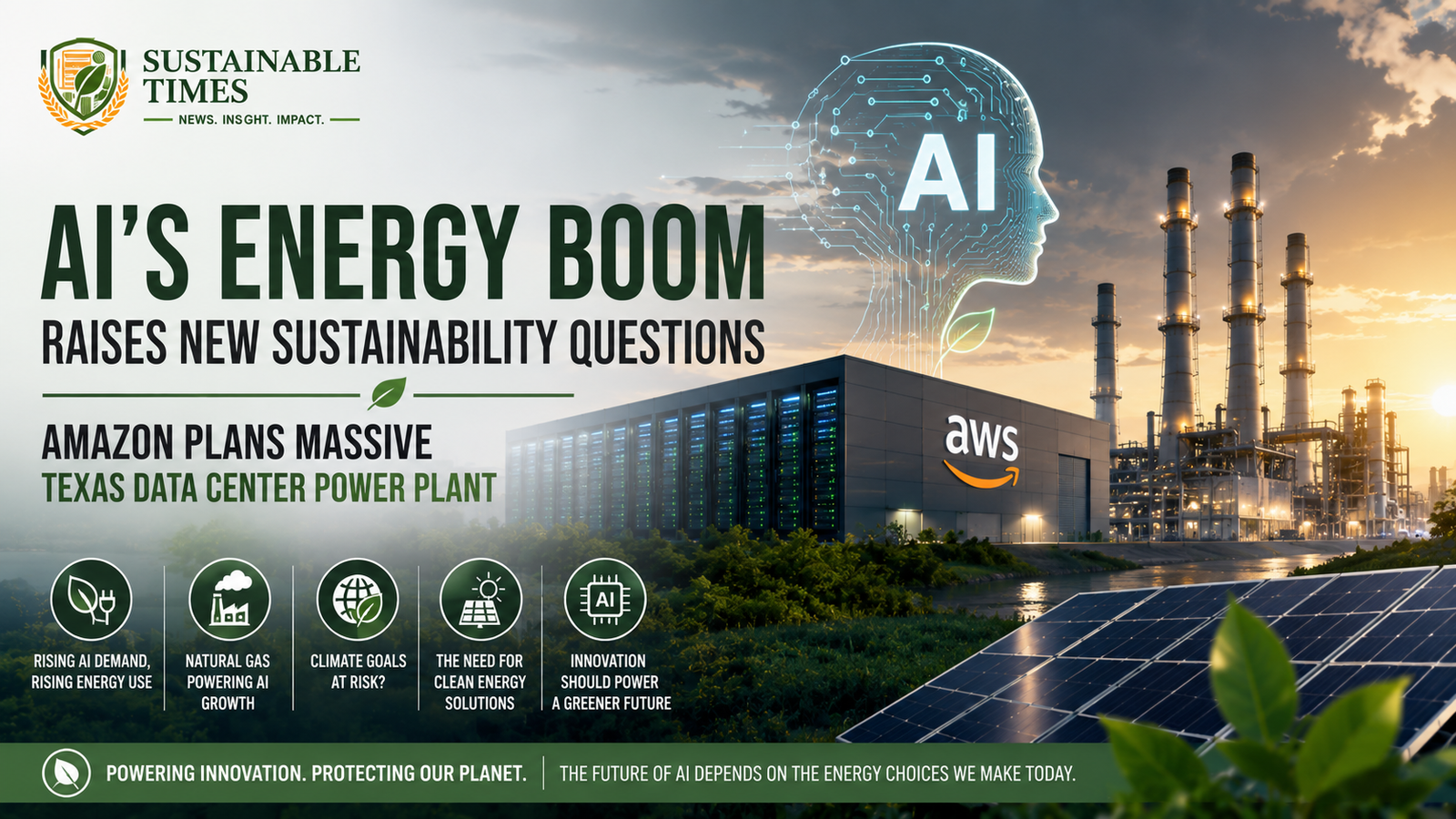
The rapid expansion of artificial intelligence is creating a new challenge for the global sustainability transition: how to power increasingly energy-intensive AI infrastructure without locking in decades of additional fossil-fuel emissions.
Amazon is now facing scrutiny over a planned data center campus in Pecos County, Texas, that will initially receive electricity from a dedicated natural-gas power plant. The facility, known as GW Ranch, could generate up to 7.65 gigawatts of electricity using 35 natural-gas turbines and has received an emissions permit allowing up to 33 million tons of greenhouse-gas emissions annually.
AI Is Changing the Energy Equation
AI data centers require enormous amounts of electricity to operate high-performance computing systems and cooling infrastructure.
As technology companies rapidly expand their AI capacity, traditional electricity grids in several regions are struggling to accommodate new demand quickly enough. This has encouraged companies to consider dedicated, or behind-the-meter, power plants that can provide electricity directly to data centers.
Texas has become a major center for this trend. A recent analysis found that dozens of natural-gas power projects are being developed specifically to serve data centers, with Texas accounting for a significant share of planned capacity.
The Sustainability Challenge
The development highlights a growing contradiction in the technology sector.
AI can support climate action by improving weather forecasting, optimizing energy systems, monitoring ecosystems, and increasing the efficiency of industrial operations. At the same time, the infrastructure required to run increasingly powerful AI systems can increase electricity demand and associated emissions.
Amazon has committed to achieving net-zero carbon emissions across its business by 2040. The company says the Texas project will eventually connect to the grid and that it is exploring options including solar power and battery storage.
The question is whether clean-energy additions can grow quickly enough to offset the emissions created by rapidly expanding AI infrastructure.
A Broader Industry Trend
Amazon’s project is not an isolated development.
Technology companies are increasingly turning to natural gas to overcome grid constraints and secure reliable electricity for new AI facilities. Similar projects involving major technology and energy companies are emerging across Texas and other parts of the United States.
This trend could create a difficult trade-off: AI infrastructure can support technological and economic development, but relying heavily on fossil fuels to power that growth could undermine corporate climate commitments.
Can AI Growth Become Cleaner?
The industry has several potential pathways to reduce the environmental impact of AI infrastructure.
Companies can combine:
- Solar and wind power
- Battery energy storage
- More efficient AI hardware
- Advanced data-center cooling
- Grid-connected clean electricity
- Demand-response technologies
- Improved energy-efficiency standards
Researchers have also highlighted the importance of integrating data centers with cleaner electricity systems rather than allowing rapid AI demand growth to automatically translate into additional fossil-fuel generation.
Why This Matters for the Energy Transition
The AI boom is changing the way policymakers and businesses think about electricity demand.
For years, the sustainability conversation focused heavily on replacing fossil-fuel generation with renewable energy. The rapid expansion of AI adds another dimension: new electricity demand itself must grow sustainably.
If companies build clean power, storage, efficient computing, and grid infrastructure alongside AI capacity, data centers could become an important market for the clean-energy industry.
If fossil-fuel generation becomes the fastest way to meet that demand, however, AI growth could make decarbonization more difficult.
Looking Ahead
The debate surrounding Amazon’s Texas project reflects a much larger question facing the technology industry: Can the AI revolution scale without creating a new fossil-fuel dependency?
The answer will depend on how quickly renewable energy, storage, grid infrastructure, and efficiency technologies can expand alongside computing capacity.
As AI becomes increasingly embedded in the global economy, the sustainability of its physical infrastructure will become just as important as the applications it enables.
Key Takeaway
AI is becoming an important driver of global electricity demand. The challenge now is to ensure that the infrastructure powering this technological transformation develops alongside the clean-energy transition—not against it.
About The Author