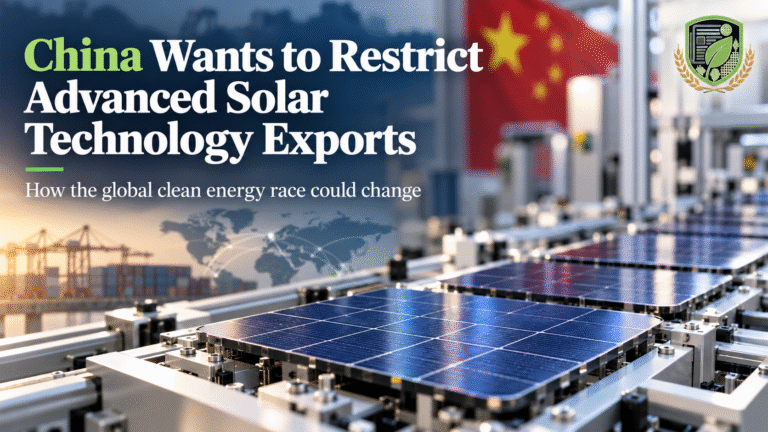
Global Uncertainty Pushes Renewable Energy Investment Toward China
Rising geopolitical tensions are reshaping global renewable energy investment patterns. Investors are now turning to China as a stable and reliable hub for green projects. Growing trade barriers in other regions are also pushing capital toward more predictable markets.
China Sees Strong Growth in Clean Energy Investment
China has rapidly increased its focus on renewable energy through its Belt and Road Initiative. Between 2022 and 2023, around 68 percent of its overseas energy investments went into wind and solar projects. This marks a sharp rise compared to earlier decades, when renewables received a much smaller share.
Older coal projects are still moving forward due to past commitments. However, new funding decisions now favor clean energy. This shift reflects rising global demand for renewable technologies and sustainable solutions.
What Is Driving This Shift
China’s domestic market plays a key role in this transition. The country has built large scale capacity in solar and wind manufacturing. As a result, companies are expanding exports to regions like Africa. These efforts are supported by major financial commitments, including a 51 billion dollar push for low carbon projects.
Government policies are also evolving. Authorities are focusing more on quality growth instead of rapid expansion. China aims to reach about 3,600 gigawatts of wind and solar capacity by 2035. At the same time, it is improving energy storage systems to reduce pressure on power grids.
Impact on Global Energy Markets
China’s growing influence is changing the global renewable energy landscape. While the country continues to expand, global solar growth may slow slightly. Projections suggest installations could reach 649 gigawatts in 2026, which is slightly lower than 2025 levels. Policy changes in China and the United States are contributing to this trend.
Investors now face both risks and opportunities. China’s strong position in supply chains and clean technology exports will shape energy markets in emerging economies. At the same time, changing policies and global tensions may create uncertainty for future investments.
About The Author