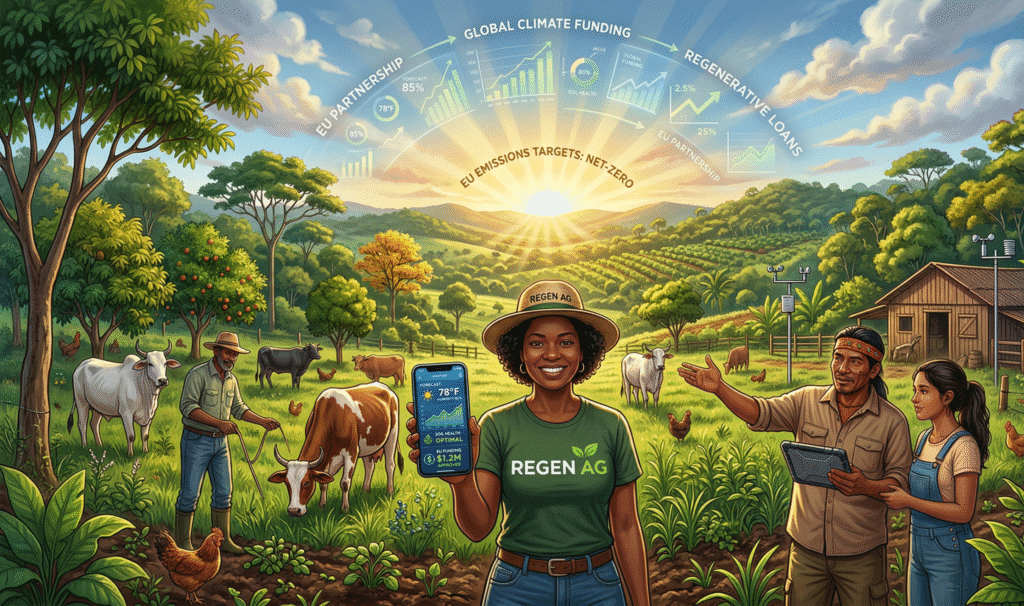
Sustainable agriculture is quickly becoming a central focus in global climate action, as governments and institutions look to reduce emissions from food systems while strengthening farmer resilience. Experts say transforming agriculture is essential to meeting long-term climate goals without increasing deforestation.
Major Funding Gap Slows Progress
Agriculture remains one of the largest contributors to greenhouse gas emissions, mainly due to deforestation and land use changes. Despite this, the sector currently receives less than five percent of total climate finance.
According to recent estimates, around $1.1 trillion in annual investment will be required over the next five years to build resilient and sustainable food systems. This funding could help restore degraded land, improve crop productivity, and support rural employment.
For example, Brazil has nearly 100 million hectares of underused pastureland that could be restored for productive use. This approach would increase agricultural output without expanding into forested areas, helping to balance economic growth with environmental protection.
European Union Pushes Ahead with Climate Targets
In a significant policy development, European Union countries have agreed to cut greenhouse gas emissions by 90 percent by 2040. This move reflects a strong commitment to climate action despite resistance from some member states.
However, the bloc has also eased certain corporate sustainability regulations, particularly those related to supply chain risks. This adjustment comes in response to growing pressure from businesses and international competitors, highlighting the challenge of balancing ambitious climate goals with economic realities.
Innovations Driving Change on the Ground
Across the globe, practical innovations are helping farmers transition to more sustainable practices.
In Brazil, farmers are adopting pasture restoration techniques, sustainable cattle intensification, and agroforestry systems. These methods not only improve productivity but also reduce pressure on natural ecosystems.
Meanwhile, in India, smallholder farmers are using AI-based weather tools to make better decisions. These technologies have helped reduce debt levels by up to 50 percent while increasing savings, offering a scalable model for climate-vulnerable regions.
A Critical Moment for Climate and Food Systems
The growing focus on sustainable agriculture reflects a broader shift in global climate strategy. With the right level of investment and policy support, the sector has the potential to deliver both environmental benefits and economic growth.
Experts emphasize that closing the funding gap and scaling proven solutions will be crucial in the coming years to ensure food security while meeting international climate commitments.
About The Author