Stand beside the ocean, and the first things you notice are usually the waves, the wind and the distinctive smell of seawater.
But something far more complicated is happening in the air above the surface.
The ocean is constantly exchanging gases with the atmosphere. Some of these compounds influence air chemistry, while others help form the tiny particles involved in cloud development.
For decades, scientists have studied these interactions to understand how marine ecosystems influence the Earth’s climate.
Now, researchers have discovered that the process is much more complex than many previous measurements suggested.
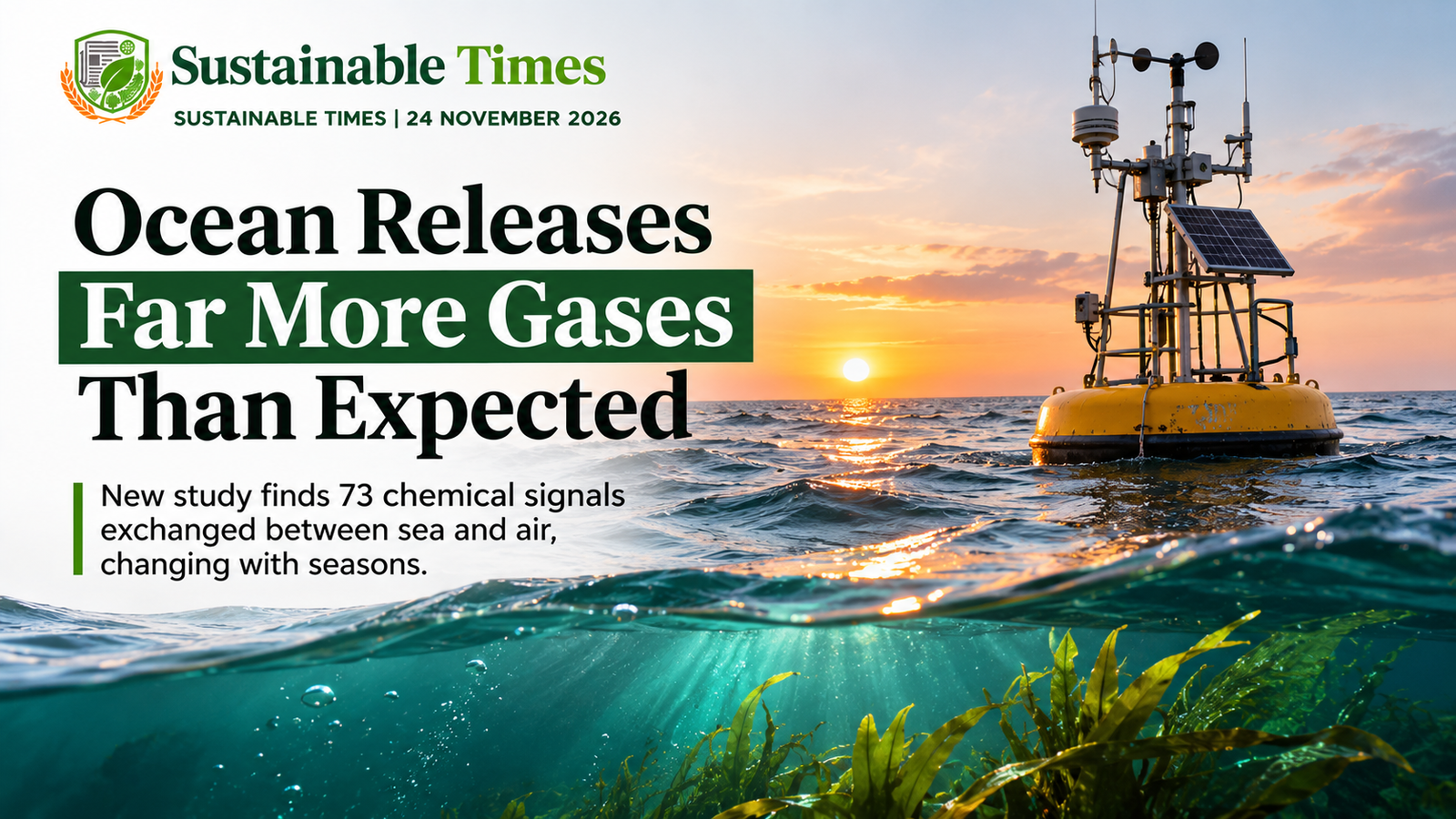
A new study published on 23 November 2026 in Nature Communications reveals that researchers detected the exchange of 73 different chemical signals between the Baltic Sea and the atmosphere, successfully identifying 48 compounds.
The international research team, led by scientists at the University of Copenhagen, found that these exchanges changed significantly as summer gave way to autumn.
Some gases became less abundant, while others appeared more prominently as marine conditions changed.
The findings reveal a potential blind spot in climate research.
If scientists do not fully understand the gases moving between the ocean and the atmosphere, how accurately can they predict the ways marine ecosystems will influence future climate conditions?
The Ocean Has a Chemical Life We Rarely See
The ocean covers approximately 70% of the Earth’s surface and plays an essential role in regulating the global climate.
It absorbs heat, exchanges carbon dioxide with the atmosphere and supports biological processes that influence the movement of carbon and nutrients.
However, its influence extends beyond the gases most commonly associated with climate change.
Marine organisms also produce and transform numerous volatile organic compounds.
These compounds can move between seawater and the air above it, participating in chemical reactions that influence atmospheric conditions.
Some are involved in the formation of atmospheric particles, while others contribute to chemical processes affecting air composition.
Scientists have known about these exchanges for years.
The challenge has been measuring enough compounds continuously to understand how the entire system changes.
Many earlier studies focused on a small selection of substances or collected measurements over relatively short periods.
That left researchers with an incomplete picture of the chemical activity occurring above the sea.
The new study significantly expands that picture.
Researchers Monitored the Baltic Sea for 51 Days
The research team established its measurements on Utö, an island in the Baltic Sea.
There, scientists used specialised instruments to continuously analyse gases moving between the water and the atmosphere.
The monitoring period lasted 51 days, covering the transition from late summer into autumn.
A sophisticated mass spectrometer analysed incoming air ten times every second, while wind measurements helped researchers determine how chemical compounds moved across the sea–air boundary.
The team detected 73 distinct mass-spectrometry signals associated with volatile compounds, identifying 48 of them chemically.
That represents a much broader range of substances than most earlier studies examined simultaneously.
Researchers from the University of Copenhagen collaborated with scientists from Lund University, the Finnish Meteorological Institute, the Finnish Environment Institute and Germany’s GEOMAR Helmholtz Centre for Ocean Research Kiel.
Their findings showed that chemical exchanges were not constant.
Instead, they changed with biological activity, wind conditions and the structure of the water column.
This matters because climate models need to represent how the atmosphere responds to changing environmental conditions.
If those exchanges are more variable than previously assumed, simplified estimates could overlook important processes.
A Familiar Ocean Smell Revealed Something Unexpected
One of the most interesting findings involved a compound called dimethyl sulphide, or DMS.
DMS contributes to the familiar smell associated with the sea.
It also plays an important role in atmospheric chemistry.
Once released into the air, DMS can undergo reactions that produce sulphur-containing particles.
Under suitable conditions, these particles can contribute to cloud formation.
Clouds influence the Earth’s energy balance because they can reflect incoming sunlight and affect how heat moves through the atmosphere.
That makes DMS relevant to climate research.
However, the new measurements revealed something researchers did not fully anticipate.
During the late-summer observation period, DMS emissions were associated with the presence of cyanobacterial blooms in the Baltic Sea.
As the season changed, cyanobacterial biomass declined.
At the same time, DMS emissions fell sharply, approaching zero.
The researchers observed a much stronger seasonal relationship than a simple, constant emission model would capture.
That discovery raises important questions about how changes in marine ecosystems could influence atmospheric chemistry.
Tiny Marine Organisms May Influence the Air Above Them
Cyanobacteria are microscopic organisms that occur naturally in aquatic environments.
Under favourable conditions, they can multiply rapidly and form large blooms.
Some blooms become harmful, affecting water quality, aquatic organisms and recreational activities.
But cyanobacteria also participate in complex biological and chemical interactions.
The new research suggests that changes in these communities may be connected to significant changes in the release of certain atmospheric compounds.
However, scientists do not yet know exactly why the relationship occurs.
Cyanobacteria themselves produce relatively little of the material that directly forms DMS.
The researchers therefore suspect that other microorganisms living within bloom-affected water may contribute to the process.
Additional experiments will be needed to determine the precise mechanisms.
This uncertainty is important.
The study does not demonstrate that cyanobacterial blooms directly control cloud formation or global temperatures.
It reveals a biological relationship that could influence the production of a climatically relevant atmospheric compound.
Understanding that relationship may help researchers improve future models.
Why Seasonal Changes Matter More Than Expected
One of the study’s most significant conclusions is that different compounds responded differently as the seasons changed.
Some sulphur-containing emissions declined as biological conditions shifted.
Other oxygen- and nitrogen-containing compounds showed more complicated patterns, including periods of absorption by the sea and occasional emissions into the atmosphere.
Wind-driven mixing also influenced how gases moved across the surface.
That means marine ecosystems cannot necessarily be represented by one fixed exchange rate throughout the year.
A chemical released during summer may behave very differently in autumn.
Similarly, changes in phytoplankton communities and water conditions may influence which compounds become more abundant.
For climate scientists, these details matter because atmospheric models rely on estimates of chemical exchanges across different environments.
When those estimates are too simple, the models may miss important seasonal variations.
The researchers argue that future work should examine these processes in greater detail rather than assuming that ocean chemistry remains relatively constant.
Climate Change Could Alter the Ocean’s Chemical Behaviour
The discovery becomes particularly relevant as global temperatures rise.
Climate change is already influencing ocean temperatures, biological productivity and the physical structure of marine waters.
Warmer conditions can affect when certain microorganisms grow and how long blooms persist.
Changes in wind, water mixing and nutrient availability can also influence marine ecosystems.
If those biological changes affect the gases exchanged with the atmosphere, climate change could alter aspects of ocean–atmosphere chemistry that scientists are only beginning to understand.
The University of Copenhagen researchers suggest that longer or more frequent algal blooms could affect the timing and quantity of certain emissions.
But the direction and scale of those effects remain uncertain.
More DMS does not automatically mean more cooling, just as fewer emissions do not necessarily translate directly into higher temperatures.
Atmospheric chemistry involves multiple interacting processes.
The new research therefore identifies a reason to improve climate modelling rather than establishing a straightforward new mechanism for predicting future warming.
One Baltic Sea Experiment Cannot Explain Every Ocean
Although the findings are significant, the study has important limitations.
The researchers conducted their measurements at one Baltic Sea location during a 51-day seasonal transition.
The Baltic Sea has distinctive biological and chemical characteristics.
Its conditions differ from those in tropical oceans, polar waters and major open-ocean regions.
The results therefore cannot automatically be applied to every marine environment.
Scientists now need comparable measurements in other locations and across different seasons.
Longer monitoring programmes could help determine how these exchanges vary between ecosystems and from one year to another.
Researchers must also identify more of the chemical signals that remain unresolved.
The 73 detected signals do not mean scientists fully characterised 73 separate named compounds.
Only 48 were chemically identified.
That distinction is important because understanding the environmental role of a substance requires more than detecting its presence.
Researchers need to know what it is, where it originates, how it reacts and how much moves between the sea and the atmosphere.
The Discovery Could Improve Future Climate Research
The study represents a methodological advance as well as a scientific finding.
By measuring many compounds continuously, researchers captured changes that shorter or narrower studies might have missed.
That approach could become increasingly useful as climate scientists attempt to connect marine ecology with atmospheric chemistry.
Better measurements may help researchers understand how changing plankton communities influence emissions of volatile compounds.
They could also improve estimates of how ocean conditions affect atmospheric particles and certain cloud-related processes.
However, translating these observations into improved global climate projections will require further research.
Scientists must first establish whether similar patterns occur across larger regions and different marine ecosystems.
The findings are therefore best viewed as an important step toward better models, not proof that current climate projections are fundamentally incorrect.
Protecting Marine Ecosystems Is About More Than Wildlife
The research also offers a wider sustainability lesson.
Marine ecosystems are often discussed primarily in terms of fisheries, biodiversity and carbon storage.
Those functions remain essential.
But the new study highlights another connection between ocean health and the wider environment.
Microscopic marine organisms participate in chemical processes that extend beyond the water itself.
Their activities can influence the composition of the air above the ocean.
That does not mean every change in plankton abundance will produce a measurable climate effect.
It does demonstrate why researchers need to understand marine ecosystems as part of a connected Earth system.
Changes beneath the surface can influence processes occurring far above it.
For policymakers, this reinforces the value of protecting marine biodiversity and improving ocean monitoring.
Healthy ecosystems provide services that scientists may not yet fully understand.
Looking Ahead
The University of Copenhagen team’s findings have opened a new research opportunity.
Scientists now have evidence that exchanges of volatile compounds between the sea and atmosphere are more chemically diverse and seasonally variable than many earlier observations suggested.
The next challenge is to identify the mechanisms responsible and determine how widely the patterns occur.
Researchers will need to expand measurements across different oceans, monitor longer seasonal cycles and understand how changing marine communities influence chemical exchanges.
Those findings could eventually help improve climate models and our understanding of atmospheric processes.
For now, the discovery reveals just how much remains unknown about one of the planet’s largest natural systems.
The ocean does far more than absorb carbon dioxide and support marine wildlife.
It also participates in a complex exchange of chemicals with the atmosphere—a process that shifts as the living world beneath the waves changes.
The next breakthrough in understanding Earth’s climate may not come from looking higher into the atmosphere. It may come from examining the invisible chemistry unfolding just above the ocean’s surface.
About The Author