When heavy rain threatens a hillside community, a few minutes can determine whether families reach safety or become trapped by flooding and landslides.
In many parts of the world, weather agencies can now detect approaching storms, monitor rainfall and forecast dangerous conditions. Satellites, advanced forecasting models and digital communication networks have significantly improved our ability to anticipate extreme weather.
Yet one critical problem remains: predicting a disaster does not guarantee that people will receive a warning in time to escape it.
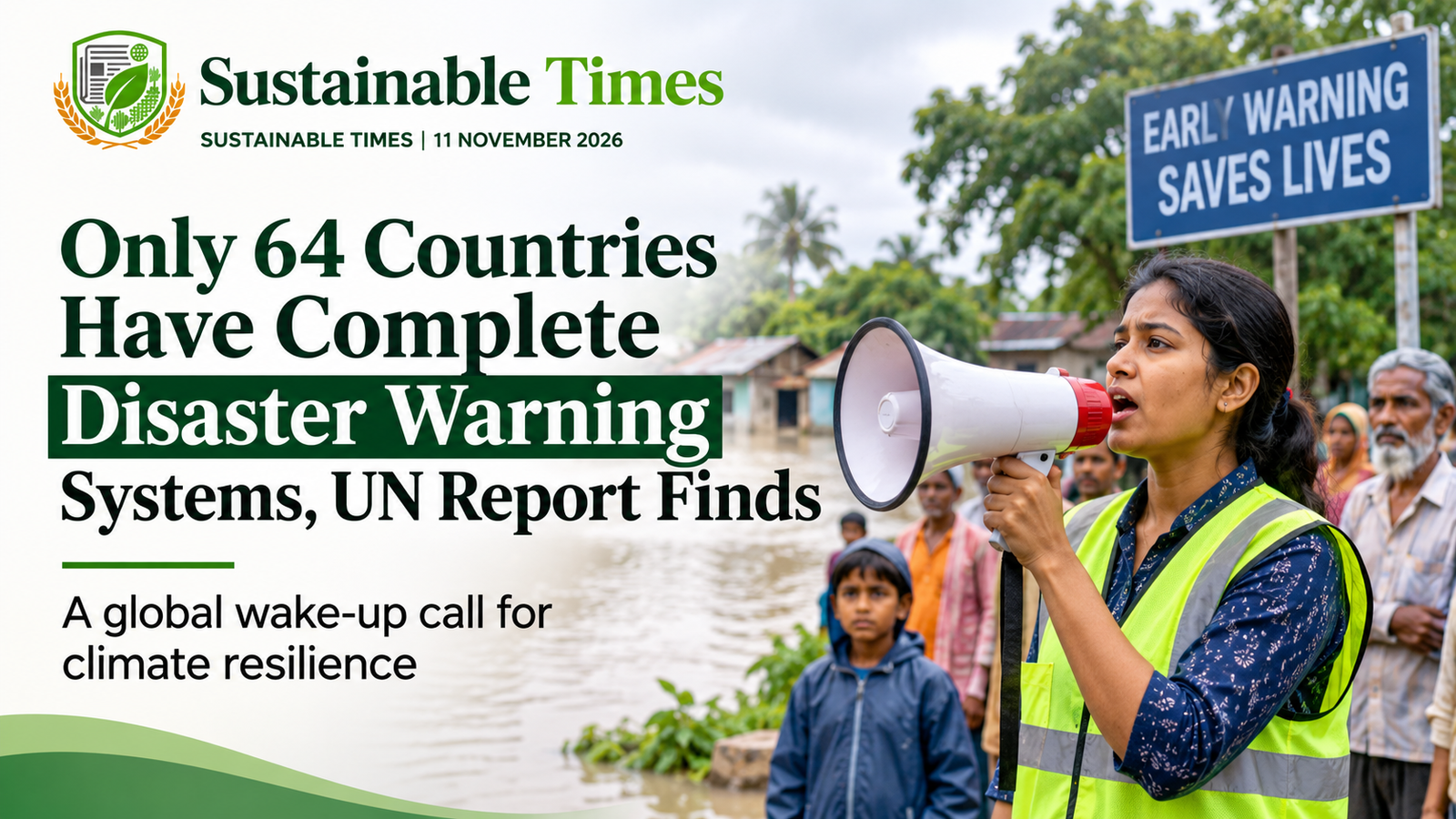
A new Reuters investigation published on 11 November has highlighted this growing gap in global disaster preparedness. According to a draft United Nations report reviewed by Reuters, 136 countries have some early-warning capacity, but only 64 have capabilities across all four essential pillars of an effective warning system.
The findings raise serious questions about the world’s progress towards the United Nations’ goal of ensuring that everyone is protected by early-warning systems by the end of 2027.
As climate-related disasters become increasingly dangerous, governments must move beyond investing in forecasting technology and ensure that warnings reach the people who need them most.
A Warning System Is More Than a Weather Forecast
Early-warning systems play an essential role in protecting communities against floods, cyclones, heatwaves, droughts, landslides and other natural hazards.
However, an effective system involves much more than predicting when extreme weather will occur.
The United Nations identifies four essential pillars that must work together.
1. Understanding disaster risks
Authorities need accurate information about vulnerable communities, local geography, infrastructure and the hazards that could affect a particular area.
Without understanding who is at risk and where they live, even an accurate forecast may fail to protect the right people.
2. Monitoring and forecasting
Weather stations, satellites, radar systems and scientific models help meteorological agencies identify developing threats and estimate when dangerous conditions may occur.
Reliable observations are particularly important in areas where weather-monitoring infrastructure remains limited.
3. Communicating warnings
Once authorities identify a potential threat, they must communicate it quickly through channels that people can access and understand.
These may include mobile alerts, radio broadcasts, television, community volunteers and local emergency networks.
4. Preparedness and response
People must know what to do after receiving a warning.
This includes identifying evacuation routes, reaching shelters, protecting essential belongings and following instructions from emergency authorities.
A weakness in any one of these stages can undermine the entire system.
For example, a meteorological agency may accurately predict flooding, but its forecast will have limited value if mobile networks fail or residents do not know where to evacuate.
Only 64 Countries Have All Four Capabilities
The latest findings reveal an important distinction between having some early-warning infrastructure and operating a complete system.
According to the draft UN report cited by Reuters, 136 countries now have at least some early-warning capacity.
That represents a 143% increase since international reporting began in 2015.
However, only 64 countries have capabilities across all four essential pillars.
This means that many countries have made progress in monitoring and forecasting but still struggle with communication, preparedness or the information needed to identify vulnerable populations.
The gap becomes particularly concerning when looking at lower-income countries.
Data cited in the report suggest that fewer than half of people who received warnings in low-income and lower-middle-income countries were able to act on them.
In upper-middle-income countries, approximately three-quarters of people receiving warnings could take action.
The difference highlights a fundamental problem.
Receiving a warning and being able to respond to it are two very different things.
A family may receive an evacuation message but lack transport. Another household may understand the danger but have nowhere safe to go.
Effective disaster preparedness must address these practical barriers rather than simply measure how many alerts authorities send.
A Community in Peru Is Building Its Own Warning Network
While governments continue developing larger forecasting systems, some communities are creating smaller, locally managed networks to protect themselves.
One example comes from Santa Inés Bajo, a neighbourhood in eastern Lima, Peru.
During the rainy season, resident Raquel Izarra climbs onto the roof of her home twice a day to measure rainfall using a homemade rain gauge.
She then shares the readings with local authorities through WhatsApp.
More than 60 other volunteers participate in the community monitoring effort.
Their objective is straightforward: identify rainfall patterns that could trigger floods or mudslides and alert residents before conditions become dangerous.
The community remembers the devastating flooding and mudslides that affected the area in 2017.
Residents now use local observations to recognise when rainfall reaches levels that could activate dangerous ravines above their neighbourhood.
This approach demonstrates the value of community participation in disaster preparedness.
Residents understand their surroundings, recognise local warning signs and can communicate with neighbours who may not receive official alerts quickly.
Technology supports the process, but local knowledge makes it more effective.
Nepal’s Recent Disaster Shows What Happens When Warnings Arrive Too Late
The importance of timely communication became particularly clear during a devastating avalanche and flood in Nepal in August 2026.
According to Reuters, the scale and speed of the torrent associated with a glacier-related event overwhelmed the existing warning arrangements.
Many people were caught before official alerts could reach them.
However, local communication helped save lives.
At Tribhuvan Trishuli Secondary School, headmaster Rajendra Dawadi received information from people further up the valley and decided to evacuate approximately 900 students.
He later explained that waiting for an official warning could have put everyone at the school in serious danger.
The incident highlights a difficult reality for communities exposed to sudden disasters.
Even sophisticated forecasting systems cannot guarantee sufficient response time when hazards develop rapidly.
This makes local communication networks, evacuation planning and community awareness essential parts of disaster management.
The Last Mile Is Becoming the Biggest Challenge
Disaster-warning technology has advanced considerably.
Satellite observations can identify developing weather systems, forecasting models can estimate their likely movement, and mobile networks can distribute information to large populations.
But getting the warning to the last household remains difficult.
A message sent by authorities may never reach someone living in a remote settlement with unreliable connectivity.
In other cases, residents may receive an alert but lack the resources to evacuate.
The problem also involves language and accessibility.
Warnings must reach people who speak different languages, have limited literacy or live with disabilities.
Authorities must communicate risks in ways that residents can understand immediately.
The Reuters investigation highlights considerable differences between regions.
In East Asia, approximately 95% of disaster-affected people surveyed received warnings.
In Central and Western Africa, that figure was only 47%.
Such differences demonstrate why a single global approach cannot address every community’s needs.
Countries require communication systems designed around their own infrastructure, geography and population.
Mobile Technology Could Help Close the Gap
One promising solution is cell broadcast technology.
Unlike conventional text messages, cell broadcast systems can send alerts to compatible mobile phones within a defined geographical area.
Users do not need to install a separate application or subscribe to a particular service.
This makes the technology particularly useful during emergencies when authorities need to communicate with large numbers of people quickly.
The International Telecommunication Union is working with governments, mobile operators and development partners to support the use of cell broadcast as part of the UN’s Early Warnings for All initiative.
At COP31 on 11 November, a dedicated event is bringing together telecommunications and development-finance stakeholders to explore ways of financing these systems.
The United Nations estimates that approximately $500 million could establish and maintain cell-broadcast warning systems across every country for three years.
However, mobile alerts should complement rather than replace other communication channels.
Not everyone owns a compatible phone, has reliable network coverage or can act on a digital notification.
Radio, community volunteers, public announcements and local emergency services will remain important, particularly in remote and underserved areas.
The Financial Challenge Behind Disaster Preparedness
Building an effective warning system requires long-term investment.
Countries need weather-monitoring stations, reliable communications infrastructure, trained personnel, updated forecasting systems and emergency-response facilities.
They also need money to maintain these systems after the initial installation.
This is where many vulnerable countries encounter difficulties.
The African Development Bank estimates that Africa requires an additional $5 billion to $10 billion in investment to strengthen early-warning and related resilience capabilities.
Funding is particularly important for countries with limited monitoring infrastructure and large populations exposed to floods, droughts and other climate-related hazards.
A weather station may be installed through an international development project, but it still requires maintenance, trained staff and consistent funding to remain operational.
The World Meteorological Organization has also highlighted the importance of sustained investment in weather observations and data-sharing networks during COP31.
Without that support, forecasting systems risk becoming less reliable precisely when communities need them most.
What This Means for India
The warning-system challenge has particular relevance for India.
The country faces multiple climate-related hazards, including tropical cyclones, extreme rainfall, river flooding, heatwaves, landslides and droughts.
Its large geographical area and varied terrain create different forecasting and communication requirements.
The India Meteorological Department plays a central role in monitoring weather conditions and issuing forecasts and warnings.
However, effective disaster preparedness also depends on how quickly information reaches district administrations, local emergency services and vulnerable households.
For example, communities living near rivers, coastal settlements and landslide-prone mountain regions may require different warning arrangements.
A cyclone warning must reach coastal residents early enough for evacuation.
A flood alert must communicate which settlements and roads face danger.
A heatwave warning must help local authorities prepare healthcare facilities and protect outdoor workers.
The wider lesson from the international findings is that forecasting improvements must go hand in hand with last-mile communication and practical response planning.
India can continue strengthening its disaster-management infrastructure by expanding local monitoring, improving multilingual alerts and supporting community-level preparedness.
The United Nations’ 2027 Target Is Under Pressure
The Early Warnings for All initiative was launched by UN Secretary-General António Guterres in 2022.
Its objective is to ensure that everyone on Earth is protected by multi-hazard early-warning systems by the end of 2027.
The initiative brings together international organisations, governments, meteorological agencies, telecommunications providers and humanitarian organisations.
Despite considerable progress, the latest findings suggest that achieving universal coverage within the original timeframe is unlikely.
The challenge is not simply installing more weather stations or sending more mobile alerts.
Countries must connect all four pillars into functioning systems that can protect people before, during and after disasters.
That requires coordination between scientific institutions, local authorities, emergency services and communities.
It also requires sustained funding rather than short-term infrastructure projects.
What Needs to Happen Next?
Closing the global warning gap will require a shift in how governments measure progress.
Instead of focusing only on the number of countries with forecasting technology, authorities should examine whether communities can receive, understand and act on warnings.
Several priorities stand out.
- Strengthen local monitoring: Expand weather stations, rainfall gauges and other observation systems in high-risk areas.
- Improve communication: Use cell broadcasts, radio, multilingual alerts and community networks to reach people through multiple channels.
- Invest in preparedness: Establish evacuation plans, accessible shelters and regular emergency exercises.
- Support community participation: Involve local residents in monitoring hazards and sharing information.
- Secure long-term funding: Provide resources for maintenance, training, staffing and reliable communications.
These measures may appear less impressive than launching a new satellite or developing an advanced forecasting model.
But their practical value can be greater when they ensure that an accurate warning reaches someone who can act on it.
Looking Ahead
Climate change is increasing the pressure on communities already exposed to floods, heatwaves, storms and other extreme weather events.
As these risks grow, disaster preparedness will become an increasingly important part of sustainable development.
The latest findings reveal that the world has made progress in building early-warning capabilities, but major gaps remain between predicting danger and protecting people.
The examples from Peru and Nepal show why community participation and reliable communication matter just as much as forecasting technology.
Governments must therefore treat early-warning systems as essential public infrastructure rather than optional additions to climate policy.
The goal should not simply be to predict the next disaster more accurately.
It should be to ensure that people have enough time, information and resources to protect themselves.
Because a warning only saves lives when it reaches someone in time—and when that person has a safe way to respond.
About The Author